
Skip to content
Hone & Handle
A cook wiping down a kitchen knife with a cloth

Steel & Care

What the steel actually does, and the handful of habits that decide whether a good knife lasts decades or a year.

Hone & Handle earns a commission from qualifying purchases made through links on this page, at no extra cost to you. It does not change what we recommend or the order we rank things in — here is how we choose and here is the full disclosure.

Most knife problems are not knife problems. They are board problems, storage problems and angle problems, and all three are cheap to fix once you know which one you have.

The steel, briefly

Four properties, and no alloy wins all four: edge retention, toughness, corrosion resistance and ease of sharpening. Hardness pushes the first up and the second down — that is the whole trade.

58 to 61 HRC is where almost every good kitchen knife sits. VG-10 at around 60 is the sensible default: fine edge, good retention, genuinely stain resistant, sharpens on any ordinary stone. SG2 at 62 to 64 holds an edge roughly twice as long and gives up toughness and sharpening ease for it. Carbon steel sharpens most easily of all and rusts within the hour.

Full chart on the steel guide; the two decisions that matter most are VG-10 against SG2 and carbon against stainless.

The two habits that decide everything

  1. What you cut on. Glass, stone, ceramic and bamboo are all harder than your edge and will roll or chip it. Soft rubber, hinoki and end-grain wood will not. Changing board alone can double the interval between sharpenings. Which boards work.
  2. How you clear the board. Sweeping chopped onion off with the edge drags the apex sideways and rolls it in seconds. Turn the knife over and use the spine. This single change costs nothing and is worth more than most upgrades.

The thumbnail test

Press a thumbnail hard into your cutting board. If it leaves a faint mark, the board will deform under the edge rather than the other way around. If it leaves nothing at all, the board is harder than your knife — and that is where your edge is going.

Storage chips more tips than cutting does

A knife loose in a drawer meets a peeler, a can opener and the drawer runner every time it opens. Over a year that is thousands of small collisions, and the tip — the thinnest, least supported part of the blade — takes most of them.

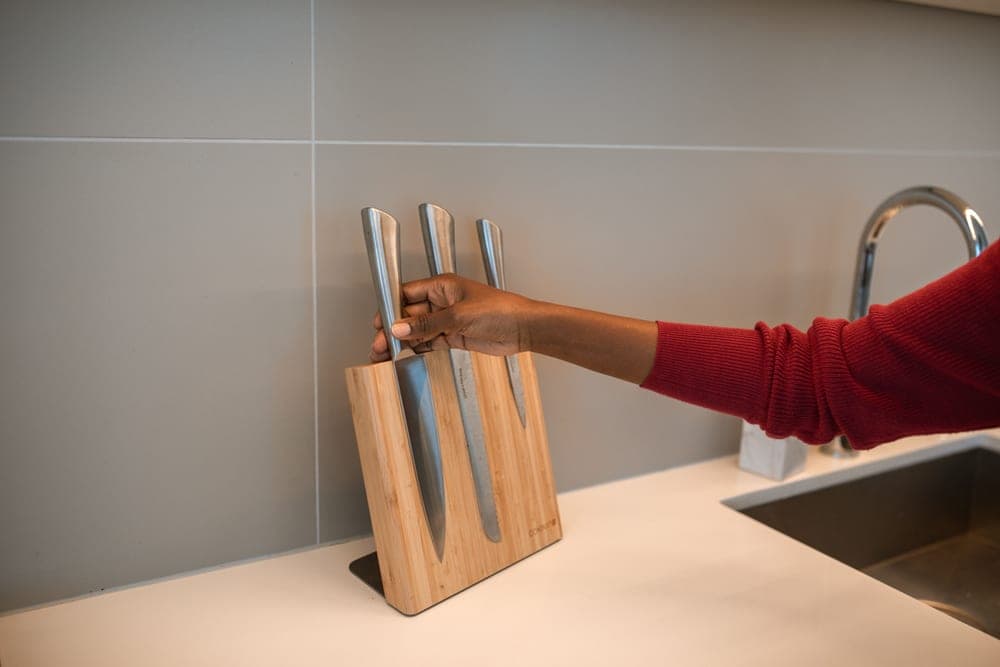
A sheath costs a few dollars and solves it entirely. A magnetic rack is better still, because the whole blade gets airflow and dries properly. Storage options compared.

When something has gone wrong

Symptom to page
SymptomStart here
Small notches along the edgeWhy is my knife chipping?
Orange spots on the bladeWhy is my knife rusting?
Blue-gray discoloration that will not wipe offPatina, not rust
Dull again within a weekCheck the board
Will not take an edge at allThe sharpening diagnostic

The whole care routine

Hand wash and dry immediately. Cut on something soft. Clear the board with the spine, not the edge. Store it where the edge cannot touch anything hard. Hone weekly on ceramic, sharpen on a stone two to four times a year, and keep a cheap heavy knife for bone.

That is eight habits and they are all on the care guide. Most people already do six of them.

What to buy
Head to head

A knife blade with a dark finish photographed close up

VG-10 vs SG2 Steel

SG2's edge retention against VG-10's toughness and ease of sharpening — and which suits the way you actually cook.

A blade edge photographed in close detail

Single Bevel vs Double Bevel

What single-bevel geometry does in the cut, why it is handed, and how sharpening differs from a normal kitchen knife.

Guides

The patterned surface of a laminated steel blade

Knife Steel Guide

A steel comparison chart for kitchen knives — hardness, edge retention, corrosion resistance and sharpening difficulty.

A cook wiping down a kitchen knife with a cloth

Japanese Knife Care Guide

The eight care habits that decide whether a Japanese knife lasts decades, including the two most people get wrong.

Kitchen knives stored on a wooden surface

Knife Storage Guide

Four ways to store kitchen knives compared on edge safety, hygiene and cost — and why the drawer is the worst of them.

When something goes wrong

A close view of a worn and damaged blade edge

Why Is My Knife Chipping?

Six causes of a chipping kitchen knife, in diagnostic order, and how to repair the damage once you have found it.

A darkened blade surface photographed in close detail

Carbon Steel Patina vs Rust

How to tell a protective patina from destructive rust, how to remove the second, and how to encourage the first.

Old knives with corroded blades on a workshop surface

Why Is My Knife Rusting?

Five causes of rust on a kitchen knife — including on stainless — and the habit change that fixes each.

Common questions

What HRC hardness should a kitchen knife be?

58 to 61 HRC covers almost every good kitchen knife. Below 56 the edge rolls constantly; above 63 it becomes fragile and slow to sharpen. Western knives typically sit at 56 to 58, Japanese at 59 to 61, and powder-steel specialists at 62 to 64.

What cutting board is best for Japanese knives?

Soft synthetic rubber, a wood-core board with a soft polyethylene face, or a softwood like hinoki. All three deform slightly under the edge instead of resisting it. Avoid glass, stone, ceramic and — the one people miss — bamboo, which is a high-silica grass much harder than it looks.

Why does my knife keep chipping?

In order of likelihood: a hard cutting board, a sharpening angle that is too acute, a carbide pull-through sharpener, loose drawer storage, twisting the blade, or genuinely hard food. A defective blade is possible but uncommon.

Can Japanese knives go in the dishwasher?

No. Dishwasher detergent is abrasive and alkaline, the heat degrades wooden handles, and the knife knocks against other items all cycle. This applies to stainless Japanese knives as well as carbon.

Is patina on a carbon knife a problem?

No, it is protective. A patina is a stable blue-gray or dark oxide layer that acts as a barrier against further oxidation. Rust is orange, powdery, lifts off on a cloth and leaves a pit — that is the one to deal with.

Sources