Japanese Knives
Best Nakiri Knives
What this is based on: published manufacturer specifications and retailer listings, cited on each product; the weight of professional and owner reviews across multiple retailers; and hands-on experience sharpening and cooking with knives of this type. We have not individually tested every model listed, we do not run instrumented sharpness testing, and we do not claim a test we did not run.
Quick picks
| # | Product | Best for | Score | Price |
|---|---|---|---|---|
| 1 | Tojiro DP Nakiri 165mm (F-502) | First nakiri | 8.7 | |
| 2 | 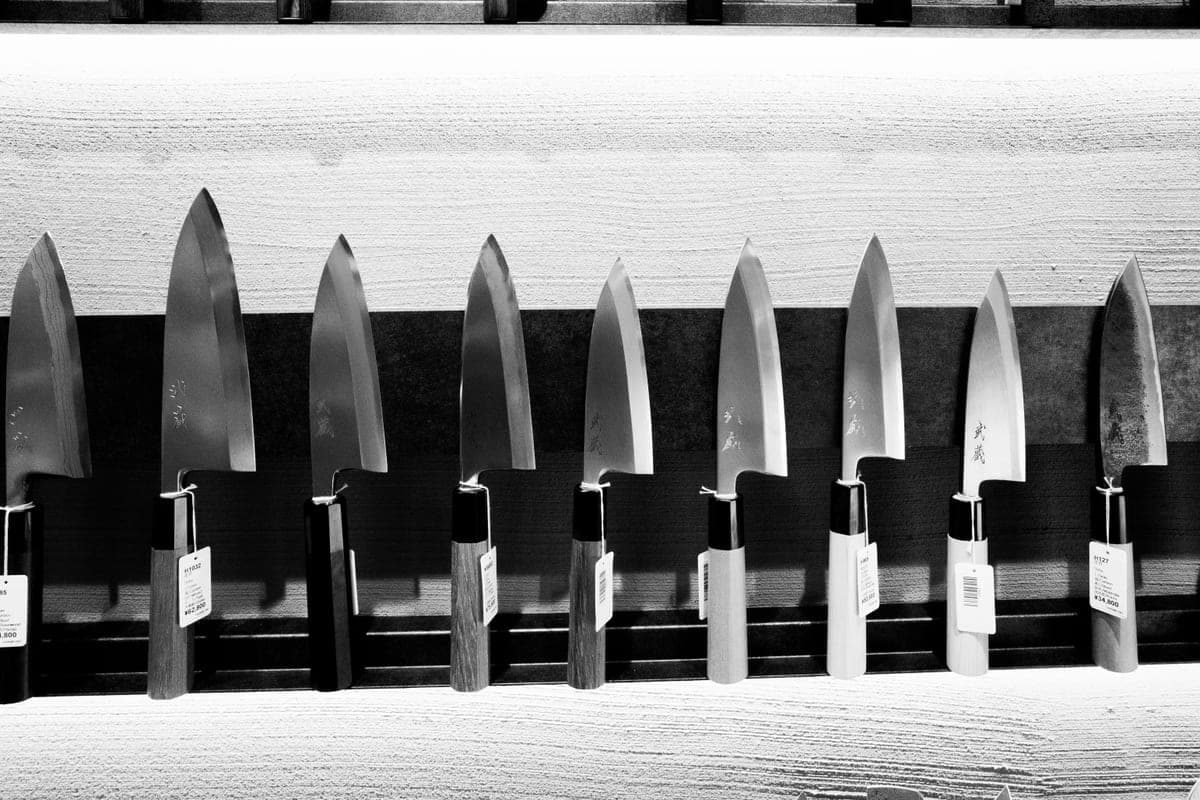 Shun Classic 6.5" Nakiri (DM0728) | An upgrade nakiri | 8.3 |
The flat edge is the whole point. A chef's knife has a curved belly, so on a straight downward cut only part of the edge touches the board — which is why the last millimeter of an onion slice stays attached and the whole thing unfolds like a concertina. A nakiri's edge contacts the board along its full length, so the cut finishes. Over a kilo of vegetables that difference compounds into real time.
The tall blade does two things. At around 45mm at the heel, your knuckles clear the board in a pinch grip, and the broad flat face works as a bench scraper for moving prepped vegetables to the pan.
Who this is for
A nakiri is a second or third knife. It earns its place in a kitchen that already has a general-purpose blade and does a lot of vegetable prep — weeknight stir-fries, big salads, anything where you are working through a board of produce rather than portioning a protein.
The technique it wants
- Straight down, not rocking. There is no belly to rock on. Lift, place, press.
- Let the height work. Pinch the blade, knuckles against the flat, and guide with your other hand as a fence.
- Push slightly forward on the way down for anything with a skin — a tomato or a bell pepper — so the edge slices rather than crushes.
- Scoop with the face, not the edge. Turning a nakiri onto its spine to sweep the board is fine; scraping with the edge is how you dull it.
Care, because thin corners
The two square corners of a nakiri are thin and unsupported, and they are the first thing to ding. Keep it off hard boards — a soft rubber or hinoki surface is materially kinder, which we cover in the board guide — and never store it loose in a drawer. A sheath costs almost nothing.
The verdict
The Tojiro DP nakiri is the one to buy. VG-10 at 59 to 61 HRC, a genuinely consistent 1.8mm spine, 45mm of blade height, at a price that makes it an easy addition rather than a decision. The Shun Classic nakiri is a better object with a flat grind that releases a little more cleanly and a handle that works left-handed, and it costs several times as much to do the same job.
The picks in detail
#1 · First nakiri
Tojiro DP Nakiri 165mm (F-502)
A flat 165 mm edge in VG-10 at 59-61 HRC for the price of a mid-range German paring knife. The obvious first nakiri.
What it does well
- 45 mm of blade height means your knuckles clear the board
- Genuinely flat edge — full contact, no accordion slices
- 1.8 mm spine falls through vegetables rather than wedging
Where it gives way
- No tip, so it cannot do fine tip work at all
- 207 g is heavier than the profile suggests
- Western handle and bolster feel dense for such a light job
Skip it if: Anyone expecting it to replace a chef's knife. A nakiri does not have a tip and cannot break down a chicken.
| Blade length | 165-170 mm |
|---|---|
| Steel | Takefu VG-10 core, three-layer |
| Hardness | 59-61 HRC |
| Heel height | 45 mm |
| Spine | 1.8 mm, consistent |
| Weight | approx. 207 g |
#2 · An upgrade nakiri
Shun Classic 6.5" Nakiri (DM0728)
Flat-ground, double-bevelled to 16 degrees per side, 69-layer Damascus over a VG-MAX core. The nakiri for someone who already knows they want one.
What it does well
- Flat grind gives excellent release on dense vegetables
- Handle works for left-handed cooks, unlike the D-shaped Classic chef's knife
- Kai's lifetime warranty applies
Where it gives way
- Several times the price of the Tojiro for a knife doing the same job
- Thin tip corners are easy to ding on the board
- Damascus cladding is cosmetic
Skip it if: A first nakiri. Buy the Tojiro, decide you use it, then buy this.
| Blade length | 6.5 in (165 mm) |
|---|---|
| Steel | VG-MAX core, 34 Damascus layers each side (69 total) |
| Edge | Double bevel, flat ground, 16 degrees per side |
| Handle | Pakkawood, usable left or right handed |
Common questions
What is a nakiri knife used for?
Can a nakiri replace a chef's knife?
Nakiri or santoku for a home cook?
Is a nakiri single-bevel?
Sources
Read next
Japanese Knives
Nakiri vs Chef Knife
Japanese Knives
Santoku vs Nakiri
Japanese Knives
Best Santoku Knives
Japanese Knives
Japanese Knife Types
Steel & Care
Best Cutting Boards for Japanese Knives
Whetstones & Skill