Japanese Knives
Best Knives for Cutting Vegetables
What this is based on: published manufacturer specifications and retailer listings, cited on each product; the weight of professional and owner reviews across multiple retailers; and hands-on experience sharpening and cooking with knives of this type. We have not individually tested every model listed, we do not run instrumented sharpness testing, and we do not claim a test we did not run.
Quick picks
| # | Product | Best for | Score | Price |
|---|---|---|---|---|
| 1 | Tojiro DP Nakiri 165mm (F-502) | First nakiri | 8.7 | |
| 2 | 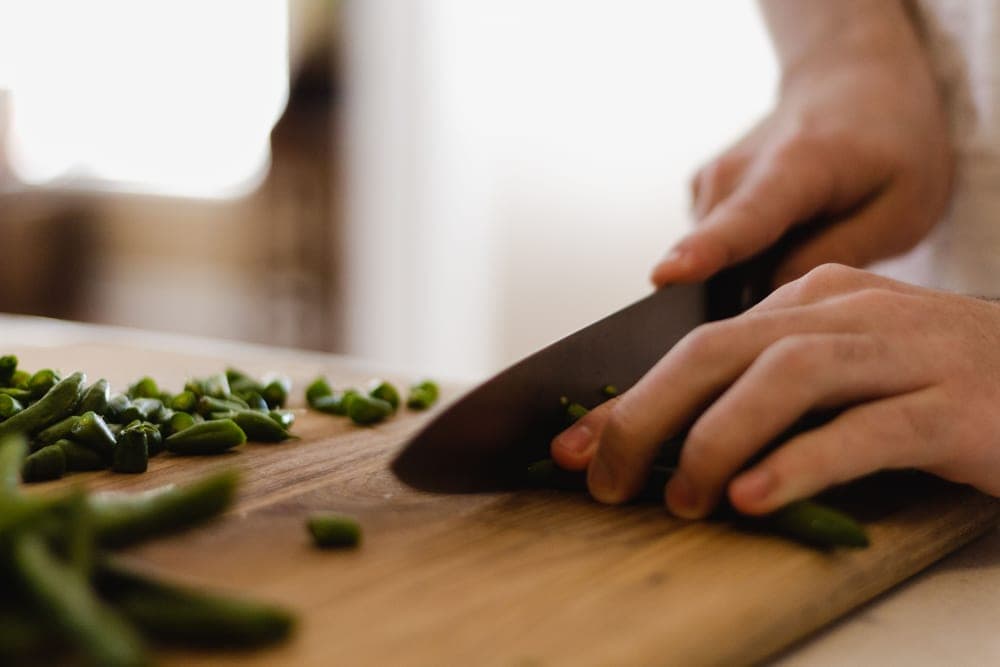 MAC Professional 6.5" Santoku (MSK-65) | Precision vegetable work | 8.5 | |
| 3 | Tojiro DP Gyuto 210mm (F-808) | First Japanese knife | 8.6 | |
| 4 |  Shun Classic 6.5" Nakiri (DM0728) | An upgrade nakiri | 8.3 |
Produce is the easiest cutting job in the kitchen and the one most knives are worst at. Nothing about a carrot is hard. What makes vegetable prep miserable is a blade that wedges instead of parting, an edge that arcs away from the board so slices stay joined at the bottom, and a heel so short that your knuckles hit the board before the blade does.
The three things that actually matter
- A flat edge. A chef's knife has a belly, which is what lets you rock-chop. The cost of that curve is that only part of the edge touches the board at a time, so a stack of onion slices stays hinged at the bottom and you go back over it. A flat edge touches the board along its whole length and the cut is finished the first time.
- Blade height at the heel. 45 mm is the number to look for. It clears your knuckles on a cabbage or a celeriac, and it gives cut food a surface to slide off instead of folding back into the blade.
- Spine thickness. Under 2 mm at the heel. A thick spine has to shove the vegetable apart as it goes through; a thin one falls through. This is the biggest single difference between a Japanese knife and the one that came in your block set, and it matters more than the steel.
Steel comes third, not first. VG-10 at around 60 HRC stays sharp through far more produce than a 56 HRC German blade, but a sharp thick knife still wedges, and a dull thin one still slices better than you expect. If the choice is between a better steel and a thinner grind, take the grind.
How the four picks compare
| Knife | Length | Heel height | Spine | Has a tip? |
|---|---|---|---|---|
| Tojiro DP Nakiri F-502 | 165-170 mm | 45 mm | 1.8 mm | No |
| MAC Professional Santoku MSK-65 | 6.5 in | Not published | Thin for the price | Yes, and it is delicate |
| Tojiro DP Gyuto F-808 | 210 mm | 43 mm | 1.9 mm | Yes |
| Shun Classic Nakiri DM0728 | 165 mm (6.5 in) | Not published | Flat ground | No |
Where a figure is not published by the maker or a specialist retailer we leave it blank rather than estimate it. How we source specifications.
Which one to buy
- You already own a chef's knife. Buy the Tojiro nakiri. It is the cheapest large improvement available to a kitchen that already has a general-purpose blade, and it does the job that blade is worst at.
- You want one knife, total. Buy the Tojiro DP gyuto. 43 mm and 1.9 mm is close enough to nakiri geometry that vegetables are easy, and the tip means you never need a second knife for anything else. Our gyuto roundup goes deeper on the shape.
- Your board is small, or your hands are. The MAC MSK-65 at 6.5 in is the easiest of the four to control, and we cover that case properly in chef knives for small hands.
- You already use a nakiri daily. The Shun Classic is the upgrade, and its pakkawood handle works in either hand, unlike the D-shaped Classic chef's knife.
The board matters as much as the knife
A flat, thin, hard edge is exactly the edge a bad board destroys. Glass, bamboo, stone and hard composite boards chip 60 HRC steel; rubber and soft Japanese cypress do not. If you buy one of these knives and keep using a bamboo board, the knife will not last and the board will be the reason. Our board picks are here, and chipping has six usual causes — the board is the first one to rule out.
Flat blades want a push cut, not a rock chop: forward and down, not back and forth over a pivot. Rock-chop a nakiri and you will hear it tap the board at both ends and wonder why it feels worse than your old knife. Thirty seconds of adjustment fixes it permanently.
The verdict
Tojiro DP nakiri if you want the best vegetable knife on this page and you own something else for meat. Tojiro DP gyuto if this has to be your only knife. MAC MSK-65 if control on a crowded board matters more than reach. Shun Classic nakiri only once you know you reach for a nakiri every day — it does the same job as the Tojiro for several times the money, and the Damascus cladding is cosmetic.
The picks in detail
#1 · First nakiri
Tojiro DP Nakiri 165mm (F-502)
A flat 165 mm edge in VG-10 at 59-61 HRC for the price of a mid-range German paring knife. The obvious first nakiri.
What it does well
- 45 mm of blade height means your knuckles clear the board
- Genuinely flat edge — full contact, no accordion slices
- 1.8 mm spine falls through vegetables rather than wedging
Where it gives way
- No tip, so it cannot do fine tip work at all
- 207 g is heavier than the profile suggests
- Western handle and bolster feel dense for such a light job
Skip it if: Anyone expecting it to replace a chef's knife. A nakiri does not have a tip and cannot break down a chicken.
| Blade length | 165-170 mm |
|---|---|
| Steel | Takefu VG-10 core, three-layer |
| Hardness | 59-61 HRC |
| Heel height | 45 mm |
| Spine | 1.8 mm, consistent |
| Weight | approx. 207 g |
#2 · Precision vegetable work
MAC Professional 6.5" Santoku (MSK-65)
The MTH-80's logic in a santoku: thin, light, 15 degrees per side, and consistent from unit to unit.
What it does well
- Extremely thin behind the edge for its price
- Same 15-degree factory geometry as the rest of the Professional line
- Light and neutral in the hand
Where it gives way
- Thin tip is easy to damage
- No bolster to protect your knuckles in a heavy grip
- Costs more than the Tojiro equivalent
Skip it if: Heavy jobs. It is thin, and thin blades dislike bone and frozen food.
| Blade length | 6.5 in |
|---|---|
| Steel | Sub-zero tempered high-carbon molybdenum vanadium alloy |
| Hardness | approx. 61 HRC (MAC Professional line) |
| Edge angle | 15 degrees per side |
#3 · First Japanese knife
Tojiro DP Gyuto 210mm (F-808)
The default answer to 'my first real Japanese knife'. VG-10 at around 60 HRC in a plain three-layer build, at a price that makes the inevitable first chip survivable.
What it does well
- VG-10 at 59-60 HRC takes a genuinely fine edge and holds it far longer than a German knife at 56-58
- 1.9 mm spine and 43 mm heel make it thin behind the edge without being fragile
- Cheap enough that learning to sharpen on it is not frightening
Where it gives way
- Handle finish is functional and unlovely; some units need the bolster easing with sandpaper
- Stainless cladding is soft and scratches readily
- Nothing about the fit and finish will impress anyone
Skip it if: Anyone who wants the knife to be beautiful. The handle is a workmanlike composite with a stainless bolster and nothing about it is charming.
| Blade length | 210 mm (8.3 in) |
|---|---|
| Steel | VG-10 core, 13-chrome stainless cladding (san mai) |
| Hardness | 59-60 HRC |
| Heel height | 43 mm |
| Spine at heel | 1.9 mm |
| Weight | approx. 187 g |
| Handle | Western, laminated composite wood with stainless bolster |
#4 · An upgrade nakiri
Shun Classic 6.5" Nakiri (DM0728)
Flat-ground, double-bevelled to 16 degrees per side, 69-layer Damascus over a VG-MAX core. The nakiri for someone who already knows they want one.
What it does well
- Flat grind gives excellent release on dense vegetables
- Handle works for left-handed cooks, unlike the D-shaped Classic chef's knife
- Kai's lifetime warranty applies
Where it gives way
- Several times the price of the Tojiro for a knife doing the same job
- Thin tip corners are easy to ding on the board
- Damascus cladding is cosmetic
Skip it if: A first nakiri. Buy the Tojiro, decide you use it, then buy this.
| Blade length | 6.5 in (165 mm) |
|---|---|
| Steel | VG-MAX core, 34 Damascus layers each side (69 total) |
| Edge | Double bevel, flat ground, 16 degrees per side |
| Handle | Pakkawood, usable left or right handed |
Common questions
What knife is best for cutting vegetables?
Is a nakiri better than a chef's knife for vegetables?
Does blade height matter for chopping vegetables?
Will a thin Japanese blade chip on hard vegetables?
Sources
Read next
Japanese Knives
Best Nakiri Knives
Japanese Knives
Santoku vs Nakiri
Japanese Knives
Nakiri vs Chef Knife
Japanese Knives
Chef Knife vs Cleaver
Steel & Care
Best Cutting Boards for Japanese Knives
Japanese Knives