Sharpeners
Best Honing Rods
What this is based on: published manufacturer specifications and retailer listings, cited on each product; the weight of professional and owner reviews across multiple retailers; and hands-on experience sharpening and cooking with knives of this type. We have not individually tested every model listed, we do not run instrumented sharpness testing, and we do not claim a test we did not run.
Quick picks
| # | Product | Best for | Score | Price |
|---|---|---|---|---|
| 1 | Idahone Fine Ceramic Honing Rod, 12" | Maintaining a hard Japanese edge between sharpenings | 8.8 | |
| 2 |  Leather Bench Strop with Stropping Compound | Finishing after the stones | 8.0 | |
| 3 |  King KDS Combination Whetstone #1000/#6000 | Your first stone | 8.4 |
The hardness problem
To push a rolled edge back into alignment the rod must be harder than the steel it is pushing. A traditional steel rod is hard enough for a Western knife at 54 to 58 HRC — which is why every German knife block comes with one.
A Japanese knife at 60 to 61 HRC is a different proposition. Many steel rods are simply not hard enough, so the rod glides along the edge and nothing happens. Ceramic solves this: it is roughly four times harder than the majority of knife steels, which takes the guesswork out entirely.
| Material | Works on | Removes steel? | Risk |
|---|---|---|---|
| Steel (smooth or grooved) | Western knives, 54–58 HRC | Almost none | Ineffective on hard steel; grooved rods scratch |
| Ceramic, fine (approx. 1200 ANSI) | Everything, including 60+ HRC | A very small amount | Brittle — it chips if dropped or knocked |
| Diamond-coated | Everything | A lot | This is a sharpening tool, not a honing one. Too aggressive weekly. |
The grit that matters
The Idahone fine rod is 1200 ANSI, which is approximately 3500 on the Japanese JIS scale. That sits in the useful band: fine enough that weekly use removes no meaningful steel, coarse enough that five passes actually straighten the edge.
It is also high-alumina ceramic and made in the US, which matters for a practical reason — cheaper ceramic rods develop grooves where the blade repeatedly contacts them, and a grooved rod stops working evenly.
How to use one
- Stand the rod vertically with the tip resting on a board or a folded towel. This is safer and gives better angle control than the waved-in-the-air technique.
- Set the heel of the blade near the top of the rod at roughly 15 degrees — the same angle you sharpen at.
- Draw the knife down and toward you so the whole edge passes across the rod in one stroke. Light contact.
- Alternate sides. Five passes per side is plenty.
- Test on paper. If it still catches, the edge is worn rather than rolled and you need a stone.
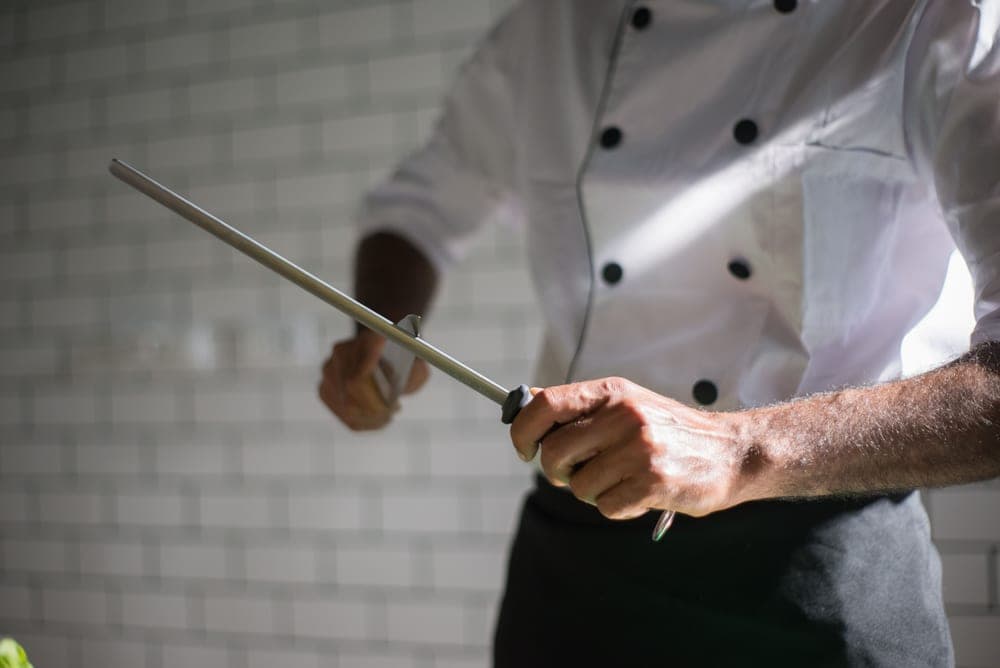
Speed. The theatrical fast honing you see in restaurants is showmanship. Slow and consistent is what works.
Dropping it. Ceramic is brittle. One knock against a stone worktop and the rod is finished.
The verdict
The Idahone 12-inch fine ceramic rod. High-alumina ceramic, 1200 ANSI, a 12-inch rod that covers a 210mm gyuto in one stroke, and a rock maple handle. It resists the grooving that ruins cheaper rods and it is hard enough for any kitchen knife you are likely to own.
A leather strop is the alternative if you would rather not own a rod — it does a slightly different job (deburring and refining rather than realigning) but it will also bring back some bite mid-week. When neither helps, the edge is gone and it is stone time.
The picks in detail
#1 · Maintaining a hard Japanese edge between sharpenings
Idahone Fine Ceramic Honing Rod, 12"
The honing rod that is actually harder than your knife. 1200 ANSI alumina ceramic, which is roughly 3000-3500 on the Japanese scale.
What it does well
- Ceramic is harder than the steel in a 60+ HRC Japanese knife; a steel rod often is not
- 1200 ANSI realigns without removing meaningful steel
- High-alumina body resists the grooving that ruins cheaper rods
Where it gives way
- Ceramic is brittle — one hard knock on a stone counter and it is done
- Removes so little steel that it cannot rescue a truly dull knife
- 12 in is longer than some drawers
Skip it if: Anyone who bangs the rod on the counter. Ceramic chips; steel does not.
| Rod length | 12 in (30.5 cm) |
|---|---|
| Rod diameter | 1/2 in (12.7 mm) |
| Overall length | 17.5 in (44.5 cm) |
| Grit | Fine, 1200 ANSI (approx. 3500 JIS) |
| Material | High-alumina ceramic |
| Handle | Hard rock maple, 5.25 in |
| Origin | Made in the USA |
#2 · Finishing after the stones
Leather Bench Strop with Stropping Compound
Ten dollars of leather and abrasive that removes the burr your finishing stone left behind. The cheapest real improvement in this whole category.
What it does well
- Turns a good stone edge into a noticeably better one in two minutes
- Extends the interval between full sharpenings
- Costs less than almost anything else in the kitchen
Where it gives way
- Easy to round the edge over if you lift the spine
- Does nothing for a genuinely dull knife
- Leather needs re-charging with compound periodically
Skip it if: Sharpening. A strop refines and deburrs; it removes almost no steel and will not fix a dull knife.
| Function | Burr removal and edge refinement |
|---|---|
| Compound | Typically chromium oxide, roughly 0.5 micron |
| Direction | Edge-trailing strokes only |
#3 · Your first stone
King KDS Combination Whetstone #1000/#6000
The stone almost everyone learns on. Soft, forgiving, cheap, and it tells you loudly when your angle wanders.
What it does well
- Two useful grits in one block for the price of half a premium stone
- Soft binder builds slurry readily, which gives beginners real feedback
- Almost impossible to damage a knife on it
Where it gives way
- Dishes quickly and needs flattening often
- The soak is a real commitment — you cannot sharpen on a whim
- Slow on hard powder steels like SG2
Skip it if: Impatient people. The 1000 side wants a 10-15 minute soak before every session and the clay binder dishes fast.
| Grits | #1000 / #6000, combination |
|---|---|
| Binder | Clay |
| Soaking | #1000 side: 10-15 minutes. #6000 side: splash only |
| Size | 207 x 66 x 36 mm |
| Weight | approx. 956 g |
Common questions
Ceramic or diamond honing rod for Japanese steel?
Can I use a steel honing rod on a Japanese knife?
What grit should a honing rod be?
How do you use a honing rod correctly?
How long should a honing rod be?
Sources
Read next
Sharpeners
Honing Rod vs Whetstone
Whetstones & Skill
Sharpening vs Honing
Whetstones & Skill
How Often to Sharpen a Kitchen Knife
Whetstones & Skill
Best Strops for Kitchen Knives
Japanese Knives