Whetstones & Skill
How Often to Sharpen a Kitchen Knife
What this is based on: published manufacturer specifications and retailer listings, cited on each product; the weight of professional and owner reviews across multiple retailers; and hands-on experience sharpening and cooking with knives of this type. We have not individually tested every model listed, we do not run instrumented sharpness testing, and we do not claim a test we did not run.
Quick picks
| # | Product | Best for | Score | Price |
|---|---|---|---|---|
| 1 | 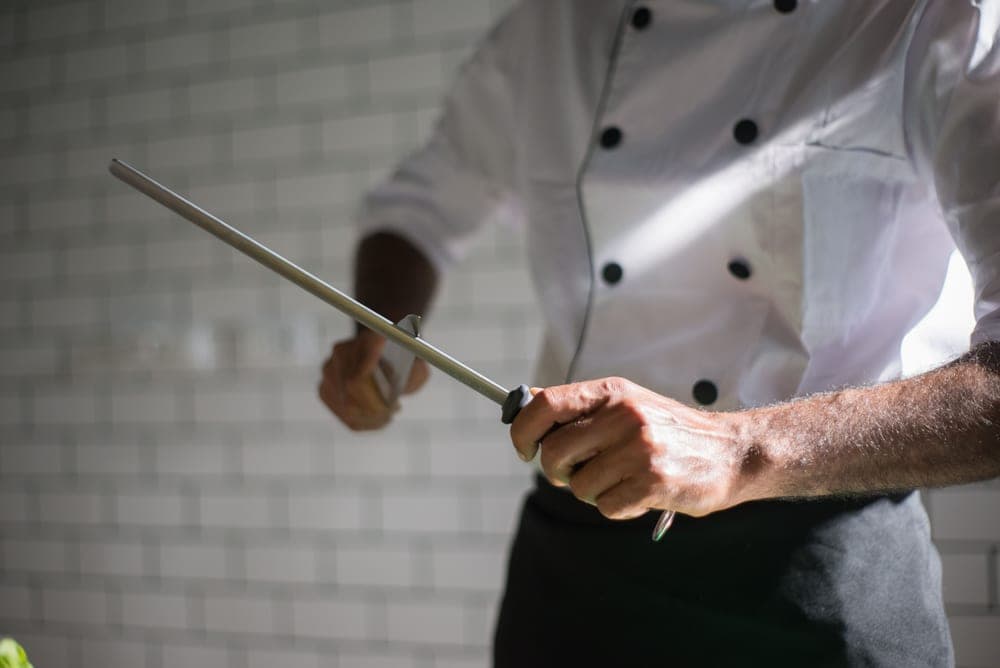 Idahone Fine Ceramic Honing Rod, 12" | Maintaining a hard Japanese edge between sharpenings | 8.8 | |
| 2 |  King KDS Combination Whetstone #1000/#6000 | Your first stone | 8.4 | |
| 3 |  Leather Bench Strop with Stropping Compound | Finishing after the stones | 8.0 |
The test that replaces a schedule
Hold a sheet of printer paper by one corner, hanging free. Try to slice downward through it with the middle of the blade.
- Slices cleanly with no pressure: the edge is fine. Do nothing.
- Catches, then cuts: the edge has rolled. Hone it.
- Tears, crumples, or will not start: the edge is gone. Get the stone out.
A tomato works too: if it needs downward pressure to start the cut, the edge is done.
Honing and sharpening are different jobs
| Honing | Sharpening | |
|---|---|---|
| What it does | Realigns an edge that has rolled over | Removes steel to create a new apex |
| Tool | Ceramic rod (or a strop) | Whetstone |
| Time | Ten seconds | Ten to twenty minutes |
| Frequency | Weekly, or before each session | 2–4 times a year |
| Steel removed | Almost none | A real amount |
The full distinction is on sharpening against honing.
What actually changes the interval
- Your cutting board, by a wide margin. Glass, stone, ceramic and bamboo blunt an edge dramatically faster than soft rubber, hinoki or end-grain wood. Changing board alone can double the interval. Board guide.
- Scraping with the edge. Sweeping chopped onion off the board with the edge of the blade is the single most damaging habit in most kitchens. Turn the knife over and use the spine.
- Steel hardness. 61 HRC holds longer than 56 HRC. Powder steels like SG2 at 62 to 64 HRC hold longer still — commonly cited as roughly twice as long as VG-10.
- The dishwasher. Heat, harsh detergent and knocking against other items. Never, on any good knife.
- What you cut. Root vegetables, squash and anything with grit on it are hard on an edge. Herbs and soft produce barely touch it.
Can you sharpen too often?
Technically yes — every sharpening removes steel and a knife has a finite amount. In practice this is not the problem anyone actually has. A knife sharpened four times a year on a 1,000-grit stone will outlast its owner.
The real risk in over-frequent sharpening is starting on a coarse stone every time. A 400-grit stone removes a lot of steel. Start at 1,000 unless there is damage to grind out.
A dull knife requires force, and force is what makes a blade slip off a tomato skin and into a knuckle. Under-sharpening is both more common and more dangerous than over-sharpening. If in doubt, sharpen.
A routine that works
- Before a big prep session: five light passes per side on a ceramic rod. Ten seconds.
- Every week or two: the paper test. Hone if it catches.
- When honing stops helping: 1,000-grit stone, then strop. Two to four times a year.
- When you see a bright notch along the edge: that is a chip. 400 grit down to sound steel first. Why it happened.
The picks in detail
#1 · Maintaining a hard Japanese edge between sharpenings
Idahone Fine Ceramic Honing Rod, 12"
The honing rod that is actually harder than your knife. 1200 ANSI alumina ceramic, which is roughly 3000-3500 on the Japanese scale.
What it does well
- Ceramic is harder than the steel in a 60+ HRC Japanese knife; a steel rod often is not
- 1200 ANSI realigns without removing meaningful steel
- High-alumina body resists the grooving that ruins cheaper rods
Where it gives way
- Ceramic is brittle — one hard knock on a stone counter and it is done
- Removes so little steel that it cannot rescue a truly dull knife
- 12 in is longer than some drawers
Skip it if: Anyone who bangs the rod on the counter. Ceramic chips; steel does not.
| Rod length | 12 in (30.5 cm) |
|---|---|
| Rod diameter | 1/2 in (12.7 mm) |
| Overall length | 17.5 in (44.5 cm) |
| Grit | Fine, 1200 ANSI (approx. 3500 JIS) |
| Material | High-alumina ceramic |
| Handle | Hard rock maple, 5.25 in |
| Origin | Made in the USA |
#2 · Your first stone
King KDS Combination Whetstone #1000/#6000
The stone almost everyone learns on. Soft, forgiving, cheap, and it tells you loudly when your angle wanders.
What it does well
- Two useful grits in one block for the price of half a premium stone
- Soft binder builds slurry readily, which gives beginners real feedback
- Almost impossible to damage a knife on it
Where it gives way
- Dishes quickly and needs flattening often
- The soak is a real commitment — you cannot sharpen on a whim
- Slow on hard powder steels like SG2
Skip it if: Impatient people. The 1000 side wants a 10-15 minute soak before every session and the clay binder dishes fast.
| Grits | #1000 / #6000, combination |
|---|---|
| Binder | Clay |
| Soaking | #1000 side: 10-15 minutes. #6000 side: splash only |
| Size | 207 x 66 x 36 mm |
| Weight | approx. 956 g |
#3 · Finishing after the stones
Leather Bench Strop with Stropping Compound
Ten dollars of leather and abrasive that removes the burr your finishing stone left behind. The cheapest real improvement in this whole category.
What it does well
- Turns a good stone edge into a noticeably better one in two minutes
- Extends the interval between full sharpenings
- Costs less than almost anything else in the kitchen
Where it gives way
- Easy to round the edge over if you lift the spine
- Does nothing for a genuinely dull knife
- Leather needs re-charging with compound periodically
Skip it if: Sharpening. A strop refines and deburrs; it removes almost no steel and will not fix a dull knife.
| Function | Burr removal and edge refinement |
|---|---|
| Compound | Typically chromium oxide, roughly 0.5 micron |
| Direction | Edge-trailing strokes only |
Common questions
How often should I sharpen my kitchen knives?
How often should I hone a knife?
Does a Japanese knife need sharpening more or less often?
What makes a knife go dull faster?
Sources
Read next
Whetstones & Skill
Sharpening vs Honing
Whetstones & Skill
How to Sharpen a Japanese Knife
Sharpeners
Best Honing Rods
Whetstones & Skill
Why Your Knife Still Isn't Sharp
Steel & Care
Best Cutting Boards for Japanese Knives
Whetstones & Skill