Sharpeners
Is Professional Knife Sharpening Worth It?
What this is based on: published manufacturer specifications and retailer listings, cited on each product; the weight of professional and owner reviews across multiple retailers; and hands-on experience sharpening and cooking with knives of this type. We have not individually tested every model listed, we do not run instrumented sharpness testing, and we do not claim a test we did not run.
Quick picks
| # | Product | Best for | Score | Price |
|---|---|---|---|---|
| 1 |  King KDS Combination Whetstone #1000/#6000 | Your first stone | 8.4 | |
| 2 |  Naniwa Professional (Chosera) 1000 | The one stone to own if you only own one | 8.6 | |
| 3 | Horl 2 Rolling Knife Sharpener | Someone who will leave it on the counter | 7.9 | |
| 4 | 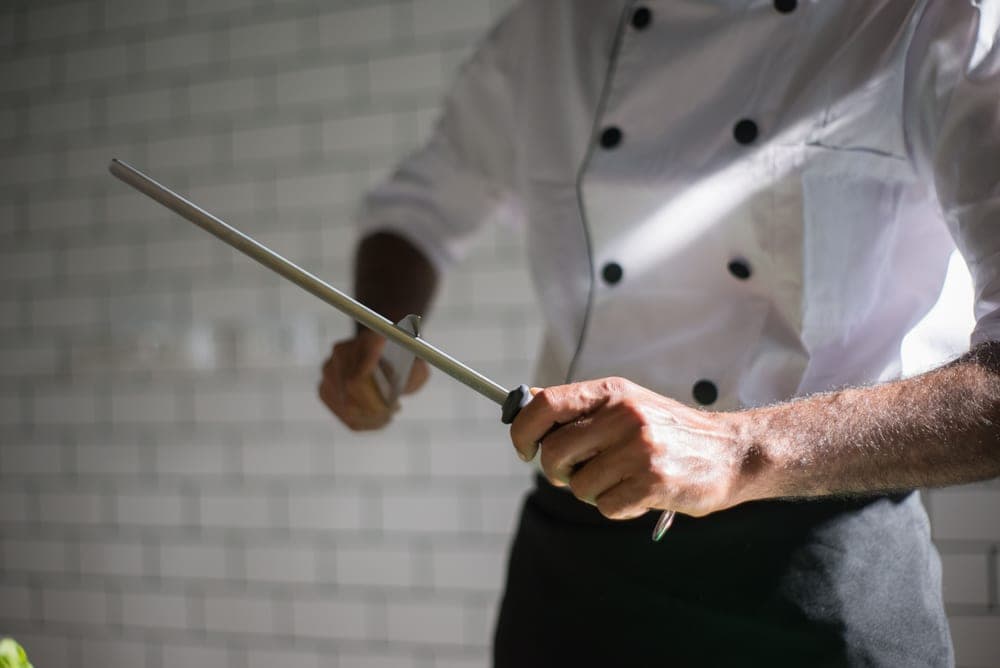 Idahone Fine Ceramic Honing Rod, 12" | Maintaining a hard Japanese edge between sharpenings | 8.8 |
We do not publish prices anywhere on this site, so this page will not quote figures at you. Why we work that way. What we can set out is the structure of the decision, which does not depend on the numbers: a service is a per-knife, per-occasion cost that repeats forever, and equipment is a one-time cost that does not. The question is only how many occasions you have.
To be clear about what this site is: Hone & Handle is an editorial publisher. We do not sharpen knives, we do not take knives in, and we have no sharpening service to sell you. This page is advice about whether to use someone else's.
Pay a professional for these four jobs
- Chip repair. Grinding past a chip means removing steel along the whole edge to keep the profile straight. It is slow, it is easy to do badly, and it is the job most likely to make a beginner give up on sharpening entirely.
- A broken or rounded tip. Reshaping a tip is freehand grinding against a profile you have to visualize. Pay for it.
- Reprofiling. Taking a 20-degree Western factory edge down to 15 degrees means removing a lot of metal at a new angle. A professional does it in minutes with the right equipment; freehand it is an evening.
- Thinning behind the edge. After years of sharpening, the blade immediately above the edge gets thick and the knife starts wedging even when it is sharp. Correcting that is a real skill and a genuine reason to pay someone.
Do these yourself
| Job | Who should do it | What it needs |
|---|---|---|
| Weekly realignment of a rolled edge | You | A fine ceramic rod, thirty seconds |
| Routine sharpening every few months | You | One 1,000-grit stone, five to ten minutes |
| Burr removal and refinement | You | A leather strop with compound |
| Repairing a chip | A professional, or a long session on a coarse stone | Coarse grit and patience |
| Changing the edge angle | A professional, or a guided system | Equipment that holds an angle for you |
| Serrated bread knife | Nobody — replace it | Not worth the labor either way |
The two rows at the top are the ones that decide the economics. Honing and routine sharpening are the overwhelming majority of what a kitchen knife needs, they are both easy, and they are both things a service charges for every time. How often a knife actually needs each is the number to apply to your own kitchen.
What to buy instead
- If you will learn: the King KDS 1000/6000. Soft, forgiving, two useful grits in one block, and loud about a wandering angle — which is exactly the feedback a beginner needs. It wants a 10 to 15 minute soak and it dishes quickly.
- If you want one stone for good: the Naniwa Professional 1000. Splash-and-go, 20 mm of abrasive, fast enough to reset a dull edge and refined enough to finish on. The full stone comparison.
- If you will not learn: the Horl 2. A rolling sharpener fixes the angle at 15 or 20 degrees so skill stops being the variable. It is the most expensive of the rolling sharpeners and the smoothest. Rolling sharpeners compared.
- Whatever else you buy: a fine ceramic rod. It is the single cheapest way to need sharpening — by anyone — less often. Rod picks.
"What angle will you sharpen it to, and on what?" A sharpener who answers "15 degrees per side, on water stones" understands your knife. A sharpener who cannot answer is likely running a powered belt at a single factory angle, and on a thin 61 HRC Japanese blade that is a reprofiling you did not ask for. What powered sharpening does to an edge.
The verdict
Use a professional as a repair shop, not as a subscription. Send the chipped knife, the broken tip and the German blade you want reprofiled to 15 degrees. Keep the weekly rod and the occasional stone session for yourself, because those are the jobs that come up constantly, they are the easiest to learn, and doing them yourself is the whole reason a good knife stays good. How to tell which job you are looking at.
The picks in detail
#1 · Your first stone
King KDS Combination Whetstone #1000/#6000
The stone almost everyone learns on. Soft, forgiving, cheap, and it tells you loudly when your angle wanders.
What it does well
- Two useful grits in one block for the price of half a premium stone
- Soft binder builds slurry readily, which gives beginners real feedback
- Almost impossible to damage a knife on it
Where it gives way
- Dishes quickly and needs flattening often
- The soak is a real commitment — you cannot sharpen on a whim
- Slow on hard powder steels like SG2
Skip it if: Impatient people. The 1000 side wants a 10-15 minute soak before every session and the clay binder dishes fast.
| Grits | #1000 / #6000, combination |
|---|---|
| Binder | Clay |
| Soaking | #1000 side: 10-15 minutes. #6000 side: splash only |
| Size | 207 x 66 x 36 mm |
| Weight | approx. 956 g |
#2 · The one stone to own if you only own one
Naniwa Professional (Chosera) 1000
The stone that does the most with one grit. Hard enough to dish slowly, soft enough to raise a slurry that tells you what the edge is doing.
What it does well
- Splash and go, but still builds a rich, informative slurry
- Fast enough to reset a dull edge, refined enough to finish on
- 20 mm of abrasive — years of use before it is spent
Where it gives way
- Expensive for a single grit
- Magnesia binder does not like being stored wet
- You will still want a finishing stone eventually
Skip it if: A tight budget. It costs more than a combination stone and gives you one grit.
| Grit | 1000 |
|---|---|
| Size | 210 x 70 x 20 mm |
| Soaking | Splash and go |
| Binder | Magnesia |
#3 · Someone who will leave it on the counter
Horl 2 Rolling Knife Sharpener
The original of the type, made in Germany, with the longest magnetic angle support of the group and the smoothest roll. It is also the most expensive by a wide margin.
What it does well
- 4.5 in magnetic support gives the most stable blade hold
- Rolls the smoothest of the rolling sharpeners, which makes control easier
- Removable abrasive discs mean it is serviceable rather than disposable
Where it gives way
- The most expensive rolling sharpener by a large margin
- Same 15 / 20 degree limitation as the cheaper alternatives
- Four pieces to keep track of instead of two
Skip it if: A tight budget. The performance gap over the Tumbler is smaller than the price gap.
| Angles | 15 degrees and 20 degrees |
|---|---|
| Magnetic support | 4.5 in — the longest of the rolling sharpeners |
| Components | 4 pieces, both abrasive surfaces removable |
| Origin | Made in Germany |
#4 · Maintaining a hard Japanese edge between sharpenings
Idahone Fine Ceramic Honing Rod, 12"
The honing rod that is actually harder than your knife. 1200 ANSI alumina ceramic, which is roughly 3000-3500 on the Japanese scale.
What it does well
- Ceramic is harder than the steel in a 60+ HRC Japanese knife; a steel rod often is not
- 1200 ANSI realigns without removing meaningful steel
- High-alumina body resists the grooving that ruins cheaper rods
Where it gives way
- Ceramic is brittle — one hard knock on a stone counter and it is done
- Removes so little steel that it cannot rescue a truly dull knife
- 12 in is longer than some drawers
Skip it if: Anyone who bangs the rod on the counter. Ceramic chips; steel does not.
| Rod length | 12 in (30.5 cm) |
|---|---|
| Rod diameter | 1/2 in (12.7 mm) |
| Overall length | 17.5 in (44.5 cm) |
| Grit | Fine, 1200 ANSI (approx. 3500 JIS) |
| Material | High-alumina ceramic |
| Handle | Hard rock maple, 5.25 in |
| Origin | Made in the USA |
Common questions
Is professional knife sharpening worth it?
Can a professional sharpener damage my knife?
Should I send a Japanese knife to a professional?
How long does a professionally sharpened edge last?
Sources
Read next
Whetstones & Skill
How Often to Sharpen a Kitchen Knife
Sharpeners
Electric Sharpener vs Whetstone
Sharpeners
Best Knife Sharpening Kits for Beginners
Whetstones & Skill
How to Tell if a Knife Is Sharp
Whetstones & Skill
Best Whetstones for Kitchen Knives
Sharpeners