Japanese Knives
Japanese vs German Knives
What this is based on: published manufacturer specifications and retailer listings, cited on each product; the weight of professional and owner reviews across multiple retailers; and hands-on experience sharpening and cooking with knives of this type. We have not individually tested every model listed, we do not run instrumented sharpness testing, and we do not claim a test we did not run.
Quick picks
| # | Product | Best for | Score | Price |
|---|---|---|---|---|
| 1 |  MAC Professional 8" Chef's Knife with Dimples (MTH-80) | The one-knife kitchen | 8.8 | |
| 2 |  Wüsthof Classic 8" Chef's Knife | Cooks who want weight and a bolster | 7.4 | |
| 3 |  Tojiro DP Gyuto 210mm (F-808) | First Japanese knife | 8.6 | |
| 4 | 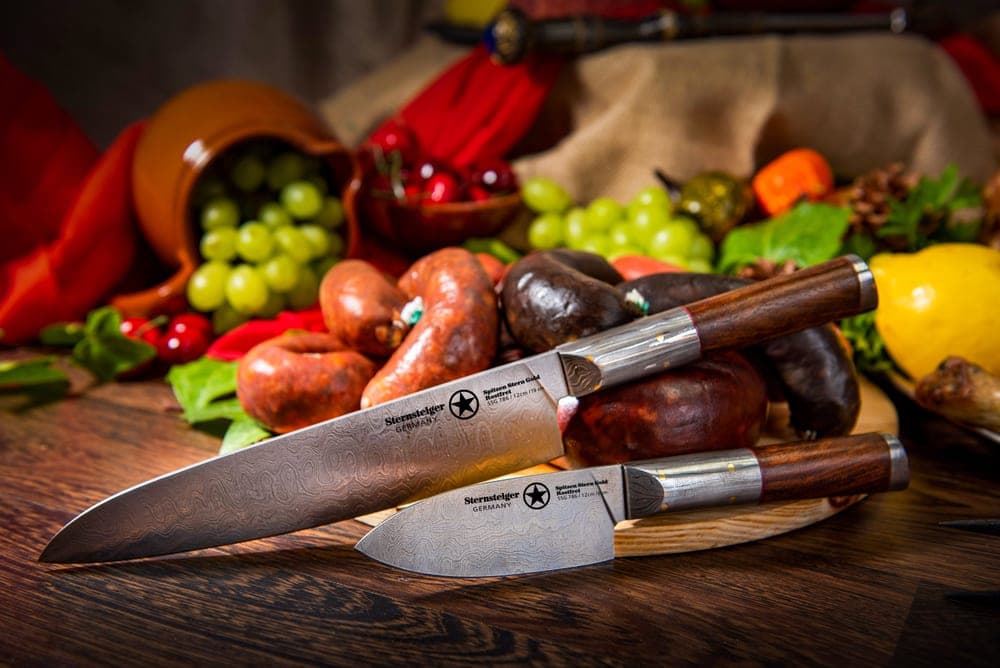 Victorinox Fibrox Pro 8" Chef's Knife | A beater, or a sanity check before you spend more | 7.0 |
| Wüsthof Classic 8" | MAC MTH-80 | Tojiro DP 210mm | |
|---|---|---|---|
| Origin | Solingen, Germany | Japan | Japan |
| Hardness | 58 HRC | 61 HRC | 59–60 HRC |
| Factory edge | 14° per side | 15° per side | approx. 15° per side |
| Spine at heel | 3mm | 2.5mm | 1.9mm |
| Weight | 265g | 193g | 187g |
| Construction | Forged, full bolster | Mono-steel, integrated bolster | San mai, partial bolster |
The difference is thickness, not angle
Wüsthof's factory bevel is more acute than MAC's. And yet a MAC goes through a butternut squash noticeably more easily. The reason is that the bevel is only the last fraction of a millimeter of the blade. What determines whether a knife separates food or splits it is the taper behind that bevel — and 1.9mm against 3mm at the spine is a 58 percent difference in the wedge you are driving through the vegetable.
This matters practically: if you own a German knife and it wedges, changing your sharpening angle will not fix it. Thinning the blade behind the edge on a coarse stone will, and that is a substantial job.
Hardness: what three points buy
- Longer interval between sharpenings. Harder steel deforms less under load, so the edge stays aligned longer.
- A finer achievable edge. A harder, finer-grained steel supports a thinner apex without folding over.
- Chipping instead of rolling. This is the cost. A rolled edge is a ten-second fix on a rod; a chip is a stone job.
Maintenance differs more than cutting does
A German knife at 56 to 58 HRC responds well to a traditional steel honing rod, because the rod is harder than the blade. A Japanese knife at 60 plus HRC often is not softer than the rod — most steel rods are not hard enough — so the rod does nothing. Ceramic is roughly four times harder than most knife steels and is the correct choice for hard blades. See honing rods and rod against whetstone.
Never put a hard Japanese knife through a pull-through sharpener. The fixed carbide or ceramic wheels reprofile the edge toward their own angle and tear steel out of a hard, thin blade. The full explanation.
The verdict
Buy Japanese if your complaint is about how the knife feels going through food, and you are prepared to keep it off bone and hard boards. Keep German if you value forgiveness, share the kitchen, or genuinely like the weight.
The MAC MTH-80 is the knife that splits the difference most convincingly: Japanese hardness and a Japanese factory angle, with an integrated bolster and enough spine to survive normal life.
The picks in detail
#1 · The one-knife kitchen
MAC Professional 8" Chef's Knife with Dimples (MTH-80)
The knife that wins the most side-by-side tests and asks the least of you. Thin, light, 61 HRC, and forgiving enough that a mediocre sharpening job still cuts well.
What it does well
- 6.8 oz with a 2.5 mm spine — genuinely light in the hand over a long prep session
- 15 degrees per side from the factory, which is the angle you will maintain anyway
- 25-year warranty and a reputation for consistency unit to unit
Where it gives way
- Costs meaningfully more than a Tojiro DP for a similar hardness
- Mono-steel, so no cladding to protect the core if you drop it edge-first
- The dimples do less for release than the marketing implies
Skip it if: Anyone chasing maximum edge retention. At 61 HRC in a mono-steel it will not out-last a powder-steel blade, and the dimples are cosmetic more often than useful.
| Blade length | 8 in (approx. 200 mm) |
|---|---|
| Steel | Sub-zero tempered high-carbon molybdenum vanadium alloy |
| Hardness | 61 HRC |
| Edge angle | 15 degrees per side (double bevel) |
| Blade height | 1 7/8 in |
| Spine at heel | 2.5 mm |
| Weight | 6.8 oz |
| Handle | Riveted Pakkawood with integrated bolster |
#2 · Cooks who want weight and a bolster
Wüsthof Classic 8" Chef's Knife
The German benchmark, and the knife most of this site's readers are replacing. 265 g, a 3 mm spine, 58 HRC, and a 14-degree-per-side factory edge that is more acute than its reputation suggests.
What it does well
- Forged, full tang, triple-riveted — it will outlive you
- 14 degrees per side from Wüsthof's Precision Edge Technology is sharper than most people assume
- Soft enough at 58 HRC to be nearly chip-proof
Where it gives way
- 265 g is heavy; the 3 mm spine wedges in dense produce
- 58 HRC gives up meaningful edge retention to a 61 HRC Japanese blade
- Full bolster gets in the way when you sharpen the heel
Skip it if: Anyone whose complaint is 'my knife feels heavy and wedges in a sweet potato' — that is the 3 mm spine, and a thinner Japanese blade is the fix.
| Blade length | 8 in (200 mm) |
|---|---|
| Steel | X50CrMoV15 high-carbon stainless |
| Hardness | 58 HRC |
| Edge angle | 14 degrees per side (28 degrees inclusive) |
| Blade height | 1.9 in (47 mm) |
| Spine | 3 mm |
| Weight | 9.3 oz (265 g) |
#3 · First Japanese knife
Tojiro DP Gyuto 210mm (F-808)
The default answer to 'my first real Japanese knife'. VG-10 at around 60 HRC in a plain three-layer build, at a price that makes the inevitable first chip survivable.
What it does well
- VG-10 at 59-60 HRC takes a genuinely fine edge and holds it far longer than a German knife at 56-58
- 1.9 mm spine and 43 mm heel make it thin behind the edge without being fragile
- Cheap enough that learning to sharpen on it is not frightening
Where it gives way
- Handle finish is functional and unlovely; some units need the bolster easing with sandpaper
- Stainless cladding is soft and scratches readily
- Nothing about the fit and finish will impress anyone
Skip it if: Anyone who wants the knife to be beautiful. The handle is a workmanlike composite with a stainless bolster and nothing about it is charming.
| Blade length | 210 mm (8.3 in) |
|---|---|
| Steel | VG-10 core, 13-chrome stainless cladding (san mai) |
| Hardness | 59-60 HRC |
| Heel height | 43 mm |
| Spine at heel | 1.9 mm |
| Weight | approx. 187 g |
| Handle | Western, laminated composite wood with stainless bolster |
#4 · A beater, or a sanity check before you spend more
Victorinox Fibrox Pro 8" Chef's Knife
Not a Japanese knife and not pretending to be. It is the control sample: if your cooking does not improve after upgrading from this, the knife was never the problem.
What it does well
- Stamped, light and genuinely non-slip when wet
- Soft enough that a pull-through sharpener will not destroy it
- Costs a fraction of everything else here
Where it gives way
- 56 HRC means frequent honing and frequent sharpening
- 18-degree edge is blunt by Japanese standards
- No bolster, no heft, no presence — it feels like a tool because it is one
Skip it if: This site's usual reader. At 56 HRC with an 18-degree edge it is a softer, blunter tool than anything else on this page.
| Blade length | 8 in |
|---|---|
| Steel | X55CrMo14 high-carbon stainless |
| Hardness | 56 HRC |
| Edge angle | 18 degrees |
| Weight | 5.6 oz |
| Handle | Fibrox Pro thermoplastic elastomer, no bolster |
Common questions
Are Japanese knives better than German knives?
Do German knives really come sharpened at 20 degrees?
Which is easier to look after?
Can I use a honing steel on a Japanese knife?
Sources
Read next
Japanese Knives
Gyuto vs Chef Knife
Brands
Shun vs Wüsthof
Brands
Victorinox vs Wüsthof
Steel & Care
Knife Steel Guide
Whetstones & Skill
Knife Sharpening Angle Chart
Japanese Knives