Brands
Shun vs Zwilling
What this is based on: published manufacturer specifications and retailer listings, cited on each product; the weight of professional and owner reviews across multiple retailers; and hands-on experience sharpening and cooking with knives of this type. We have not individually tested every model listed, we do not run instrumented sharpness testing, and we do not claim a test we did not run.
Quick picks
| # | Product | Best for | Score | Price |
|---|---|---|---|---|
| 1 | 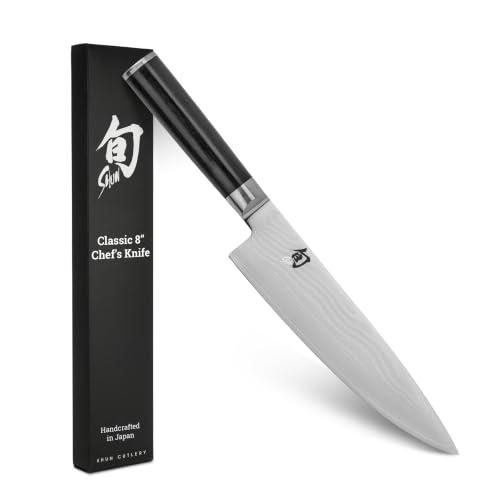 Shun Classic 8" Chef's Knife (DM0706) | A knife you want to look at | 8.3 | |
| 2 | 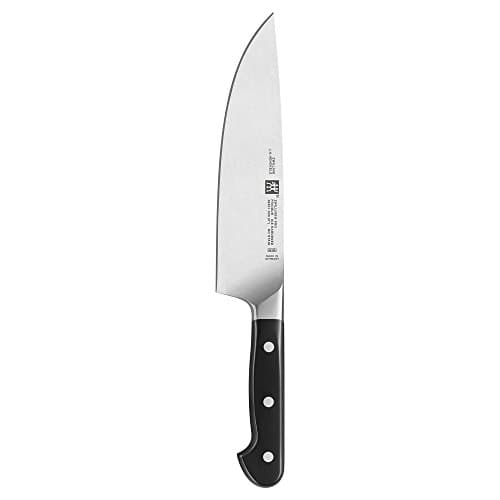 Zwilling Pro 8" Chef's Knife (38401-203) | Cooks who choke up on the blade | 7.3 | |
| 3 | 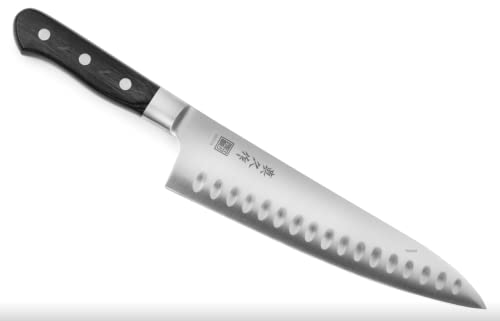 MAC Professional 8" Chef's Knife with Dimples (MTH-80) | The one-knife kitchen | 8.8 |
This is the Japan-against-Germany decision in its prettiest form, because both knives are the premium line of a serious maker rather than a supermarket blade. Which means the comparison is not about quality. It is about a four-point hardness gap, 1.35 mm of spine, and one piece of handle geometry.
The published numbers
| Shun Classic 8" | Zwilling Pro 8" | |
|---|---|---|
| Blade length | 8 in | 8 in |
| Steel | VG-MAX core, 34 Damascus layers each side | Friodur X2 ice-hardened high-carbon stainless, mono-steel |
| Hardness | 61 HRC | 57 HRC |
| Factory edge | 16° per side | approx. 15° per side |
| Blade height | Not published | 1.87 in |
| Spine at heel | Not published for the Classic chef's knife | 3.25 mm |
| Weight | Not published | 9.3 oz (266 g) |
| Handle | D-shaped pakkawood, stainless bolster and end cap | Triple-riveted resin, curved half bolster |
| Origin | Seki, Japan | Made in Germany |
| Warranty | Limited lifetime | Lifetime |
Shun does not publish a spine thickness or a weight for the Classic chef's knife, so those cells stay empty rather than filled with an estimate. What is published tells you enough: Zwilling's 3.25 mm spine is the thickest figure in our registry, and for comparison the Shun Premier - the Classic's sibling, same VG-MAX core - publishes 1.9 mm. That is the shape of the gap.
Four Rockwell points, and what they cost each way
61 HRC against 57 is the headline. A blade at 61 supports a 16-degree bevel through weeks of home prep; the same geometry on 57 HRC steel deflects, which is why German knives have always shipped with a honing rod and why honing is not sharpening matters more for the Zwilling than for the Shun.
Zwilling's answer is Friodur, its ice-hardening heat treatment, and it is a real thing rather than a sticker: it is what lets a 57 HRC stainless hold a 15-degree factory bevel at all and resist corrosion while doing it. But heat treatment cannot move hardness four points. The Zwilling edge rolls sooner and comes back faster; the Shun edge lasts longer and chips instead of rolling when it finally fails.
Wedging - the sensation of a knife splitting a sweet potato rather than slicing it - is a function of how much steel the blade pushes aside, and no amount of sharpening changes it. 3.25 mm at the heel is a lot of steel. If that is your complaint about the knife you already own, the Shun is the fix and the Zwilling is not. Our Japanese against German comparison works through the category version of this.
The curved half bolster is Zwilling's real advantage
Most German knives carry a full bolster that runs down to the heel. It feels reassuring and it causes two problems: you cannot choke your index finger up onto the blade for fine work, and you cannot sharpen the last half inch of edge because the bolster sits proud of it. Over years that leaves a stub of un-sharpened edge at the heel that never cuts anything.
The Zwilling Pro's bolster curves away instead, clearing the heel entirely. It is the reason this knife, not the Wüsthof Classic, is the German blade we would hand to someone who sharpens their own. The Shun Classic has a stainless bolster at the handle and a clear heel too, so it is not disadvantaged here - but among German knives the Pro is the one that got this right.
Against that, the Shun Classic's handle is a D-shape, which is comfortable in a right-handed pinch grip and oriented for right-handed use. Left-handed cooks should read our left-handed guide before buying the Classic; the Zwilling's symmetrical resin handle has no handedness at all.
266 grams is a decision, not a detail
The Zwilling Pro weighs 9.3 oz. That mass drops the blade through an onion under its own weight, which some cooks love and which makes the knife feel like a tool rather than an instrument. Over an hour of prep most people prefer something lighter; over a butternut squash most prefer the German knife. The Shun Classic is not light either by Japanese standards, but it is unambiguously the more delicate of the two.
There is also the replacement-cost argument, which nobody likes to make out loud. A chipped Shun tip is a trip to Kai's sharpening service or an evening on the stones; a chipped Zwilling is unlikely in the first place and cheap to fix if it happens, because 57 HRC steel grinds fast. If the knife is going into a shared kitchen, that matters more than four Rockwell points.
Which one to buy
- Your complaint is that your knife wedges and dulls. Shun Classic 8 inch. 61 HRC at 16 degrees per side, and a far thinner blade than anything German.
- You want weight, toughness and a bolster you can sharpen past. Zwilling Pro. The curved half bolster is the best handle detail in this comparison.
- You want most of the Shun's cut with the Zwilling's resilience. MAC Professional MTH-80: 61 HRC, 15 degrees per side, 2.5 mm at the spine and 6.8 oz, with a Western handle.
- You are left handed. Not the Shun Classic - its D-handle is right-hand oriented. The Zwilling Pro and the MAC are both symmetrical.
Sharpening and upkeep
These two want different routines. The Zwilling Pro is soft enough at 57 HRC that a grooved steel rod genuinely works on it - that is the pairing German knives were designed around, and honing it two or three times a week will keep it usable for a long time between stone sessions. When it does need a stone, it grinds fast and forgives an uneven stroke, which makes it an unusually good knife to learn freehand sharpening on. The curved half bolster helps here too: there is nothing blocking the heel, so the whole edge reaches the stone.
The Shun Classic at 61 HRC is a different proposition. A grooved steel rod is roughly as hard as the blade and will skate rather than correct it, so the right maintenance tool is a fine ceramic rod - the reasoning is in honing steel against ceramic rod. It needs the stone less often, but when it does, a careless session is more expensive: harder steel chips rather than deforms. Kai's free sharpening service is a real mitigation if you would rather not learn, and it is one of the better reasons to buy into the Shun range at all.
Both are stainless and neither needs babying against rust. Both should be hand washed and dried; the Zwilling's listing says dishwasher safe and we would still not do it, because the damage from a dishwasher rack is mechanical rather than chemical and applies to any thin edge.
Where each sits in its own range
Neither knife is the top of its line, and knowing what sits above it changes the decision. Shun's Premier line uses the same VG-MAX core at 60-61 HRC with a hammered tsuchime finish, a 1.9 mm spine and a symmetrical contoured handle that works in either hand - which solves the Classic's one real ergonomic limitation. Above that, the same corporate group makes Miyabi in Seki, Japan, where SG2 powder steel at 63 HRC behind a bevel under 12 degrees per side is a genuinely different cutting experience and a much more fragile one. Our Miyabi Birchwood review covers that end honestly.
On the German side, Zwilling's Pro is the line we would pick over the cheaper ranges precisely because of the bolster, and the natural cross-shop is the Wüsthof Classic - 58 HRC, a 14-degree factory edge, 3 mm at the spine and 265 g, which is heavier and thicker again. If your shortlist is really "a good German knife" rather than this specific pair, Victorinox against Wüsthof covers the value end of that question and our brands guide maps the whole field.
The verdict
The Shun Classic is the better knife to cut with and the Zwilling Pro is the better knife to own carelessly. If you are reading this because your German chef's knife feels thick and goes dull, crossing to the Shun is the upgrade you are actually looking for - and the honest third answer is that the MAC MTH-80 splits the difference better than either. The full write-up on the Japanese side is our Shun Classic review, and Shun against Wüsthof covers the other German knife most buyers weigh at the same moment.
If the Zwilling is on your list because you want a dependable workhorse rather than a Japanese edge, the cheaper version of that question is Victorinox against Zwilling - a stamped Swiss knife one Rockwell point behind it, at a fraction of the price.
The picks in detail
#1 · A knife you want to look at
Shun Classic 8" Chef's Knife (DM0706)
The Damascus-clad knife people actually buy. A 16-degree-per-side VG-MAX edge at 61 HRC, a D-shaped pakkawood handle, and a look that sells itself.
What it does well
- 16 degrees per side is a sensible factory angle — acute, but not so thin it chips on a carrot
- Handle geometry is genuinely comfortable in a pinch grip
- Kai's warranty and free sharpening service are real, useful things
Where it gives way
- You pay a significant premium over a MAC or Tojiro for the Damascus cladding
- The D-shaped handle is oriented for right-handed use
- Thin tip is easy to snap if you twist it in a squash
Skip it if: Left-handed cooks who dislike a D-shaped handle, and anyone who resents paying for 68 layers of cladding that do nothing for cutting.
| Blade length | 8 in |
|---|---|
| Steel | VG-MAX core, 34 layers Damascus cladding each side |
| Hardness | 61 HRC |
| Edge angle | 16 degrees per side |
| Handle | D-shaped pakkawood with stainless bolster and end cap |
| Warranty | Limited lifetime |
#2 · Cooks who choke up on the blade
Zwilling Pro 8" Chef's Knife (38401-203)
The German knife with the curved half bolster, which is the one real ergonomic idea in this category. 57 HRC and 3.25 mm at the spine, so it is tough rather than keen.
What it does well
- The curved half bolster leaves the heel clear, so you can sharpen the whole edge and choke up onto the blade
- Friodur ice-hardening and a forged full tang - this is a knife that tolerates a careless kitchen
- 15 degrees per side is more acute than the German reputation suggests
Where it gives way
- 3.25 mm at the spine is the thickest blade here; it wedges in dense produce
- 57 HRC gives up real edge retention to any 60+ HRC Japanese blade
- 266 g is heavy over a long prep session
Skip it if: Anyone whose complaint is wedging. At 3.25 mm the spine is the thickest in our registry, and no amount of sharpening thins a blade.
| Blade length | 8 in |
|---|---|
| Blade height | 1.87 in |
| Overall length | 13 in |
| Steel | Friodur X2 ice-hardened high-carbon stainless |
| Hardness | 57 HRC |
| Edge angle | approx. 15 degrees per side, double bevel |
| Spine at heel | 3.25 mm |
| Weight | 9.3 oz (266 g) |
| Handle | Triple-riveted resin with a curved half bolster |
| Origin | Made in Germany |
#3 · The one-knife kitchen
MAC Professional 8" Chef's Knife with Dimples (MTH-80)
The knife that wins the most side-by-side tests and asks the least of you. Thin, light, 61 HRC, and forgiving enough that a mediocre sharpening job still cuts well.
What it does well
- 6.8 oz with a 2.5 mm spine — genuinely light in the hand over a long prep session
- 15 degrees per side from the factory, which is the angle you will maintain anyway
- 25-year warranty and a reputation for consistency unit to unit
Where it gives way
- Costs meaningfully more than a Tojiro DP for a similar hardness
- Mono-steel, so no cladding to protect the core if you drop it edge-first
- The dimples do less for release than the marketing implies
Skip it if: Anyone chasing maximum edge retention. At 61 HRC in a mono-steel it will not out-last a powder-steel blade, and the dimples are cosmetic more often than useful.
| Blade length | 8 in (approx. 200 mm) |
|---|---|
| Steel | Sub-zero tempered high-carbon molybdenum vanadium alloy |
| Hardness | 61 HRC |
| Edge angle | 15 degrees per side (double bevel) |
| Blade height | 1 7/8 in |
| Spine at heel | 2.5 mm |
| Weight | 6.8 oz |
| Handle | Riveted Pakkawood with integrated bolster |
Common questions
Is Shun better than Zwilling?
What is the curved bolster on the Zwilling Pro for?
Is Zwilling the same as Henckels or Miyabi?
Which is better for a beginner?
Sources
Read next
Brands
Shun vs Wüsthof
Brands
Victorinox vs Wüsthof
Brands
MAC vs Shun
Japanese Knives
Japanese vs German Knives