Japanese Knives
Left-Handed Japanese Knives
What this is based on: published manufacturer specifications and retailer listings, cited on each product; the weight of professional and owner reviews across multiple retailers; and hands-on experience sharpening and cooking with knives of this type. We have not individually tested every model listed, we do not run instrumented sharpness testing, and we do not claim a test we did not run.
Quick picks
| # | Product | Best for | Score | Price |
|---|---|---|---|---|
| 1 | Tojiro DP Gyuto 210mm (F-808) | First Japanese knife | 8.6 | |
| 2 |  MAC Professional 8" Chef's Knife with Dimples (MTH-80) | The one-knife kitchen | 8.8 | |
| 3 |  Global G-2 8" Chef's Knife | Cooks who want the lightest knife in the drawer | 7.6 | |
| 4 | 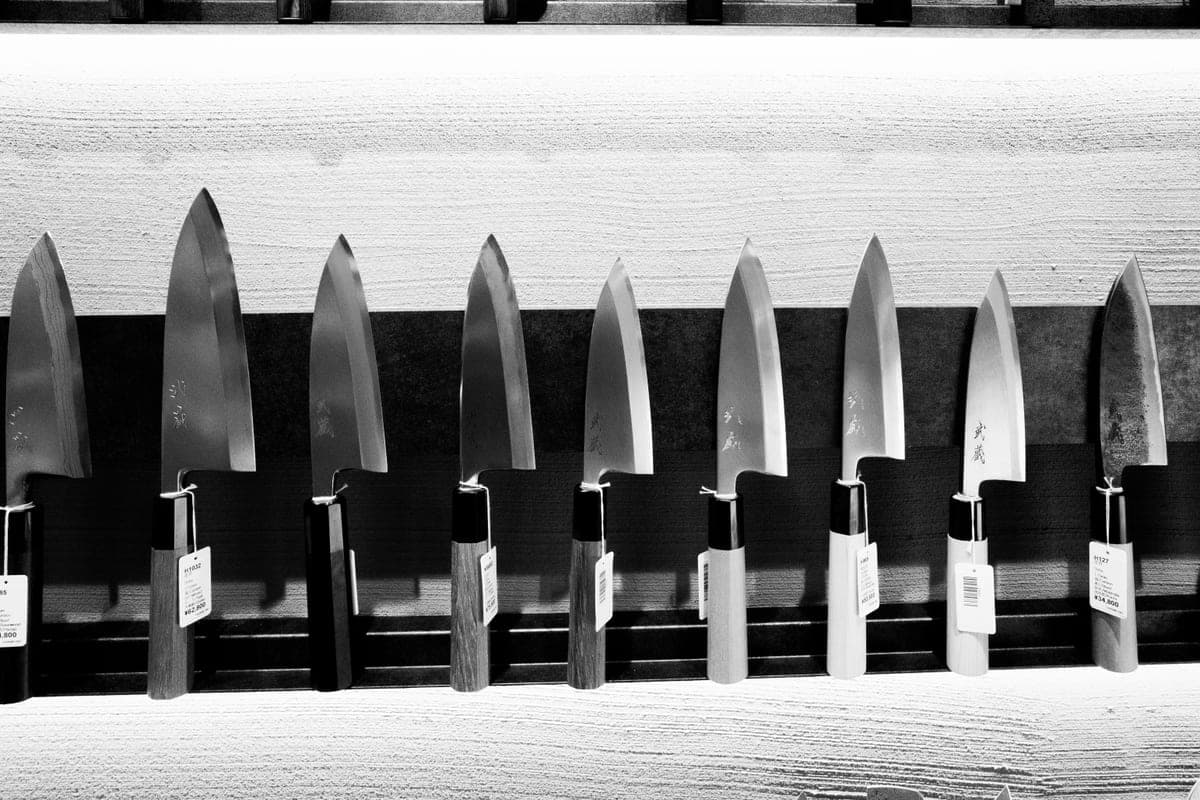 Shun Classic 6.5" Nakiri (DM0728) | An upgrade nakiri | 8.3 |
This question gets worse answers than it deserves, because "Japanese knife" covers two very different traditions. The single-bevel knives of a sushi counter are emphatically handed; the double-bevel knives almost everyone actually buys are not. If you have been told you need a special left-handed gyuto, you have been given advice about a different category of knife.
The three things that are genuinely handed
- A D-shaped handle. A D-handle is not round — it has a flat and a ridge positioned to fill one specific palm. The Shun Classic chef's knife uses one, oriented for right-handed use, and the brand lists it as such. Left-handed cooks usually describe it as tolerable rather than comfortable. The Shun Classic nakiri, by contrast, uses a symmetrical pakkawood handle and is explicitly usable in either hand.
- An asymmetric grind. Some double-bevel Japanese knives are ground 70/30 or 80/20 rather than 50/50, which steers the knife slightly away from the cut for a right-handed user and slightly into it for a left-handed one. It is a small effect and most people never notice it, but if a listing specifies an asymmetric bevel, that specification is handed.
- Any single-bevel knife. A yanagiba, usuba or deba is ground on one side only with a hollow back on the other. A right-handed version is unusable left-handed — not awkward, unusable. Left-handed versions exist and are generally special-order and dearer. Single bevel against double bevel explains why.
What is not handed, despite the marketing
| Feature | Handed? | Why |
|---|---|---|
| Double-bevel symmetrical grind | No | Identical geometry on both sides of the edge |
| Western round or oval handle | No | Rotationally neutral in the palm |
| One-piece steel handle (Global) | No | Fully symmetrical, no flat and no ridge |
| Octagonal wa handle | No | Eight even faces; the shape has no orientation |
| D-shaped wa or hybrid handle | Yes | Shaped for one palm; a mirrored version is a separate product |
| Granton or dimpled blade face | No | Usually ground on both sides, and cosmetic either way |
What to buy
- First Japanese knife. Tojiro DP F-808. Western composite handle, symmetrical grind, nothing about it cares which hand you use. The full first-knife guide applies unchanged.
- Best knife regardless of hand. MAC MTH-80. Riveted pakkawood, integrated bolster, neutral in either grip.
- Most symmetrical object in the drawer. Global G-2. One piece of steel with a dimpled handle that has no front, back or handedness — and no flat to dig into the wrong palm.
- A nakiri. The Shun Classic nakiri is the one Shun Classic piece with a handle that works both ways, which makes it the easy recommendation here.
Sharpening left-handed
Nothing changes except which side you start on. Set the stone square to the counter, start with the far side of the blade, count your strokes, and mirror them. The whetstone walkthrough works as written — swap left for right throughout. The only real left-handed pitfall is a dished stone: a mirrored stroke rides a dish differently, so you end up fixing the stone with your wrist instead of with a flattening plate.
Clamped and rolling sharpeners are symmetrical, so they do not care which hand you use — but they do fix the angle, which means they also fix any asymmetric factory grind into a symmetrical one. If your knife is deliberately ground 70/30, a guided system will quietly make it 50/50. What guided systems do and do not do.
The short version
Check two things on any listing: is the bevel double and symmetrical, and is the handle round, oval, octagonal or one-piece rather than D-shaped. If both are true, the knife is left-handed friendly and there is nothing else to look for. If a shop tries to sell you a left-handed version of a symmetrical double-bevel knife, you are paying for nothing.
The picks in detail
#1 · First Japanese knife
Tojiro DP Gyuto 210mm (F-808)
The default answer to 'my first real Japanese knife'. VG-10 at around 60 HRC in a plain three-layer build, at a price that makes the inevitable first chip survivable.
What it does well
- VG-10 at 59-60 HRC takes a genuinely fine edge and holds it far longer than a German knife at 56-58
- 1.9 mm spine and 43 mm heel make it thin behind the edge without being fragile
- Cheap enough that learning to sharpen on it is not frightening
Where it gives way
- Handle finish is functional and unlovely; some units need the bolster easing with sandpaper
- Stainless cladding is soft and scratches readily
- Nothing about the fit and finish will impress anyone
Skip it if: Anyone who wants the knife to be beautiful. The handle is a workmanlike composite with a stainless bolster and nothing about it is charming.
| Blade length | 210 mm (8.3 in) |
|---|---|
| Steel | VG-10 core, 13-chrome stainless cladding (san mai) |
| Hardness | 59-60 HRC |
| Heel height | 43 mm |
| Spine at heel | 1.9 mm |
| Weight | approx. 187 g |
| Handle | Western, laminated composite wood with stainless bolster |
#2 · The one-knife kitchen
MAC Professional 8" Chef's Knife with Dimples (MTH-80)
The knife that wins the most side-by-side tests and asks the least of you. Thin, light, 61 HRC, and forgiving enough that a mediocre sharpening job still cuts well.
What it does well
- 6.8 oz with a 2.5 mm spine — genuinely light in the hand over a long prep session
- 15 degrees per side from the factory, which is the angle you will maintain anyway
- 25-year warranty and a reputation for consistency unit to unit
Where it gives way
- Costs meaningfully more than a Tojiro DP for a similar hardness
- Mono-steel, so no cladding to protect the core if you drop it edge-first
- The dimples do less for release than the marketing implies
Skip it if: Anyone chasing maximum edge retention. At 61 HRC in a mono-steel it will not out-last a powder-steel blade, and the dimples are cosmetic more often than useful.
| Blade length | 8 in (approx. 200 mm) |
|---|---|
| Steel | Sub-zero tempered high-carbon molybdenum vanadium alloy |
| Hardness | 61 HRC |
| Edge angle | 15 degrees per side (double bevel) |
| Blade height | 1 7/8 in |
| Spine at heel | 2.5 mm |
| Weight | 6.8 oz |
| Handle | Riveted Pakkawood with integrated bolster |
#3 · Cooks who want the lightest knife in the drawer
Global G-2 8" Chef's Knife
One piece of steel, dimpled hollow handle, 170 g. Nothing else feels like it — which is exactly why you should hold one before you buy.
What it does well
- 170 g and perfectly balanced — the least tiring knife here over two hours of prep
- One-piece construction with no rivets or bolster to trap food
- 2 mm spine means it is thin behind the edge out of the box
Where it gives way
- 56-58 HRC is soft for a Japanese knife; expect to hone it often
- The dimpled steel handle is polarizing and slick when wet
- CROMOVA 18 does not take as fine a finishing edge as VG-10
Skip it if: Anyone with wet hands and no patience: the smooth steel handle gets slippery, and at 56-58 HRC it will not hold an edge like a 61 HRC blade.
| Blade length | 8 in (200 mm) |
|---|---|
| Steel | CROMOVA 18 stainless |
| Hardness | 56-58 HRC |
| Edge angle | 10-15 degrees, double bevel |
| Blade height | 1.7 in (45 mm) |
| Spine | 2 mm |
| Weight | 6 oz (170 g) |
#4 · An upgrade nakiri
Shun Classic 6.5" Nakiri (DM0728)
Flat-ground, double-bevelled to 16 degrees per side, 69-layer Damascus over a VG-MAX core. The nakiri for someone who already knows they want one.
What it does well
- Flat grind gives excellent release on dense vegetables
- Handle works for left-handed cooks, unlike the D-shaped Classic chef's knife
- Kai's lifetime warranty applies
Where it gives way
- Several times the price of the Tojiro for a knife doing the same job
- Thin tip corners are easy to ding on the board
- Damascus cladding is cosmetic
Skip it if: A first nakiri. Buy the Tojiro, decide you use it, then buy this.
| Blade length | 6.5 in (165 mm) |
|---|---|
| Steel | VG-MAX core, 34 Damascus layers each side (69 total) |
| Edge | Double bevel, flat ground, 16 degrees per side |
| Handle | Pakkawood, usable left or right handed |
Common questions
Are Japanese knives left-handed friendly?
Do I need a left-handed chef's knife?
Is a Shun Classic bad for left-handed cooks?
Does sharpening change if you are left-handed?
Sources
Read next
Steel & Care
Single Bevel vs Double Bevel
Steel & Care
Japanese vs Western Knife Handles
Japanese Knives
Your First Japanese Knife
Whetstones & Skill
How to Use a Whetstone
Japanese Knives
Best Japanese Chef Knives for Home Cooks
Japanese Knives