Whetstones & Skill
How to Use a Whetstone
What this is based on: published manufacturer specifications and retailer listings, cited on each product; the weight of professional and owner reviews across multiple retailers; and hands-on experience sharpening and cooking with knives of this type. We have not individually tested every model listed, we do not run instrumented sharpness testing, and we do not claim a test we did not run.
Quick picks
| # | Product | Best for | Score | Price |
|---|---|---|---|---|
| 1 | King KDS Combination Whetstone #1000/#6000 | Your first stone | 8.4 | |
| 2 | 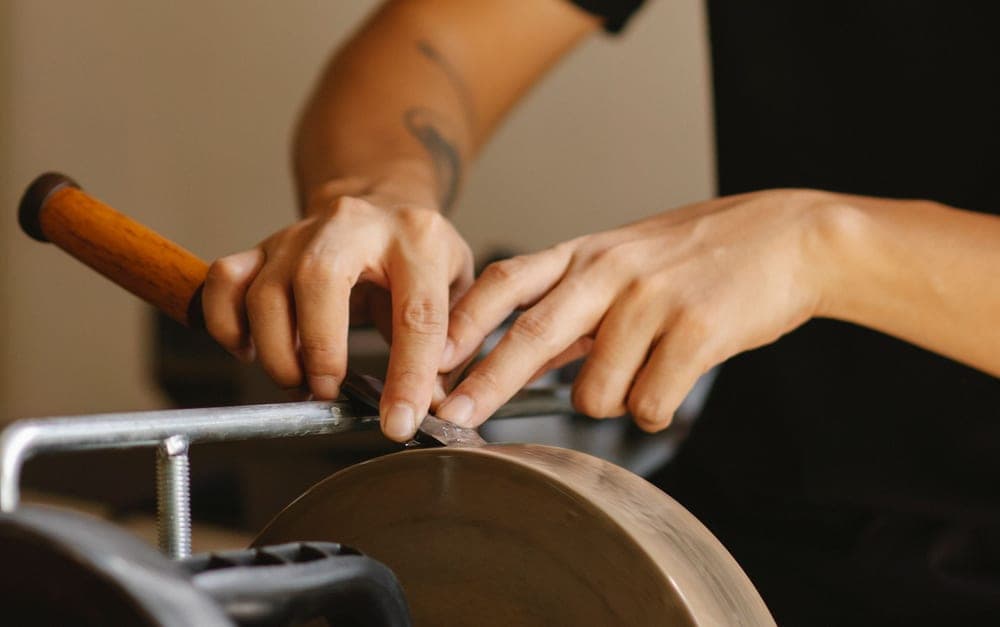 Shapton Glass Stone 1000 | Hard steels and no patience for soaking | 8.3 | |
| 3 |  Naniwa Professional (Chosera) 1000 | The one stone to own if you only own one | 8.6 |
Setup, in order
- Find out what binder your stone has. Clay wants soaking; ceramic and magnesia do not. The roundup lists this per stone.
- Soak or splash accordingly. A clay stone is ready when the bubbles stop, typically 10 to 15 minutes.
- Secure it. Damp folded towel under the stone, on a stable surface at a comfortable height. Too low and you round your angle reaching down; too high and you cannot use your body weight.
- Have water to hand. A small bowl or a spray bottle. You will need it every thirty seconds.
- Color the bevel with a marker. Thirty seconds that replaces an hour of guessing.
The stroke
Set the bevel flat on the stone at your angle. Lock your wrist. Move the knife with your upper body, not your hand — shoulders and elbows drive the stroke, which is what keeps the angle constant over the whole length.
Work in thirds. Heel third, middle third, tip third, so that every part of the edge gets equal attention. As you reach the curve toward the tip, lift the handle slightly to keep the contact point on the stone — the bevel angle stays the same, only the handle height changes.
You need enough pressure to keep the bevel flat on the stone and no more. Heavy pressure flexes a thin Japanese blade, which rounds the apex you are trying to create — so you are working harder to get a worse result. As the edge sharpens, reduce pressure further.
Slurry: keep it or wash it off?
Slurry is the gray paste of abrasive and steel that builds on the stone as you work. Loose abrasive in the slurry cuts faster and leaves a slightly less refined finish than the fixed abrasive in the stone.
- On a coarse or medium stone, leave it. It speeds things up and it is the feedback that tells you the stone is cutting.
- On a finishing stone, rinse it periodically. You want the fine fixed abrasive doing the work, not coarser loose particles.
- If it goes dry and gummy, add water immediately. A loaded stone stops cutting and starts burnishing.
Flattening, which everyone skips
Every stone wears fastest in the middle, because that is where you sharpen. Within a few sessions a soft stone develops a visible dish, and a dished stone makes a consistent angle physically impossible — the blade follows the curve and rounds the apex.
- Draw a pencil grid across the stone face.
- Run a flattening plate, a coarse diamond plate or a sheet of coarse wet-and-dry on glass across it with water.
- Stop when all the pencil is gone. Remaining pencil marks the low spots.
Soft clay stones like the King need this often. Hard stones — Shapton Glass, Naniwa Professional — need it far less. It is one of the strongest arguments for a harder stone once you sharpen regularly.
Cleaning up
- Rinse the swarf off under the tap. Do not use soap.
- Air dry completely before storing. Never store a soaking stone submerged.
- Keep it somewhere it will not freeze. Water in a saturated clay stone expands and cracks it.
- If the surface glazes over — shiny and slick rather than matte — it is loaded with swarf. A few passes with a flattening plate opens it back up.
Then what
The actual sharpening sequence is on how to sharpen a Japanese knife. The angle work is on the angle guide. If something is not working, start with the diagnostic.
The picks in detail
#1 · Your first stone
King KDS Combination Whetstone #1000/#6000
The stone almost everyone learns on. Soft, forgiving, cheap, and it tells you loudly when your angle wanders.
What it does well
- Two useful grits in one block for the price of half a premium stone
- Soft binder builds slurry readily, which gives beginners real feedback
- Almost impossible to damage a knife on it
Where it gives way
- Dishes quickly and needs flattening often
- The soak is a real commitment — you cannot sharpen on a whim
- Slow on hard powder steels like SG2
Skip it if: Impatient people. The 1000 side wants a 10-15 minute soak before every session and the clay binder dishes fast.
| Grits | #1000 / #6000, combination |
|---|---|
| Binder | Clay |
| Soaking | #1000 side: 10-15 minutes. #6000 side: splash only |
| Size | 207 x 66 x 36 mm |
| Weight | approx. 956 g |
#2 · Hard steels and no patience for soaking
Shapton Glass Stone 1000
5 mm of hard abrasive bonded to a glass plate. Splash and go, dishes slowly, and cuts hard steel that a King barely scratches.
What it does well
- Genuinely splash and go — water on, sharpen, done in five minutes
- Hard binder dishes far more slowly than a clay stone
- Cuts hard powder steels that soft stones struggle with
Where it gives way
- Only 5 mm of usable abrasive; the glass base is not a stone
- Hard and quiet, so it hides angle errors from a beginner
- Costs roughly what a full King combination stone does, for one grit
Skip it if: Learning on. It is hard and quiet — it gives far less feedback than a soft stone, which is exactly what a beginner needs.
| Grit | 1000 (Shapton scale) |
|---|---|
| Size | 210 x 70 mm, 5 mm abrasive on a 5 mm glass base |
| Soaking | Splash and go after a 5-6 minute soak on first use only |
| Binder | Non-absorbent ceramic |
#3 · The one stone to own if you only own one
Naniwa Professional (Chosera) 1000
The stone that does the most with one grit. Hard enough to dish slowly, soft enough to raise a slurry that tells you what the edge is doing.
What it does well
- Splash and go, but still builds a rich, informative slurry
- Fast enough to reset a dull edge, refined enough to finish on
- 20 mm of abrasive — years of use before it is spent
Where it gives way
- Expensive for a single grit
- Magnesia binder does not like being stored wet
- You will still want a finishing stone eventually
Skip it if: A tight budget. It costs more than a combination stone and gives you one grit.
| Grit | 1000 |
|---|---|
| Size | 210 x 70 x 20 mm |
| Soaking | Splash and go |
| Binder | Magnesia |
Common questions
How long do you soak a whetstone?
How do I stop the stone sliding around?
How much pressure should I use?
How do I know when to flatten a stone?
Should I store a whetstone wet or dry?
Sources
Read next
Whetstones & Skill
How to Sharpen a Japanese Knife
Whetstones & Skill
Best Whetstones for Kitchen Knives
Whetstones & Skill
Whetstone Grit Chart
Whetstones & Skill
Common Knife Sharpening Mistakes
Whetstones & Skill
Knife Sharpening Angle Chart
Whetstones & Skill