Sharpeners
Knife Sharpening When You Are Tall
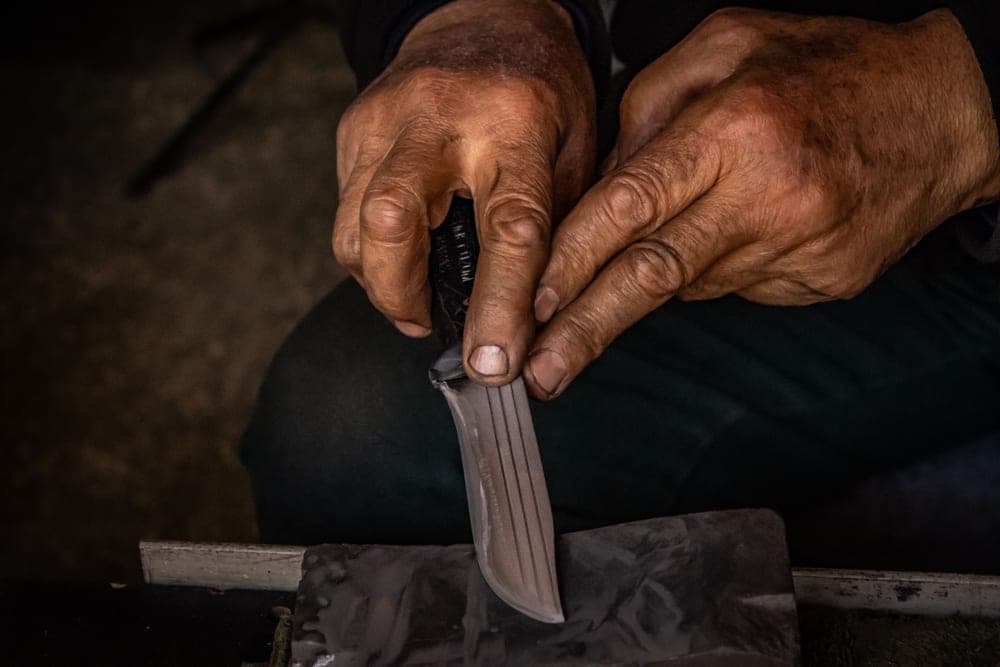
What this is based on: published manufacturer specifications and retailer listings, cited on each product; the weight of professional and owner reviews across multiple retailers; and hands-on experience sharpening and cooking with knives of this type. We have not individually tested every model listed, we do not run instrumented sharpness testing, and we do not claim a test we did not run.
Quick picks
| # | Product | Best for | Score | Price |
|---|---|---|---|---|
| 1 |  Horl 2 Rolling Knife Sharpener | Someone who will leave it on the counter | 7.9 | |
| 2 |  Work Sharp Precision Adjust Elite | Repeatable angles without years of practice | 8.2 | |
| 3 |  King KDS Combination Whetstone #1000/#6000 | Your first stone | 8.4 |
This page exists because people genuinely search for a sharpener for tall people, and nobody sells one. What they are really describing is a posture problem that looks like a technique problem, and it is worth separating the two before spending money.
Why height breaks the angle
Freehand sharpening works because your arm, shoulder and wrist lock into one fixed shape and you move the whole assembly. The angle holds as long as nothing in that chain flexes. Working at a surface that is too low breaks it in three places at once: you lean forward from the hips, your shoulder drops and rotates in, and your wrist flexes to keep the blade flat. The wrist is the one that costs you, because a two-degree wrist movement at the start of a stroke is a two-degree change in bevel angle.
The result looks exactly like bad technique — a rounded, convex bevel, a burr that never quite forms, an edge that passes the look test and fails the paper test. That is the same symptom list as every other angle failure, which is why it is so often misdiagnosed.
Four fixes, cheapest first
- Put the stone holder on a box. A sturdy wooden crate, a stack of cookbooks or a plastic storage tub on the counter raises the work 4 to 8 inches for nothing. Test it by standing relaxed with your arms hanging, then lifting your forearms to level — that is the height the stone should sit at.
- Sit down instead. A dining table at around 30 inches with the stone on a holder, and you working seated, gives most tall cooks a naturally correct forearm height and a more stable base than standing. It also lets you get your eye closer to the bevel.
- Use a taller stone or a riser block. A King KDS is 36 mm thick, which is tall for a water stone, and a wooden stone pond adds more again. It is not 6 inches, but every inch helps.
- Change tool, not posture. If none of the above fits your kitchen, buy a sharpener that does not care how tall you are. That is the next section.
Which sharpeners suit a tall cook
- Horl 2 rolling sharpener. The knife is held by a magnetic block flat on the counter and you roll the abrasive along it with one hand above the work. Your wrist does almost nothing, so a low counter costs you nothing. The 4.5 inch magnetic support is the longest of the rolling sharpeners, which also helps on a long blade.
- Work Sharp Precision Adjust Elite. The knife is clamped in a V-block and the abrasive is carried on a guided rod, so the angle is mechanical — 15 to 30 degrees in single-degree steps. Crucially it can be used on a table while seated, which is the cleanest answer to the whole problem.
- King KDS 1000/6000, once the height is sorted. We are not steering you away from a stone — it is still the most capable tool and the best value. Raise it, or sit down, and the height issue disappears. The whetstone walkthrough covers the rest of the setup.
Sharpen three strokes at your current setup, then put the stone on a box 6 inches higher and do three more. Look at the scratch pattern on the bevel under a light. If the higher setup produces a narrower, more even band of scratches, height was your problem and no amount of practice at the old height would have fixed it.
The same problem shows up in prep
A counter that is too low for sharpening is also too low for chopping, with the same consequences: a bent wrist, a dropped shoulder and a sore back after an hour. The standard fix there is a thicker cutting board, which raises the work and happens to be kinder to a thin Japanese edge than a thin board. If knuckle clearance and handle fit are also issues for you, chef knives for big hands covers the blade side of it, and our board picks cover the surface.
The verdict
There is no sharpener built for tall cooks, but there is a free fix and two tools that make height irrelevant. Raise the stone to forearm height or sit down, and a King KDS will serve you as well as it serves anyone. If you would rather not think about posture at all, the Horl 2 keeps your hand above a flat counter and the Work Sharp Precision Adjust Elite can be used seated at a table with the angle set mechanically. Before you buy anything, read the common sharpening mistakes — working height belongs on that list and rarely appears on it.
The picks in detail
#1 · Someone who will leave it on the counter
Horl 2 Rolling Knife Sharpener
The original of the type, made in Germany, with the longest magnetic angle support of the group and the smoothest roll. It is also the most expensive by a wide margin.
What it does well
- 4.5 in magnetic support gives the most stable blade hold
- Rolls the smoothest of the rolling sharpeners, which makes control easier
- Removable abrasive discs mean it is serviceable rather than disposable
Where it gives way
- The most expensive rolling sharpener by a large margin
- Same 15 / 20 degree limitation as the cheaper alternatives
- Four pieces to keep track of instead of two
Skip it if: A tight budget. The performance gap over the Tumbler is smaller than the price gap.
| Angles | 15 degrees and 20 degrees |
|---|---|
| Magnetic support | 4.5 in — the longest of the rolling sharpeners |
| Components | 4 pieces, both abrasive surfaces removable |
| Origin | Made in Germany |
#2 · Repeatable angles without years of practice
Work Sharp Precision Adjust Elite
A clamped, angle-guided system adjustable from 15 to 30 degrees in one-degree steps, with five diamond plates, a ceramic and a strop. It removes the one variable beginners cannot control.
What it does well
- One-degree angle increments mean you can actually match a 15-degree Japanese factory edge
- Seven abrasive options covers repair through polish
- Angle repeatability is the thing beginners lack, and this supplies it
Where it gives way
- Clamp limits blade length and height
- Slower per knife than a competent freehand session
- A lot of parts to store and lose
Skip it if: Long or very tall blades. A clamp-and-rod system fights a 240 mm gyuto, and it is slow compared to a stone once you can hold an angle.
| Angle range | 15-30 degrees, 1-degree increments |
|---|---|
| Abrasives | 220, 320, 400, 600, 800 diamond plates + fine ceramic |
| Also included | Leather strop and ceramic rod for serrations |
| Clamp | V-Block |
| Storage | Carry case and Tri-Brasive rack |
#3 · Your first stone
King KDS Combination Whetstone #1000/#6000
The stone almost everyone learns on. Soft, forgiving, cheap, and it tells you loudly when your angle wanders.
What it does well
- Two useful grits in one block for the price of half a premium stone
- Soft binder builds slurry readily, which gives beginners real feedback
- Almost impossible to damage a knife on it
Where it gives way
- Dishes quickly and needs flattening often
- The soak is a real commitment — you cannot sharpen on a whim
- Slow on hard powder steels like SG2
Skip it if: Impatient people. The 1000 side wants a 10-15 minute soak before every session and the clay binder dishes fast.
| Grits | #1000 / #6000, combination |
|---|---|
| Binder | Clay |
| Soaking | #1000 side: 10-15 minutes. #6000 side: splash only |
| Size | 207 x 66 x 36 mm |
| Weight | approx. 956 g |
Common questions
Is there a knife sharpener for tall people?
What height should a whetstone be for sharpening?
Why can I not hold a consistent sharpening angle?
Should I sharpen sitting down?
Sources
Read next
Whetstones & Skill
How to Use a Whetstone
Whetstones & Skill
Knife Sharpening Angle Chart
Whetstones & Skill
Common Knife Sharpening Mistakes
Sharpeners
Best Rolling Knife Sharpeners
Sharpeners
Guided Sharpening Systems
Japanese Knives