Brands
Shun vs Cangshan
What this is based on: published manufacturer specifications and retailer listings, cited on each product; the weight of professional and owner reviews across multiple retailers; and hands-on experience sharpening and cooking with knives of this type. We have not individually tested every model listed, we do not run instrumented sharpness testing, and we do not claim a test we did not run.
Quick picks
| # | Product | Best for | Score | Price |
|---|---|---|---|---|
| 1 | 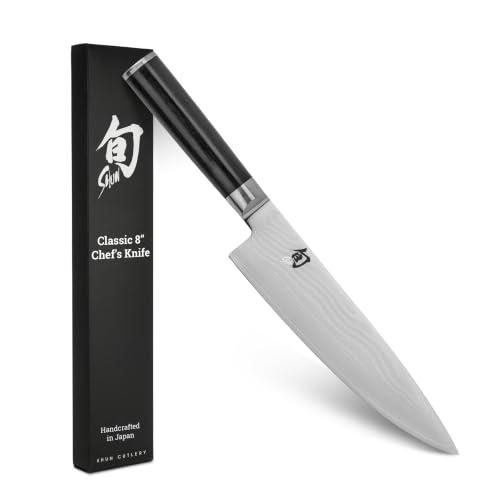 Shun Classic 8" Chef's Knife (DM0706) | A knife you want to look at | 8.3 | |
| 2 | 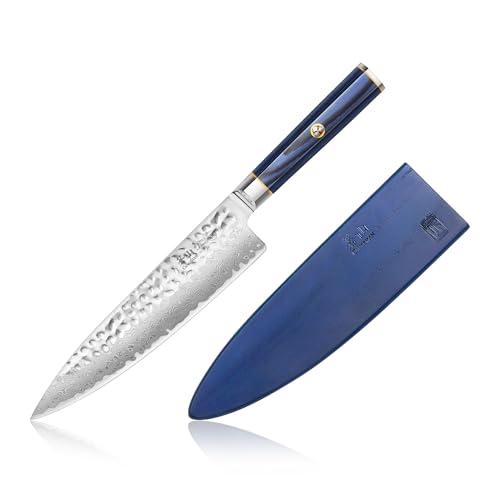 Cangshan KITA 8" Chef's Knife (501387) | A symmetrical, wa-style handle without a Japanese price | 7.7 | |
| 3 | 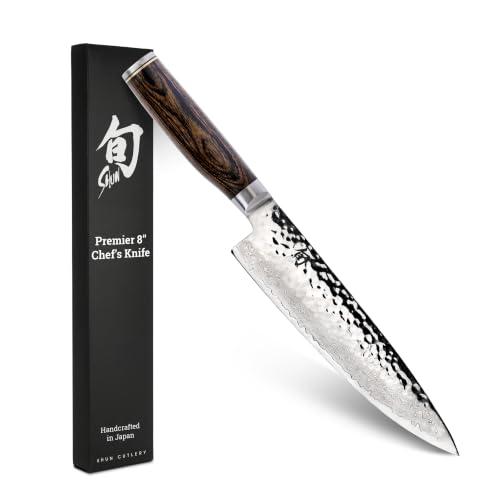 Shun Premier 8" Chef's Knife (TDM0706) | A right- or left-handed cook who wants the Shun edge without a D-handle | 8.2 |
This is a more interesting comparison than it looks, because the usual shape of a Shun-against-a-challenger argument is "cheaper, harder, less documented". That is not what is happening here. The Cangshan is not cheaper by much, its published hardness is in the same bracket, and the thing it actually does better is the part of a knife you hold.
The published numbers
| Shun Classic 8" | Cangshan KITA 8" | |
|---|---|---|
| Blade length | 8 in | 8 in |
| Steel | VG-MAX core, a named alloy | "X-7 proprietary" - no composition published |
| Cladding | 34 Damascus layers each side | 67 laser-welded Damascus layers |
| Hardness | 61 HRC | 61 ± 2 HRC |
| Factory edge | 16° per side | Not published |
| Blade height | Not published | Not published |
| Spine at heel | Not published for the Classic chef's knife | Not published |
| Weight | Not published | Not published |
| Handle | D-shaped pakkawood, stainless bolster and end cap | Octagonal G-10 fiberglass, full tang |
| In the box | Knife | Knife plus a magnetic ash wood saya-style sheath |
| Origin | Seki, Japan | China |
| Warranty | Limited lifetime | Not published on the retailer listing |
Neither maker publishes a spine thickness, a blade height or a weight for these knives, so those rows stay empty rather than filled with an estimate. The Shun Premier - same VG-MAX core, same line's grind - does publish 1.9 mm and 7.5 oz, which is the only reference point available on either side of this table.
The handle is the real decision
The Shun Classic's handle is a D-shape: laminated pakkawood with a stainless bolster and end cap, swelling slightly on one side so it settles into a right-handed pinch grip. It is comfortable, it is well made, and it has a handedness. If you are left handed, or if you swap grip often, you feel it.
The Cangshan's handle is an octagon in G-10 fiberglass over a full tang. That shape is not a styling choice - it is the shape most Japanese knives have used for a century, because an octagon indexes in the hand without telling you which way round to hold it. It works identically in either hand, it does not roll on a board, and the flats give you a reference for where the edge is pointing. For a cook whose complaint is the handle rather than the blade, this is the upgrade.
What G-10 costs you is warmth. It is a hard industrial laminate styled to look like wood, and up close it does not read as wood. It also does not swell, crack, stain or care how long it spent in the sink, which pakkawood eventually will. Our Japanese against Western handles guide works through why the octagonal wa shape behaves differently from a riveted Western handle, and it applies directly here.
A lot of people replace a knife when what they actually dislike is its handle. The blade specifications on this page are close enough that handle shape is the honest tiebreaker: octagonal and symmetrical from Cangshan, D-shaped and right-handed from the Shun Classic, contoured and symmetrical from the Shun Premier. All three cut; only one of them fits whichever hand you hold it in.
61 HRC flat against 61 ± 2
Shun publishes 61 HRC. Cangshan publishes 61 ± 2 HRC. Those look like the same claim and they are not. A ± 2 band spans 59 to 63, and the two ends of it are different knives: at 59 the edge rolls and comes back easily, at 63 it holds longer and chips instead of rolling. You do not get to know which one arrived.
That is not an accusation - a tolerance band is an honest way to describe production spread, and plenty of good makers publish one. It is a reason to prefer the knife with a flat figure when you are paying similar money, because a flat figure is a commitment and a band is a range of outcomes. The same logic applies to the edge angle: Shun publishes 16 degrees per side, Cangshan publishes nothing, so your first sharpening session on the KITA starts with finding out what you have.
What "X-7 Damascus" tells you, and what it does not
Cangshan calls the steel X-7 and publishes 67 laser-welded Damascus layers at 61 ± 2 HRC. What it does not publish is a composition - no carbon figure, no chromium figure, nothing you could line up against a named alloy. So the comparison against VG-MAX cannot be made at the steel level at all; it can only be made at the hardness level, and there the two are in the same bracket.
The 67-against-34 layer count is the headline on the Cangshan listing and it is the least useful number in this comparison. On both knives the pattern lives in soft cladding wrapped around a harder core, and the core does the cutting - more layers do not cut better. Is Damascus steel worth it takes that apart properly, and Shun against Dalstrong runs the same layer-count argument against the other big Damascus challenger.
The saya in the box is worth real money
Cangshan ships the KITA with a magnetic ash wood saya-style sheath. Shun ships the Classic with nothing. That matters more than an accessory usually does, because the most common way a thin, hard edge gets chipped in a home kitchen is loose storage - a blade knocking against other steel in a drawer. A sheath is the cheapest fix for the single most expensive mistake, and it is the reason our storage guide leads on it.
Buying a saya separately is a real line item, so treat the included one as part of the price rather than as packaging. If you are buying the Shun instead, budget for a sheath or a magnetic strip in the same order.
Seki against China, and what that does and does not mean
The Shun Classic is made in Seki, Japan, and says so. The retailer listings for the KITA give the country of origin as China. Cangshan is a US company designing in the US and manufacturing abroad, which is an ordinary arrangement and not a hidden one - it is printed on the listings.
What origin buys you here is not automatically better steel. It is a long, narrow tradition of grinding kitchen knives thin, and a maker whose whole business depends on that reputation. What it does not buy you is immunity from a bad unit, and it does not mean a Chinese-made knife at 61 HRC cannot cut. Judge the knife on what is published, then decide how much the provenance is worth to you - that is a legitimate thing to pay for, and it is most of the gap here.
Sharpening and upkeep
Both are hard stainless blades in the 60-plus bracket and both want stones rather than a grooved steel rod - a ribbed rod is about as hard as the edge and will skate across it instead of correcting it, which is the argument in honing steel against ceramic rod. A fine ceramic rod between stone sessions suits either knife.
The difference is what you start from. The Shun arrives at a published 16 degrees per side, so you match it and keep matching it. The Cangshan publishes no angle, so the sensible move is to set your own at around 15 degrees per side on the first real session and never think about it again - our angle guide covers holding it and how to sharpen a Japanese knife covers the session.
Aftercare is the one place the gap is wide. Kai runs a sharpening service for Shun owners and the Classic carries a limited lifetime warranty. The KITA's retailer listing publishes no warranty term and there is no maker sharpening service in it. On a blade that is possibly running at 63 HRC, where a failure is a chip rather than a roll, that is a difference worth pricing. Both are hand-wash-only knives; the Cangshan listing says so explicitly.
Which one to buy
- Your complaint is the handle. Cangshan KITA. An octagonal, symmetrical G-10 handle at this price is genuinely hard to find, and the saya comes with it.
- You want to know exactly what you bought. Shun Classic. Named steel, flat hardness figure, published angle, stated origin, warranty, sharpening service.
- You are left handed. Not the Shun Classic. The Cangshan is symmetrical, and so is the Shun Premier if you want to stay with Shun - our left-handed guide has the longer list.
- You want the symmetrical handle and the Japanese build. Shun Premier: same VG-MAX core at 60-61 HRC, a contoured symmetrical handle, and the only published geometry anywhere in this comparison at 1.9 mm and 7.5 oz.
- The knife is going into a wet or shared kitchen. Cangshan. G-10 is the more durable handle material by a wide margin, and it does not mind neglect.
The verdict
The Cangshan KITA is a better knife than the usual Amazon Damascus challenger and it competes on the right thing: it has a handle shape the Shun Classic cannot offer, and it includes the accessory most owners end up buying anyway. What it does not give you is a flat hardness figure, a published angle, a named steel, a stated warranty or anywhere to send the knife when you chip it.
Our pick between exactly these two is the Shun Classic, for documentation and aftercare rather than for cutting - but it is a close call, and it flips to the Cangshan the moment you are left handed or the handle is what you disliked about your last knife. The honest third answer is the Shun Premier, which is the only knife here that gives you the symmetrical handle and the published geometry at the same time. The full write-up on the Classic is our Shun Classic review, Classic against Premier settles the in-range question, and our brands guide maps where every maker on this site sits.
Both of these blades sit in the hardness bracket where a soft clay stone starts to glaze over, so the medium stone matters more than it would on a German knife. Our Shapton Glass Stone 1000 review covers the stone we would put either of them on.
The picks in detail
#1 · A knife you want to look at
Shun Classic 8" Chef's Knife (DM0706)
The Damascus-clad knife people actually buy. A 16-degree-per-side VG-MAX edge at 61 HRC, a D-shaped pakkawood handle, and a look that sells itself.
What it does well
- 16 degrees per side is a sensible factory angle — acute, but not so thin it chips on a carrot
- Handle geometry is genuinely comfortable in a pinch grip
- Kai's warranty and free sharpening service are real, useful things
Where it gives way
- You pay a significant premium over a MAC or Tojiro for the Damascus cladding
- The D-shaped handle is oriented for right-handed use
- Thin tip is easy to snap if you twist it in a squash
Skip it if: Left-handed cooks who dislike a D-shaped handle, and anyone who resents paying for 68 layers of cladding that do nothing for cutting.
| Blade length | 8 in |
|---|---|
| Steel | VG-MAX core, 34 layers Damascus cladding each side |
| Hardness | 61 HRC |
| Edge angle | 16 degrees per side |
| Handle | D-shaped pakkawood with stainless bolster and end cap |
| Warranty | Limited lifetime |
#2 · A symmetrical, wa-style handle without a Japanese price
Cangshan KITA 8" Chef's Knife (501387)
A Damascus-clad 61 HRC blade with an octagonal G-10 handle and a magnetic wooden saya in the box, at Shun Classic money. The handle is the reason to buy it and the published hardness is a band rather than a figure.
What it does well
- An octagonal, symmetrical handle at this price is genuinely unusual - it works in either hand and it is the shape most Japanese knives use
- A magnetic wooden saya is included, which is a real accessory most makers charge extra for
- 61 +/- 2 HRC is in the same bracket as the Shun Classic, and the hammered finish is better looking than the price suggests
Where it gives way
- No published edge angle, spine thickness, blade height or weight, so the geometry cannot be checked before it arrives
- The hardness is published as a +/- 2 band, which spans 59 to 63 - two different knives in practice
- G-10 is tough and grippy but has none of the warmth of the wood handle it is styled after
- No maker sharpening service and no warranty figure on the retailer listing, against Kai's limited lifetime cover for Shun
Skip it if: Anyone buying origin. Cangshan is a US brand and its retailers list these knives as made in China - which is fine, and is not the same thing as a Seki blade.
| Blade length | 8 in |
|---|---|
| Steel | X-7 proprietary Damascus, 67 laser-welded layers |
| Hardness | 61 +/- 2 HRC (a band, not a figure) |
| Factory edge | Not published |
| Blade height | Not published |
| Spine at heel | Not published |
| Weight | Not published |
| Handle | Octagonal G-10 fiberglass, full tang, hammered blade finish |
| Included | Deep blue ash wood magnetic saya-style sheath |
| Care | Hand wash only, dry immediately |
| Origin | China |
| Warranty | Not published on the retailer listing |
#3 · A right- or left-handed cook who wants the Shun edge without a D-handle
Shun Premier 8" Chef's Knife (TDM0706)
The same VG-MAX core and 16-degree edge as the Classic, in a thinner blade with a hammered tsuchime face and a contoured walnut handle. You are buying the finish and the grip, not a better cutter.
What it does well
- Contoured symmetrical handle works in either hand, unlike the Classic D-handle
- 1.9 mm spine is thinner than the Classic at the same blade height, so it wedges less
- Hammered face measurably reduces how much wet food clings to the blade
Where it gives way
- List price sits above the Classic for the same steel, hardness and edge angle, though street prices often overlap
- The walnut handle has no bolster, which some cooks read as less secure
- Hammered finish is cosmetic above the first few millimeters of the edge
Skip it if: Anyone chasing cutting performance per dollar. A MAC MTH-80 or a Tojiro DP cuts as well or better for less.
| Blade length | 8 in (200 mm) |
|---|---|
| Blade height | 1.9 in (47 mm) |
| Spine thickness | 1.9 mm |
| Steel | VG-MAX core, 34-layer SUS410/SUS431 Damascus each side |
| Hardness | 60-61 HRC |
| Edge angle | Approximately 16 degrees per side, double bevel |
| Finish | Hammered tsuchime |
| Handle | Contoured walnut PakkaWood, stainless end cap, 5 in |
| Weight | 7.5 oz (215 g) |
| Origin | Seki, Japan |
| Warranty | Limited lifetime |
Common questions
Is Cangshan a Japanese brand?
What is X-7 Damascus steel?
Is the Cangshan as good as the Shun?
Does the included wooden sheath matter?
Which is better for a left-handed cook?
Sources
Read next
Brands
Shun Classic vs Premier
Brands
Shun vs Dalstrong

Steel & Care
Is Damascus Steel Worth It?
Steel & Care