Steel & Care
Is Damascus Steel Worth It?
What this is based on: published manufacturer specifications and retailer listings, cited on each product; the weight of professional and owner reviews across multiple retailers; and hands-on experience sharpening and cooking with knives of this type. We have not individually tested every model listed, we do not run instrumented sharpness testing, and we do not claim a test we did not run.
Quick picks
| # | Product | Best for | Score | Price |
|---|---|---|---|---|
| 1 | Shun Classic 8" Chef's Knife (DM0706) | A knife you want to look at | 8.3 | |
| 2 |  Miyabi Birchwood SG2 8" Chef's Knife | Someone who already sharpens their own | 8.6 | |
| 3 |  Tojiro DP Gyuto 210mm (F-808) | First Japanese knife | 8.6 |
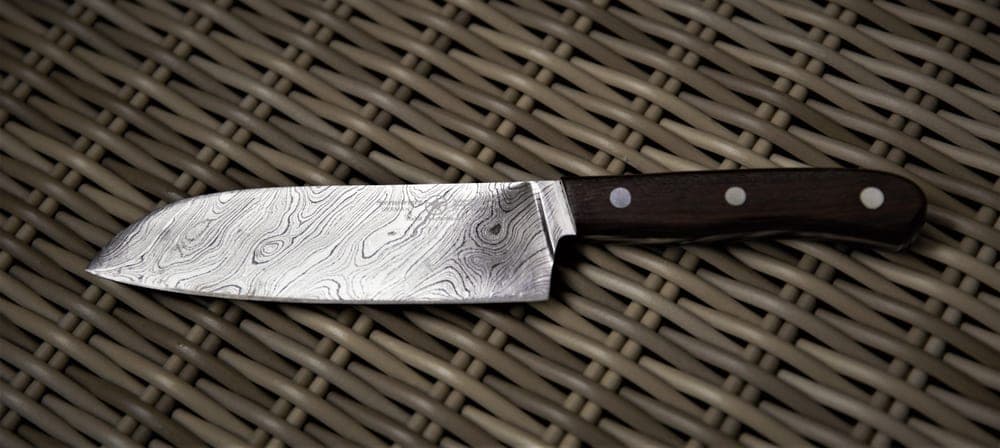
Historical wootz Damascus was a single steel with a visible structure. Everything sold as Damascus in a kitchen shop today is something else: alternating layers of two or more stainless alloys, forge-welded, folded, ground and then acid-etched so the layers show. That laminate is wrapped around a separate, harder core steel in a construction called san mai. Only the core reaches the edge.
How to read a Damascus listing
- Find the core steel. VG-10, VG-MAX, SG2, AUS-10 — a name. If the listing says only "Japanese steel" or "Damascus steel", there is no specification on the page.
- Find the hardness. A real figure, like 61 HRC or 63 HRC, attached to that named steel. An HRC number with no alloy behind it is a marketing figure.
- Ignore the layer count. 34 layers, 67 layers, 101 layers — it is a decorative variable. More layers makes a finer pattern, not a better knife.
- Then look at the grind. Spine thickness and edge angle will tell you more about how the knife cuts than every other line on the listing combined.
Our steel reference has the hardness and retention figures for the common cores, and VG-10 against SG2 is the comparison that separates most Damascus kitchen knives in this price range.
Three knives, two with Damascus and one without
| Knife | Cladding | Core steel | Hardness | Factory edge |
|---|---|---|---|---|
| Shun Classic DM0706 | 34 Damascus layers each side | VG-MAX | 61 HRC | 16 degrees per side |
| Miyabi Birchwood SG2 | 50 Damascus layers each side | SG2 micro-carbide powder steel | 63 HRC, Cryodur | approx. 9.5-12 degrees per side |
| Tojiro DP F-808 | Plain 13-chrome stainless, san mai | VG-10 | 59-60 HRC | Not published |
The Tojiro is in this table on purpose. It is built the same way as the other two — a hard core clad in softer stainless — and the only structural difference is that its cladding is not patterned. It is also, by a wide margin, the cheapest of the three. That price gap is a reasonable measure of what the pattern costs.
When Damascus is worth paying for
- When you want to look at the knife. This is a legitimate reason and we are not going to pretend otherwise. A knife you enjoy picking up is a knife you use, and a knife you use is a knife you maintain.
- When the Damascus knife is simply the better knife. The Miyabi's SG2 core at 63 HRC genuinely outperforms VG-10 on edge retention. You are buying the core and the pattern comes with it. How that retention compares.
- When the brand's service matters. Kai's lifetime warranty and sharpening service on the Shun Classic are real, useful things, and they come attached to the Damascus line rather than to a plainer one.
A heavily patterned, very cheap knife with no named core steel is the single most common trap in this category. The pattern is the cheapest part of the knife to fake and the easiest thing to photograph. If a listing leads with layers and never names a steel, assume the core is unremarkable stainless — and that you cannot sharpen what you cannot identify.
The verdict
Damascus is good when the knife underneath it is good. Buy the Shun Classic if you want the Damascus look with a sensible 16-degree VG-MAX edge and a real warranty. Buy the Miyabi Birchwood if you want the hardest core we recommend and you already sharpen on a hard stone. Buy the Tojiro DP if you would rather put the pattern premium into a stone — which, for most readers, is the better-spent money.
The picks in detail
#1 · A knife you want to look at
Shun Classic 8" Chef's Knife (DM0706)
The Damascus-clad knife people actually buy. A 16-degree-per-side VG-MAX edge at 61 HRC, a D-shaped pakkawood handle, and a look that sells itself.
What it does well
- 16 degrees per side is a sensible factory angle — acute, but not so thin it chips on a carrot
- Handle geometry is genuinely comfortable in a pinch grip
- Kai's warranty and free sharpening service are real, useful things
Where it gives way
- You pay a significant premium over a MAC or Tojiro for the Damascus cladding
- The D-shaped handle is oriented for right-handed use
- Thin tip is easy to snap if you twist it in a squash
Skip it if: Left-handed cooks who dislike a D-shaped handle, and anyone who resents paying for 68 layers of cladding that do nothing for cutting.
| Blade length | 8 in |
|---|---|
| Steel | VG-MAX core, 34 layers Damascus cladding each side |
| Hardness | 61 HRC |
| Edge angle | 16 degrees per side |
| Handle | D-shaped pakkawood with stainless bolster and end cap |
| Warranty | Limited lifetime |
#2 · Someone who already sharpens their own
Miyabi Birchwood SG2 8" Chef's Knife
SG2 powder steel at 63 HRC behind a 9.5-to-12-degree edge and 101 layers of Damascus. The sharpest knife here out of the box, and the least forgiving.
What it does well
- 63 HRC SG2 holds an edge appreciably longer than VG-10 at 60 — commonly cited as roughly twice as long
- A sub-12-degree factory edge is genuinely rare and it shows on the first cut
- 178 g with a 2.1 mm spine — light and thin for a Damascus-clad knife
Where it gives way
- 63 HRC and a very acute edge is a chipping risk on any hard board
- Powder steel is slow on a soft clay stone; you want a hard stone or diamond
- Costs several times what a Tojiro DP does
Skip it if: A first Japanese knife. At 63 HRC with an edge under 12 degrees per side it will chip on a hard board or a careless twist, and it is slow to sharpen on a soft stone.
| Blade length | 8 in |
|---|---|
| Steel | SG2 micro-carbide powder steel core, 50 Damascus layers each side |
| Hardness | 63 HRC, Cryodur ice-hardened |
| Edge angle | approx. 9.5-12 degrees per side, double bevel |
| Blade height | 1.75 in |
| Spine at heel | 2.1 mm |
| Weight | 6.2 oz (178 g) |
| Handle | Karelian birch with stainless bolster and mosaic pin |
| Origin | Seki, Japan |
#3 · First Japanese knife
Tojiro DP Gyuto 210mm (F-808)
The default answer to 'my first real Japanese knife'. VG-10 at around 60 HRC in a plain three-layer build, at a price that makes the inevitable first chip survivable.
What it does well
- VG-10 at 59-60 HRC takes a genuinely fine edge and holds it far longer than a German knife at 56-58
- 1.9 mm spine and 43 mm heel make it thin behind the edge without being fragile
- Cheap enough that learning to sharpen on it is not frightening
Where it gives way
- Handle finish is functional and unlovely; some units need the bolster easing with sandpaper
- Stainless cladding is soft and scratches readily
- Nothing about the fit and finish will impress anyone
Skip it if: Anyone who wants the knife to be beautiful. The handle is a workmanlike composite with a stainless bolster and nothing about it is charming.
| Blade length | 210 mm (8.3 in) |
|---|---|
| Steel | VG-10 core, 13-chrome stainless cladding (san mai) |
| Hardness | 59-60 HRC |
| Heel height | 43 mm |
| Spine at heel | 1.9 mm |
| Weight | approx. 187 g |
| Handle | Western, laminated composite wood with stainless bolster |
Common questions
Is Damascus steel good for kitchen knives?
Does Damascus cladding make a knife stronger?
How can I tell if Damascus is real?
Is a Damascus knife harder to sharpen?
Sources
Read next
Steel & Care
Knife Steel Guide
Steel & Care
VG-10 vs SG2 Steel
Japanese Knives
Best Chef Knives for Edge Retention
Steel & Care
Carbon vs Stainless Kitchen Knives
Japanese Knives