Sharpeners
Honing Steel vs Ceramic Rod
What this is based on: published manufacturer specifications and retailer listings, cited on each product; the weight of professional and owner reviews across multiple retailers; and hands-on experience sharpening and cooking with knives of this type. We have not individually tested every model listed, we do not run instrumented sharpness testing, and we do not claim a test we did not run.
Quick picks
| # | Product | Best for | Score | Price |
|---|---|---|---|---|
| 1 | 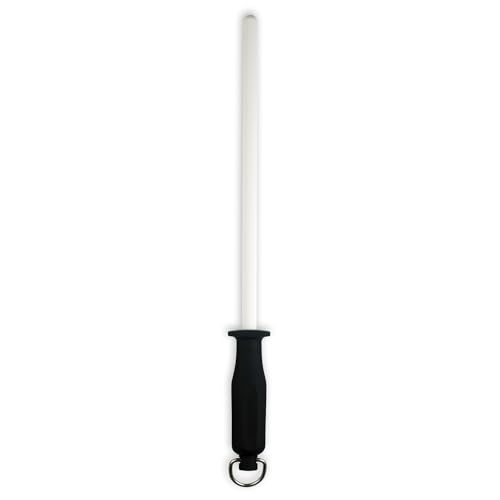 Messermeister 12" Fine Ceramic Sharpening Rod (CR-12F) | Maintaining a hard Japanese edge between sharpenings | 8.8 | |
| 2 | 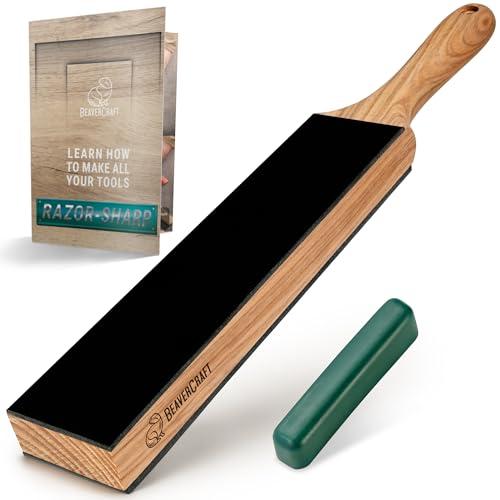 BeaverCraft LS6P1 Leather Strop & Compound Kit | Finishing after the stones | 8.0 | |
| 3 | 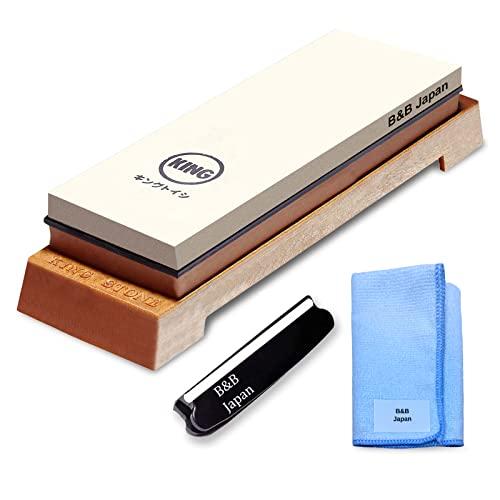 King 1000/6000 Combination Whetstone (Starter Set) | Your first stone | 8.4 |
This is one of the few decisions in the kitchen that comes down to a single number. A honing rod does not sharpen; it pushes a rolled edge back into line, and to do that it has to be harder than the steel it is pushing. Everything else - grooves, length, grit, handle - is secondary to that one requirement.
The hardness rule, in numbers
| Rod type | Relative hardness | What it does to the edge | Right for |
|---|---|---|---|
| Grooved steel | approx. 58-60 HRC | Burnishes and realigns soft steel | German knives at 56-58 HRC |
| Fine ceramic | Harder than any kitchen blade | Realigns and removes a trace of steel | Japanese knives at 60-64 HRC |
| Diamond | Hardest of the three | Cuts - removes real steel | Occasional fast touch-up, not daily use |
| Leather strop | Softer than everything | Deburrs and polishes the apex | Finishing after stones |
Read that table against your own drawer. A Wüsthof Classic at 58 HRC is exactly what a grooved steel rod was designed for, and that pairing works - it is why German knives have always shipped with one. A Shun Classic at 61 HRC or a Miyabi at 63 is a different problem, and the rod that came with the block set is the wrong tool for it.
Why fine ceramic is the default above 60 HRC
Ceramic rods are described in the published guides as being substantially harder than even the hardest Japanese blade, and the useful ones are fine rather than coarse - roughly 1000 to 1500 grit, which removes just enough material to clean up a rolled or slightly damaged apex without touching the geometry behind it. The Messermeister CR-12F is a fine 1200 grit rod, which the manufacturer's specification puts at around 3500 on the Japanese scale, on 12 inches of rod and 18.25 inches overall.
Length is worth a thought. A 12 inch rod takes a 240 mm gyuto in one stroke; a 10 inch rod makes you do it in two, and the second stroke is where most people change angle. The cost of the longer rod is that it will not fit some drawers, and ceramic has one real vulnerability - it is brittle. One hard knock on a stone worktop and you own two pieces of a rod.
A rod works at light pressure and a consistent angle, five or six strokes a side. The failure mode with hard Japanese steel is force: people press because the knife is actually dull and honing cannot fix dull, and a hard edge under force micro-chips. If a rod is not producing a result in six light strokes, the knife needs a stone, not more pressure.
Where diamond rods fit, and where they do not
A diamond rod cuts. That makes it fast and makes it the wrong thing to reach for every evening, because a tool that removes steel used daily is a tool that reprofiles your bevel over a year. There is a sensible use for one - a quick recovery on a knife that has gone past honing but that you do not want to set up stones for - but it is an occasional tool, not a maintenance habit.
The strop sits at the opposite end. Leather with compound removes almost no steel and is unmatched at taking off the burr a finishing stone leaves behind, which is why it is a finishing step rather than a replacement for a rod. Our rod against strop comparison sets out which jobs belong to which.
Honing is not sharpening, and the distinction is practical
A rod realigns an edge that is still there. A stone makes a new one. If you hone twice a week a good Japanese knife will go a surprisingly long time between sharpenings, and if you never hone you will be on the stones far more often than you need to be. Neither habit substitutes for the other, which is the argument in sharpening against honing.
The technique for a hard Japanese edge is also not the technique in the knife-block instruction leaflet: lighter, slower, fewer strokes, and the same angle you sharpen at rather than whatever feels natural. We cover it step by step in how to hone a Japanese knife.
What to buy
- Japanese knives, 60 HRC and up. A fine ceramic rod. The Messermeister CR-12F at 1200 grit and 12 inches is the pick here.
- German knives at 56-58 HRC. The grooved steel rod you already own is correct. Spend the money on a board instead.
- You finish on stones and want more from the edge. The leather strop and compound - it removes the burr a rod cannot.
- Honing has stopped working. That is a sharpening problem. A 1000/6000 combination stone is the next purchase, not another rod.
The verdict
Ceramic for Japanese steel, steel for German steel, diamond for occasional rescue, leather for finishing. The reason the question gets asked at all is that most people inherit a rod with a knife block and assume one rod suits every knife - and then conclude honing does not work when the real problem is that their rod is softer than their blade. Our honing rod roundup ranks the options, and rod against whetstone covers when to stop honing and start sharpening.
The picks in detail
#1 · Maintaining a hard Japanese edge between sharpenings
Messermeister 12" Fine Ceramic Sharpening Rod (CR-12F)
The honing rod that is actually harder than your knife. Fine 1200-grit ceramic, which is roughly 3000-3500 on the Japanese scale.
What it does well
- Ceramic is harder than the steel in a 60+ HRC Japanese knife; a steel rod often is not
- 1200 grit realigns without removing meaningful steel
- 12 in of rod handles a 240 mm gyuto in one pass
Where it gives way
- Ceramic is brittle — one hard knock on a stone counter and it is done
- Removes so little steel that it cannot rescue a truly dull knife
- 12 in is longer than some drawers
Skip it if: Anyone who bangs the rod on the counter. Ceramic chips; steel does not.
| Rod length | 12 in |
|---|---|
| Overall length | 18.25 in |
| Grit | Fine, 1200 grit (approx. 3500 JIS) |
| Material | Ceramic abrasive over a ceramic core |
| Handle | Soft-grip ABS with a metal hang ring |
| Weight | 8.2 oz (235 g) |
| Origin | Made in China |
#2 · Finishing after the stones
BeaverCraft LS6P1 Leather Strop & Compound Kit
Leather and abrasive that removes the burr your finishing stone left behind. The cheapest real improvement in this whole category.
What it does well
- Turns a good stone edge into a noticeably better one in two minutes
- Extends the interval between full sharpenings
- Costs less than almost anything else in the kitchen
Where it gives way
- Easy to round the edge over if you lift the spine
- Does nothing for a genuinely dull knife
- Leather needs re-charging with compound periodically
Skip it if: Sharpening. A strop refines and deburrs; it removes almost no steel and will not fix a dull knife.
| Function | Burr removal and edge refinement |
|---|---|
| Format | 14 in double-sided leather strop block, compound included |
| Direction | Edge-trailing strokes only |
#3 · Your first stone
King 1000/6000 Combination Whetstone (Starter Set)
The stone almost everyone learns on. Soft, forgiving, cheap, and it tells you loudly when your angle wanders.
What it does well
- Two useful grits in one block for the price of half a premium stone
- Soft binder builds slurry readily, which gives beginners real feedback
- Almost impossible to damage a knife on it
Where it gives way
- Dishes quickly and needs flattening often
- The soak is a real commitment — you cannot sharpen on a whim
- Slow on hard powder steels like SG2
Skip it if: Impatient people. The 1000 side wants a 10-15 minute soak before every session and the clay binder dishes fast.
| Grits | #1000 / #6000, combination |
|---|---|
| Binder | Clay |
| Soaking | #1000 side: 10-15 minutes. #6000 side: splash only |
| Size | 207 x 66 x 36 mm |
| Weight | approx. 956 g |
| In the box | Stone, plastic base, angle holder and wiping cloth |
Common questions
Is a ceramic rod better than a honing steel?
What grit should a ceramic honing rod be?
Will a ceramic rod chip my knife?
Should I buy a diamond rod instead?
Sources
Read next
Sharpeners
Best Honing Rods
Sharpeners
Honing Rod vs Whetstone
Sharpeners
Honing Rod vs Strop
Whetstones & Skill
Sharpening vs Honing
Whetstones & Skill
How to Hone a Japanese Knife
Whetstones & Skill