Sharpeners
Honing Rod vs Strop
What this is based on: published manufacturer specifications and retailer listings, cited on each product; the weight of professional and owner reviews across multiple retailers; and hands-on experience sharpening and cooking with knives of this type. We have not individually tested every model listed, we do not run instrumented sharpness testing, and we do not claim a test we did not run.
Quick picks
| # | Product | Best for | Score | Price |
|---|---|---|---|---|
| 1 | 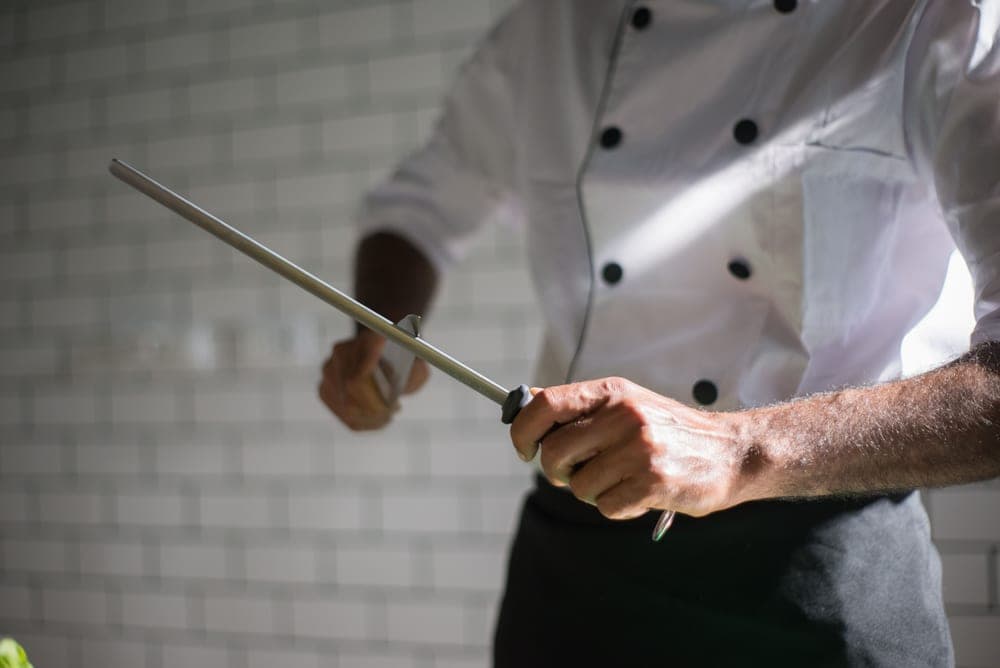 Idahone Fine Ceramic Honing Rod, 12" | Maintaining a hard Japanese edge between sharpenings | 8.8 | |
| 2 | Leather Bench Strop with Stropping Compound | Finishing after the stones | 8.0 | |
| 3 |  Naniwa Professional (Chosera) 1000 | The one stone to own if you only own one | 8.6 |
Both tools exist because a knife edge is thinner than it looks. The last few microns of steel at the apex fold sideways under lateral load long before they actually wear away, which is why a knife can feel dull on Thursday and be perfectly sharp again after thirty seconds of attention. A rod and a strop are two ways of attending to that micron-scale steel, from opposite directions.
What each one actually does
- A honing rod aligns. You draw the bevel along a hard rod at the sharpening angle and the folded steel is pushed back upright. A smooth or fine ceramic rod also removes a trace of metal, which is why ceramic works where a ribbed steel rod sometimes simply skates: the Idahone is 1200 ANSI alumina, roughly 3500 on the Japanese scale, and genuinely harder than a 61 HRC blade.
- A strop deburrs and refines. Sharpening on a stone leaves a wire edge — a fringe of weakened steel hanging off the apex. It feels extremely sharp for about one onion and then falls off, taking some of your new edge with it. Twenty edge-trailing passes on leather charged with roughly 0.5 micron compound removes that fringe and polishes what is behind it.
- Neither sharpens. A rod removes a trace of steel and a strop removes less. If the edge has actually worn round, both will fail and you need a stone — the distinction is laid out in sharpening versus honing.
Side by side
| Honing rod (fine ceramic) | Leather strop with compound | |
|---|---|---|
| Primary job | Straighten a rolled apex | Remove the burr, polish the apex |
| When you use it | Every few uses, before cooking | Immediately after sharpening |
| Time | approx. 30 seconds | 1-2 minutes |
| Abrasive | 1200 ANSI alumina ceramic (approx. 3500 JIS) | approx. 0.5 micron chromium oxide |
| Stroke direction | Either, at the sharpening angle | Edge-trailing only |
| Main risk | Chipping the ceramic rod itself on a hard counter | Rounding the edge by lifting the spine |
| Our score | 8.8 overall | 8.0 overall |
Which to buy first
- You sharpen rarely and your knives feel dull mid-week. Rod. That is a rolled edge, and thirty seconds fixes it. The Idahone at 12 inches handles a 240 mm gyuto comfortably; the shorter rods that ship with block sets do not.
- You have just started using a whetstone. Strop. The most common reason a newly sharpened knife feels worse after two days is that the burr tore off. Stropping is the fix, and the first time you feel the difference it is obvious.
- Your knives are 56-58 HRC German stainless. Rod, and use it often. Soft steel rolls more readily, which is exactly the condition a rod addresses — and why German knives traditionally come with one.
- Your knives are 63 HRC powder steel. Strop, carefully, and go easy on the rod. Very hard steel chips rather than folding, so there is less rolling to correct, and an aggressive rod stroke on a brittle apex can take a flake out.
The rod that came with your German block set is ribbed, and a ribbed steel rod works by catching the edge and bending it. At 56 HRC that realigns. At 61 HRC and above, on a thin 15-degree bevel, the ribs can take small bites out of the apex instead. Fine ceramic is the right material here — the options are in our honing rod roundup.
Why most kitchens end up with both
A full sharpening cycle in a working kitchen looks like this: stone when the edge no longer bites, strop immediately afterwards to clean up the burr, then rod every few uses for the next two or three weeks until the rod stops helping. At that point the steel really has worn and you go back to the stone. The rod stretches the interval between stone sessions, the strop makes each stone session last longer, and the stone is the only one of the three that creates a new edge.
Which is why the third pick on this page is a stone. Neither a rod nor a strop is a substitute for one, and a kitchen with both and no stone eventually has a drawer full of knives that cannot be rescued by either. The frequency question — how often to sharpen — is the companion to this one.
The verdict
Rod for maintenance, strop for finishing, stone for sharpening. If you own a stone and no strop, buy the strop — it is the cheapest upgrade in this category and it fixes a problem you probably have without knowing it. If you own neither and your knives feel dull after a week, buy a 12 inch fine ceramic rod first.
The picks in detail
#1 · Maintaining a hard Japanese edge between sharpenings
Idahone Fine Ceramic Honing Rod, 12"
The honing rod that is actually harder than your knife. 1200 ANSI alumina ceramic, which is roughly 3000-3500 on the Japanese scale.
What it does well
- Ceramic is harder than the steel in a 60+ HRC Japanese knife; a steel rod often is not
- 1200 ANSI realigns without removing meaningful steel
- High-alumina body resists the grooving that ruins cheaper rods
Where it gives way
- Ceramic is brittle — one hard knock on a stone counter and it is done
- Removes so little steel that it cannot rescue a truly dull knife
- 12 in is longer than some drawers
Skip it if: Anyone who bangs the rod on the counter. Ceramic chips; steel does not.
| Rod length | 12 in (30.5 cm) |
|---|---|
| Rod diameter | 1/2 in (12.7 mm) |
| Overall length | 17.5 in (44.5 cm) |
| Grit | Fine, 1200 ANSI (approx. 3500 JIS) |
| Material | High-alumina ceramic |
| Handle | Hard rock maple, 5.25 in |
| Origin | Made in the USA |
#2 · Finishing after the stones
Leather Bench Strop with Stropping Compound
Ten dollars of leather and abrasive that removes the burr your finishing stone left behind. The cheapest real improvement in this whole category.
What it does well
- Turns a good stone edge into a noticeably better one in two minutes
- Extends the interval between full sharpenings
- Costs less than almost anything else in the kitchen
Where it gives way
- Easy to round the edge over if you lift the spine
- Does nothing for a genuinely dull knife
- Leather needs re-charging with compound periodically
Skip it if: Sharpening. A strop refines and deburrs; it removes almost no steel and will not fix a dull knife.
| Function | Burr removal and edge refinement |
|---|---|
| Compound | Typically chromium oxide, roughly 0.5 micron |
| Direction | Edge-trailing strokes only |
#3 · The one stone to own if you only own one
Naniwa Professional (Chosera) 1000
The stone that does the most with one grit. Hard enough to dish slowly, soft enough to raise a slurry that tells you what the edge is doing.
What it does well
- Splash and go, but still builds a rich, informative slurry
- Fast enough to reset a dull edge, refined enough to finish on
- 20 mm of abrasive — years of use before it is spent
Where it gives way
- Expensive for a single grit
- Magnesia binder does not like being stored wet
- You will still want a finishing stone eventually
Skip it if: A tight budget. It costs more than a combination stone and gives you one grit.
| Grit | 1000 |
|---|---|
| Size | 210 x 70 x 20 mm |
| Soaking | Splash and go |
| Binder | Magnesia |
Common questions
What is the difference between a honing rod and a strop?
Should I use a honing rod or a strop on a Japanese knife?
Can a strop replace a honing rod?
Does honing remove metal?
Sources
Read next
Sharpeners
Honing Rod vs Whetstone
Sharpeners
Best Honing Rods
Whetstones & Skill
How to Strop a Knife
Whetstones & Skill
Best Strops for Kitchen Knives
Whetstones & Skill
Sharpening vs Honing
Whetstones & Skill