Brands
Miyabi Birchwood SG2 Review
What this is based on: published manufacturer specifications and retailer listings, cited on each product; the weight of professional and owner reviews across multiple retailers; and hands-on experience sharpening and cooking with knives of this type. We have not individually tested every model listed, we do not run instrumented sharpness testing, and we do not claim a test we did not run.
Quick picks
| # | Product | Best for | Score | Price |
|---|---|---|---|---|
| 1 | 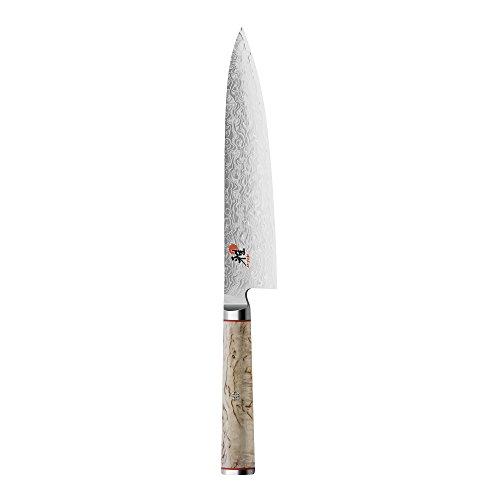 Miyabi Birchwood SG2 8" Chef's Knife | Someone who already sharpens their own | 8.6 | |
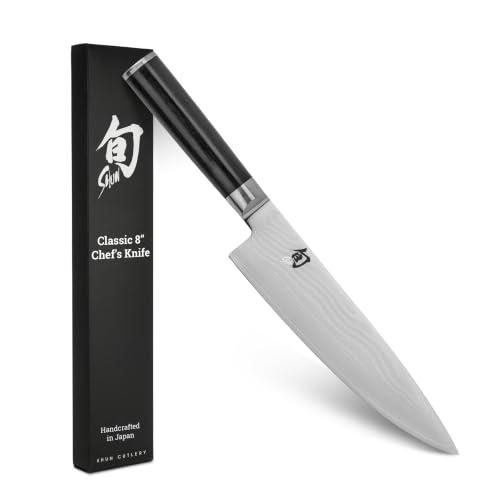
| 2 | 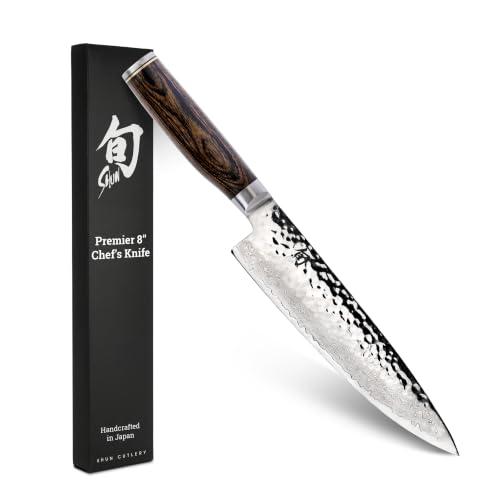 Shun Premier 8" Chef's Knife (TDM0706) | A right- or left-handed cook who wants the Shun edge without a D-handle | 8.2 | |
| 3 | 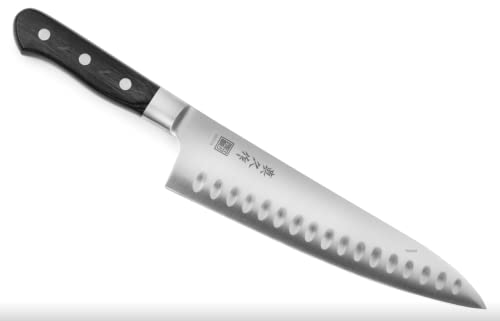 MAC Professional 8" Chef's Knife with Dimples (MTH-80) | The one-knife kitchen | 8.8 |
Almost nobody arrives at this knife without owning something already, so the useful review is not whether it is good - the published figures settle that - but what the specification commits you to. Everything below is read from Miyabi's published specifications and the registry's own sourcing; how we select and score picks is set out at our methodology page, and this site does not run instrumented sharpness testing and does not claim to.
| Miyabi Birchwood SG2 8" | |
|---|---|
| Blade length | 8 in |
| Core steel | SG2 micro-carbide powder steel |
| Cladding | 50 Damascus layers each side (101 total) |
| Hardness | 63 HRC, Cryodur ice-hardened |
| Edge angle | approx. 9.5-12° per side, double bevel |
| Blade height | 1.75 in |
| Spine at heel | 2.1 mm |
| Weight | 6.2 oz (178 g) |
| Handle | Karelian birch, stainless bolster, mosaic pin |
| Origin | Seki, Japan |
The steel is the whole product
SG2 is made differently from the stainless in every other knife at this price. The steel is atomized and sintered rather than conventionally melted, so its carbides are small and evenly distributed instead of clumped. That structure is what lets Miyabi run the core at 63 HRC and grind the bevel under 12 degrees per side without the apex crumbling - a conventionally melted steel at the same hardness could not hold that geometry.
Specialist retailers commonly describe SG2 at 63 HRC as holding an edge roughly twice as long as VG-10 at 60. We are quoting that figure rather than measuring it, and the multiple will depend entirely on your board, your food and your technique. The direction is not in dispute, and our VG-10 against SG2 page works through the metallurgy properly.
Two points of hardness and three degrees of bevel sound like fine print. On the first cut they are not. A sub-12-degree edge at 63 HRC passes through tomato skin with no pressure at all, and it is still doing that weeks after a VG-10 blade has started asking for a stone. This is the one knife on the site where the cutting performance is genuinely a step change rather than a refinement.
What that edge costs you
There is very little steel behind the apex. That is not a manufacturing flaw, it is the published geometry, and it has consequences you should accept before buying rather than discover afterwards.
- Boards. Glass, granite, bamboo and hard composite will chip it. End-grain wood or soft rubber is a condition of ownership, not a nicety - see our board picks.
- Technique. Twisting through a dense squash, levering a chicken joint, or scraping the board with the edge rather than the spine will all take a chip out. The failure mode is chipping, not rolling, and why knives chip covers the causes in order.
- Other people. A shared kitchen is the most common way this knife gets damaged. A dishwasher rack will do it in one cycle.
- Stones. Powder steel is slow on a soft clay stone - the carbides resist it and the stone dishes while you work. A hard non-absorbent stone or a diamond plate is the right pairing, and our whetstone picks for Japanese knives flag which suit hard steels.
The real cost of this knife is the knife plus a stone that can sharpen it. A Miyabi owner working a 63 HRC powder core on a soft combination stone will conclude SG2 is impossible to sharpen, when the actual problem is the stone. Plan the pair together, and read which whetstone makers suit hard steels before you order.
In the hand: light, thin, and handsome
178 g and a 2.1 mm spine put this among the lighter 8-inch knives we cover - for comparison, the Shun Premier publishes 215 g and a 1.9 mm spine, and the Wüsthof Classic 265 g on 3 mm. Blade height is 1.75 in, which is enough knuckle clearance for most hands but not generous; if you have large hands, our big-hands roundup is the better starting point.
The handle is the part people buy with their eyes. Karelian birch with a stainless bolster and a mosaic pin is a different class of object from a riveted composite scale, and it is one of very few production handles that look genuinely special. It is also real wood: hand wash, dry immediately, wipe it with oil occasionally. If you want a knife you can be careless with, the handle alone rules this out before the steel does.
What to buy instead, and when
Three honest off-ramps, all of which we would recommend over the Birchwood to the wrong buyer.
- You want the beauty and most of the retention, with far less chip risk. Shun Premier 8 inch: VG-MAX at 60-61 HRC, roughly 16 degrees per side, 1.9 mm spine, a hammered tsuchime finish and a symmetrical contoured handle that works in either hand. See Shun against Miyabi.
- You want one knife for hard daily use. MAC Professional MTH-80: 61 HRC at a flat 15 degrees per side, 2.5 mm spine, 6.8 oz, and a Pakkawood handle that behaves with wet hands. MAC against Miyabi compares them directly.
- This would be your first Japanese knife. Buy a Tojiro DP gyuto instead and learn to sharpen on it - Tojiro against Miyabi sets out exactly what the price gap buys and what it does not.
The price band it competes in
This knife sits above every price band this site normally recommends from, and that is worth stating plainly rather than dressing up. Cutting performance on a chef's knife flattens out well below what the Birchwood costs - the argument is laid out in how much to spend on a chef knife - and the money above that band buys edge retention, fit, finish and the pleasure of owning the object. Those are real things. They are not the same thing as cutting better.
Within the SG2 family, the Birchwood is the dress version. The same powder core appears in Miyabi's other lines with plainer handles and less ornamentation, and the cutting steel is the same steel. If the handle is what you are paying for, pay for it knowingly; if it is not, a plainer SG2 knife delivers the identical edge for less. And if you want to know what the tier below delivers, our best gyuto under $300 roundup covers the band where most of this site's readers should actually be shopping.
Living with it
Three habits make this knife last and all three are non-negotiable rather than nice-to-have. Store it where the edge and the point cannot touch anything - a saya, a magnetic rack or a knife roll, never loose in a drawer, because a thin tip at 63 HRC breaks rather than bends. Wash and dry it by hand the moment you finish with it, both for the birch handle and because a dishwasher rack is the single most common way knives like this get chipped. And hone it on a fine ceramic rod, not a grooved steel one: published honing guidance puts most steel rods below the hardness of a Japanese blade, and this is the hardest blade we cover.
Keep the pressure light whenever the rod or the stone is involved. The failure mode on hard powder steel is always force - people press because they expect a result and the edge micro-chips instead. Six light strokes a side on the rod, then a test cut; how to hone a Japanese knife gives the routine, and our storage guide covers the options for keeping the tip intact.
Done that way, SG2 at 63 HRC rewards you with the longest interval between sharpenings of anything on this site. Done carelessly, it is the most expensive chip in the drawer. There is not much middle ground, which is really the whole review.
The verdict
The Miyabi Birchwood SG2 is an excellent knife with a narrow brief. 63 HRC powder steel behind a bevel under 12 degrees per side is the best cutting specification on this site, and it is only a good purchase if you already own the stone to maintain it and the board to protect it. Meet those two conditions and nothing here cuts better. Miss either and you will own a chipped knife and a grievance - in which case the Shun Premier or the MAC MTH-80 is the knife you actually wanted. Our edge retention roundup ranks it against everything else on the one axis it wins outright.
The picks in detail
#1 · Someone who already sharpens their own
Miyabi Birchwood SG2 8" Chef's Knife
SG2 powder steel at 63 HRC behind a 9.5-to-12-degree edge and 101 layers of Damascus. The sharpest knife here out of the box, and the least forgiving.
What it does well
- 63 HRC SG2 holds an edge appreciably longer than VG-10 at 60 — commonly cited as roughly twice as long
- A sub-12-degree factory edge is genuinely rare and it shows on the first cut
- 178 g with a 2.1 mm spine — light and thin for a Damascus-clad knife
Where it gives way
- 63 HRC and a very acute edge is a chipping risk on any hard board
- Powder steel is slow on a soft clay stone; you want a hard stone or diamond
- Costs several times what a Tojiro DP does
Skip it if: A first Japanese knife. At 63 HRC with an edge under 12 degrees per side it will chip on a hard board or a careless twist, and it is slow to sharpen on a soft stone.
| Blade length | 8 in |
|---|---|
| Steel | SG2 micro-carbide powder steel core, 50 Damascus layers each side |
| Hardness | 63 HRC, Cryodur ice-hardened |
| Edge angle | approx. 9.5-12 degrees per side, double bevel |
| Blade height | 1.75 in |
| Spine at heel | 2.1 mm |
| Weight | 6.2 oz (178 g) |
| Handle | Karelian birch with stainless bolster and mosaic pin |
| Origin | Seki, Japan |
#2 · A right- or left-handed cook who wants the Shun edge without a D-handle
Shun Premier 8" Chef's Knife (TDM0706)
The same VG-MAX core and 16-degree edge as the Classic, in a thinner blade with a hammered tsuchime face and a contoured walnut handle. You are buying the finish and the grip, not a better cutter.
What it does well
- Contoured symmetrical handle works in either hand, unlike the Classic D-handle
- 1.9 mm spine is thinner than the Classic at the same blade height, so it wedges less
- Hammered face measurably reduces how much wet food clings to the blade
Where it gives way
- List price sits above the Classic for the same steel, hardness and edge angle, though street prices often overlap
- The walnut handle has no bolster, which some cooks read as less secure
- Hammered finish is cosmetic above the first few millimeters of the edge
Skip it if: Anyone chasing cutting performance per dollar. A MAC MTH-80 or a Tojiro DP cuts as well or better for less.
| Blade length | 8 in (200 mm) |
|---|---|
| Blade height | 1.9 in (47 mm) |
| Spine thickness | 1.9 mm |
| Steel | VG-MAX core, 34-layer SUS410/SUS431 Damascus each side |
| Hardness | 60-61 HRC |
| Edge angle | Approximately 16 degrees per side, double bevel |
| Finish | Hammered tsuchime |
| Handle | Contoured walnut PakkaWood, stainless end cap, 5 in |
| Weight | 7.5 oz (215 g) |
| Origin | Seki, Japan |
| Warranty | Limited lifetime |
#3 · The one-knife kitchen
MAC Professional 8" Chef's Knife with Dimples (MTH-80)
The knife that wins the most side-by-side tests and asks the least of you. Thin, light, 61 HRC, and forgiving enough that a mediocre sharpening job still cuts well.
What it does well
- 6.8 oz with a 2.5 mm spine — genuinely light in the hand over a long prep session
- 15 degrees per side from the factory, which is the angle you will maintain anyway
- 25-year warranty and a reputation for consistency unit to unit
Where it gives way
- Costs meaningfully more than a Tojiro DP for a similar hardness
- Mono-steel, so no cladding to protect the core if you drop it edge-first
- The dimples do less for release than the marketing implies
Skip it if: Anyone chasing maximum edge retention. At 61 HRC in a mono-steel it will not out-last a powder-steel blade, and the dimples are cosmetic more often than useful.
| Blade length | 8 in (approx. 200 mm) |
|---|---|
| Steel | Sub-zero tempered high-carbon molybdenum vanadium alloy |
| Hardness | 61 HRC |
| Edge angle | 15 degrees per side (double bevel) |
| Blade height | 1 7/8 in |
| Spine at heel | 2.5 mm |
| Weight | 6.8 oz |
| Handle | Riveted Pakkawood with integrated bolster |
Common questions
Is the Miyabi Birchwood SG2 worth it?
What steel is the Miyabi Birchwood?
Does the Miyabi Birchwood chip easily?
How do you sharpen SG2 steel?
Is the Birchwood handle practical?
Sources
Read next
Brands
Shun vs Miyabi
Brands
MAC vs Miyabi

Brands
Tojiro vs Miyabi
Steel & Care
VG-10 vs SG2 Steel
Japanese Knives
Best Chef Knives for Edge Retention
Japanese Knives