Brands
Tojiro vs Miyabi
What this is based on: published manufacturer specifications and retailer listings, cited on each product; the weight of professional and owner reviews across multiple retailers; and hands-on experience sharpening and cooking with knives of this type. We have not individually tested every model listed, we do not run instrumented sharpness testing, and we do not claim a test we did not run.
Quick picks
| # | Product | Best for | Score | Price |
|---|---|---|---|---|
| 1 |  Tojiro DP Gyuto 210mm (F-808) | First Japanese knife | 8.6 | |
| 2 | 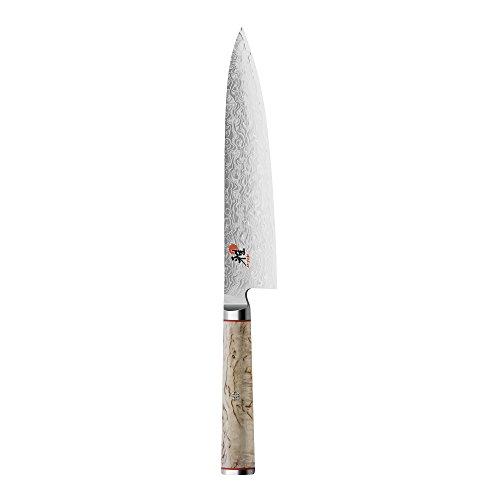 Miyabi Birchwood SG2 8" Chef's Knife | Someone who already sharpens their own | 8.6 | |
| 3 | 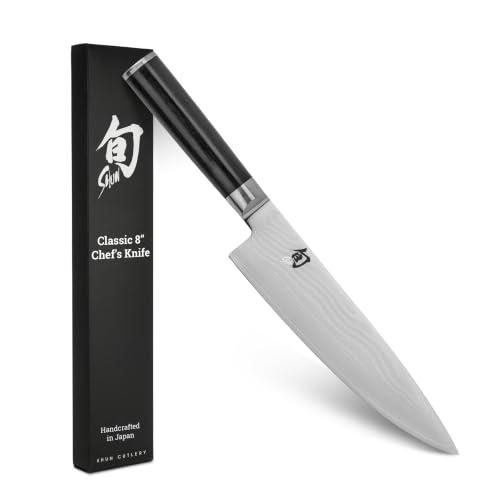 Shun Classic 8" Chef's Knife (DM0706) | A knife you want to look at | 8.3 |
Both are Japanese, both are clad over a hard core, and both are sold to the same person at different stages. The Tojiro is where most people enter; the Miyabi is where a few of them end up. The interesting question is not which is better but what changes between them, because two of the three changes are not improvements.
The published numbers
| Tojiro DP F-808 | Miyabi Birchwood SG2 | |
|---|---|---|
| Blade length | 210 mm (8.3 in) | 8 in |
| Core steel | VG-10, three-layer san mai | SG2 micro-carbide powder, 101 layers total |
| Hardness | 59-60 HRC | 63 HRC, Cryodur ice-hardened |
| Factory edge | Double bevel, conventional Japanese grind | approx. 9.5-12° per side |
| Heel height | 43 mm | 1.75 in (approx. 44 mm) |
| Spine at heel | 1.9 mm | 2.1 mm |
| Weight | approx. 187 g | 6.2 oz (178 g) |
| Handle | Western composite with stainless bolster | Karelian birch, stainless bolster, mosaic pin |
| Origin | Japan | Seki, Japan |
What powder steel actually buys
VG-10 is a conventionally melted stainless with about 1 percent carbon and 15 percent chromium, and at 59 to 60 HRC it takes a fine edge and keeps it far longer than any German knife. SG2 is made differently: the steel is atomised and sintered, so its carbides are small and evenly spread. That structure is what allows 63 HRC and a bevel under 12 degrees per side to coexist without the apex crumbling.
Specialist retailers commonly describe SG2 at 63 HRC as holding an edge roughly twice as long as VG-10 at 60. We are quoting that, not measuring it. What is not in dispute is the direction, and our VG-10 against SG2 page works through the metallurgy properly.
63 HRC behind a sub-12-degree bevel leaves very little steel supporting the apex. Glass, stone, bamboo and hard composite boards chip it. So does a twisting cut through a dense squash and so does a rack-loaded dishwasher. The Tojiro, at 59 to 60 HRC with a more conventional grind, is not immune, but it is much closer to forgiving. See why knives chip.
The Tojiro is the thinner knife
This surprises people. The Tojiro publishes 1.9 mm at the spine and the Miyabi 2.1 mm, so behind the edge the cheap knife is the slimmer one. The Miyabi cuts better anyway, because the apex is thinner and the grind behind it is finer, but the gap is smaller than the price gap implies. Weight is effectively a tie at 187 g against 178 g, and both are longer-feeling than an 8-inch German knife because the Tojiro is in fact 210 mm.
Where the Miyabi is clearly better in the hand is the handle. Karelian birch with a stainless bolster and a mosaic pin is a different class of object from Tojiro's laminated composite, which is functional and nothing more. Some units of the DP even need the bolster easing with sandpaper. If you want a knife you enjoy looking at, that is a real difference and it is fair to pay for it.
The stone requirement changes
A Tojiro DP comes back to factory sharp on one 1000-grit clay stone and a strop, which is why we recommend it to anyone learning. SG2 is slow on the same stone: the carbides resist it, the stone dishes, and you work much longer for the result. A hard non-absorbent stone or a diamond plate is the right pairing, and our whetstone picks for Japanese knives flag which of the stones in the registry suit hard steels.
Add that to the ownership cost. A Miyabi plus the stone it needs is a bigger step than the knife price alone, while a Tojiro plus a King combination stone is one of the cheapest complete setups in this hobby.
Which one to buy
- Your first real Japanese knife. Tojiro DP gyuto, every time. Learn on it, chip it, fix it.
- You own stones and want the best edge here. Miyabi Birchwood SG2, with a hard stone and a soft board.
- You want beauty and retention without sub-12-degree fragility. Shun Classic 8 inch: VG-MAX at 61 HRC, 16 degrees per side, Damascus cladding.
- You want both. Buy the Tojiro first anyway. It is the knife that teaches you whether you will maintain the Miyabi.
Where the price difference actually goes
It is worth being specific about what the extra money buys, because the answer is not evenly distributed. Roughly: the core steel, the heat treatment, the finishing grind, the handle, and the cladding - in that order of effect on how the knife cuts, and almost the reverse order of how much they cost to produce. The Damascus pattern is the most visible line item and the least functional.
That is why a Tojiro DP at a fraction of the Miyabi's price is not a fraction of the knife. Tojiro spends almost nothing on appearance and the whole budget on a VG-10 core, a san mai sandwich and a 1.9 mm grind. The Miyabi spends properly on all five, which is a legitimate thing to want. Our guide to how much to spend maps the diminishing returns across the whole range.
The verdict
The Miyabi is the sharper knife, the prettier knife and the one that holds an edge longest; the Tojiro is the thinner knife at the spine, the easier knife to sharpen, and the one that costs so little that nothing you do to it is a disaster. If you have not yet learned to hold an angle, the money is better spent on a stone than on powder steel. Our page on why Japanese knives cost what they do explains where the premium actually goes, and Tojiro against Shun covers the smaller step up.
The picks in detail
#1 · First Japanese knife
Tojiro DP Gyuto 210mm (F-808)
The default answer to 'my first real Japanese knife'. VG-10 at around 60 HRC in a plain three-layer build, at a price that makes the inevitable first chip survivable.
What it does well
- VG-10 at 59-60 HRC takes a genuinely fine edge and holds it far longer than a German knife at 56-58
- 1.9 mm spine and 43 mm heel make it thin behind the edge without being fragile
- Cheap enough that learning to sharpen on it is not frightening
Where it gives way
- Handle finish is functional and unlovely; some units need the bolster easing with sandpaper
- Stainless cladding is soft and scratches readily
- Nothing about the fit and finish will impress anyone
Skip it if: Anyone who wants the knife to be beautiful. The handle is a workmanlike composite with a stainless bolster and nothing about it is charming.
| Blade length | 210 mm (8.3 in) |
|---|---|
| Steel | VG-10 core, 13-chrome stainless cladding (san mai) |
| Hardness | 59-60 HRC |
| Heel height | 43 mm |
| Spine at heel | 1.9 mm |
| Weight | approx. 187 g |
| Handle | Western, laminated composite wood with stainless bolster |
#2 · Someone who already sharpens their own
Miyabi Birchwood SG2 8" Chef's Knife
SG2 powder steel at 63 HRC behind a 9.5-to-12-degree edge and 101 layers of Damascus. The sharpest knife here out of the box, and the least forgiving.
What it does well
- 63 HRC SG2 holds an edge appreciably longer than VG-10 at 60 — commonly cited as roughly twice as long
- A sub-12-degree factory edge is genuinely rare and it shows on the first cut
- 178 g with a 2.1 mm spine — light and thin for a Damascus-clad knife
Where it gives way
- 63 HRC and a very acute edge is a chipping risk on any hard board
- Powder steel is slow on a soft clay stone; you want a hard stone or diamond
- Costs several times what a Tojiro DP does
Skip it if: A first Japanese knife. At 63 HRC with an edge under 12 degrees per side it will chip on a hard board or a careless twist, and it is slow to sharpen on a soft stone.
| Blade length | 8 in |
|---|---|
| Steel | SG2 micro-carbide powder steel core, 50 Damascus layers each side |
| Hardness | 63 HRC, Cryodur ice-hardened |
| Edge angle | approx. 9.5-12 degrees per side, double bevel |
| Blade height | 1.75 in |
| Spine at heel | 2.1 mm |
| Weight | 6.2 oz (178 g) |
| Handle | Karelian birch with stainless bolster and mosaic pin |
| Origin | Seki, Japan |
#3 · A knife you want to look at
Shun Classic 8" Chef's Knife (DM0706)
The Damascus-clad knife people actually buy. A 16-degree-per-side VG-MAX edge at 61 HRC, a D-shaped pakkawood handle, and a look that sells itself.
What it does well
- 16 degrees per side is a sensible factory angle — acute, but not so thin it chips on a carrot
- Handle geometry is genuinely comfortable in a pinch grip
- Kai's warranty and free sharpening service are real, useful things
Where it gives way
- You pay a significant premium over a MAC or Tojiro for the Damascus cladding
- The D-shaped handle is oriented for right-handed use
- Thin tip is easy to snap if you twist it in a squash
Skip it if: Left-handed cooks who dislike a D-shaped handle, and anyone who resents paying for 68 layers of cladding that do nothing for cutting.
| Blade length | 8 in |
|---|---|
| Steel | VG-MAX core, 34 layers Damascus cladding each side |
| Hardness | 61 HRC |
| Edge angle | 16 degrees per side |
| Handle | D-shaped pakkawood with stainless bolster and end cap |
| Warranty | Limited lifetime |
Common questions
Is a Miyabi worth the money over a Tojiro?
How much longer does SG2 hold an edge than VG-10?
Which is easier to sharpen?
Can I own both?
Sources
Read next
Brands
Tojiro vs Shun
Brands
Shun vs Miyabi
Brands
Tojiro vs Wüsthof
Steel & Care
VG-10 vs SG2 Steel
Japanese Knives
Why Are Japanese Knives So Expensive?
Brands