Brands
MAC vs Miyabi
What this is based on: published manufacturer specifications and retailer listings, cited on each product; the weight of professional and owner reviews across multiple retailers; and hands-on experience sharpening and cooking with knives of this type. We have not individually tested every model listed, we do not run instrumented sharpness testing, and we do not claim a test we did not run.
Quick picks
| # | Product | Best for | Score | Price |
|---|---|---|---|---|
| 1 | 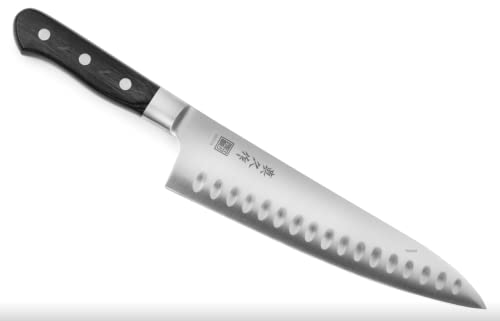 MAC Professional 8" Chef's Knife with Dimples (MTH-80) | The one-knife kitchen | 8.8 | |
| 2 | 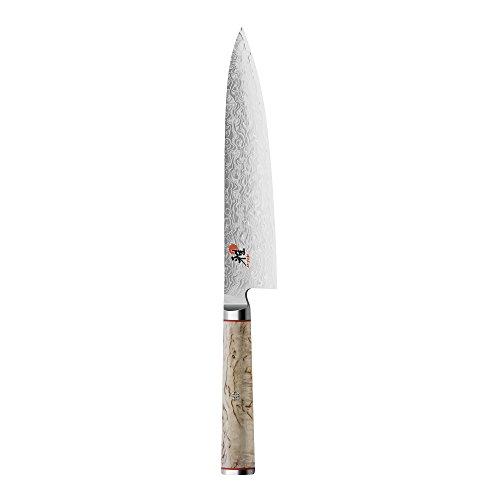 Miyabi Birchwood SG2 8" Chef's Knife | Someone who already sharpens their own | 8.6 | |
| 3 | 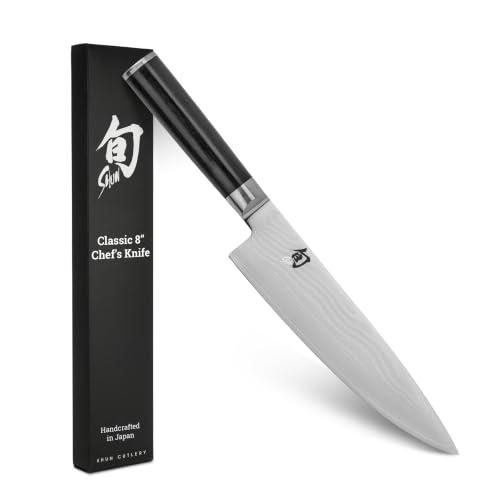 Shun Classic 8" Chef's Knife (DM0706) | A knife you want to look at | 8.3 |
This is an upgrade question rather than a first-knife question. Almost nobody arrives at the Miyabi Birchwood without owning something already, and the honest comparison is not which knife is better but which failure you would rather have: an edge that dulls a little sooner, or an edge that chips.
The published numbers
| MAC MTH-80 | Miyabi Birchwood SG2 | |
|---|---|---|
| Blade length | 8 in (approx. 200 mm) | 8 in |
| Steel | Sub-zero tempered high-carbon moly-vanadium, mono-steel | SG2 micro-carbide powder core, 50 Damascus layers each side |
| Hardness | 61 HRC | 63 HRC, Cryodur ice-hardened |
| Factory edge | 15° per side | approx. 9.5-12° per side |
| Blade height | 1 7/8 in | 1.75 in |
| Spine at heel | 2.5 mm | 2.1 mm |
| Weight | 6.8 oz | 6.2 oz (178 g) |
| Handle | Riveted Pakkawood, integrated bolster | Karelian birch, stainless bolster, mosaic pin |
Two Rockwell points, three degrees, and a different kind of steel
The headline is not 63 against 61. It is that SG2 is a powder metallurgy steel: the carbides that do the wear resistance are small and evenly distributed rather than clumped, which is what lets Miyabi grind the bevel under 12 degrees per side and have it hold. A conventionally melted steel at the same hardness would crumble at that angle.
The consequence is an edge you can feel. A sub-12-degree bevel on 63 HRC steel passes through a tomato skin with no pressure at all, and it is still doing that after the MAC has started to want a stone. Our VG-10 against SG2 comparison sets out why powder steel buys retention, and the edge retention roundup ranks the picks on that single axis.
There is very little steel behind the apex on the Miyabi. Glass, granite, bamboo and hard composite boards will chip it, and so will a twisting cut through a dense squash. End-grain wood or a soft rubber board is not a nicety here, it is a condition of ownership. The MAC at 61 HRC and 15 degrees rolls under the same abuse and comes back on a rod.
Workwear against a dress knife
The MAC handle is riveted Pakkawood with an integrated bolster. It is unglamorous and it does not care what you do to it. The Miyabi is Karelian birch with a stainless bolster and a mosaic pin, and it is one of the few genuinely beautiful production handles at any price. It also wants hand washing, immediate drying and an occasional wipe of oil, which is true of any real wood handle.
Weight is almost identical: 6.8 oz against 6.2 oz. Both are light. Neither is the knife for someone whose complaint is that their German chef's knife feels insubstantial; both are the knife for someone whose complaint is that it feels like a crowbar.
What each costs you on the stones
Powder steel is slow on a soft clay stone. The carbides resist it, the stone dishes, and you end up working much longer than you expected. A hard non-absorbent stone or a diamond plate is the right answer for the Miyabi, and our whetstone picks for Japanese knives separate the stones that suit hard steels from the ones that do not.
The MAC is easy by comparison: a single 1000-grit stone and a strop returns it to factory sharp, and because the factory grind is a flat 15 degrees per side, a 15-degree angle guide or rolling sharpener matches it exactly. That matters more than it sounds. A knife you will actually maintain beats a sharper knife you are frightened of.
Which one to buy
- One knife, hard use, no drama. MAC MTH-80. 15 degrees at 61 HRC is the most forgiving genuinely thin edge in this comparison.
- You own stones and want the best cut available here. Miyabi Birchwood SG2. Nothing else on this site arrives as sharp or stays there as long.
- You want Damascus and a long edge without the fragility. The Shun Classic 8 inch sits between them: VG-MAX at 61 HRC, 16 degrees per side, and far less chip risk than a sub-12-degree grind.
- Your board is glass, stone or bamboo. MAC, and read our board picks before you upgrade anything else.
What ownership costs over five years
Neither of these knives is a consumable, but they age differently. The MAC is a mono-steel blade with a riveted Pakkawood handle: there is no cladding to scratch through, the 15-degree bevel is easy to maintain on one stone, and a 25-year warranty sits behind it. Five years of weekly sharpening will take visible height off any knife, and the MAC gives that up without complaint because the grind behind the edge is simple.
The Miyabi asks for more. The Damascus cladding will scuff, the birch handle wants hand washing and the occasional wipe of oil, and the 63 HRC core needs a hard stone rather than whatever is in the drawer. Sharpened badly it also thickens behind the edge faster than a simpler grind, because people chase the apex and never thin the shoulder. Budget for a decent stone with the knife, not after it - our whetstone brand guide covers which makers suit hard steels.
The verdict
The Miyabi wins every test that measures sharpness and retention, and it will punish a careless kitchen for the privilege. The MAC gives up a measurable amount of cutting performance and asks nothing in return. If you are buying one knife to cook with for the next decade, that is the MAC. If you are adding the knife you reach for when the job deserves it, and you own a hard stone, that is the Miyabi. Our Shun against Miyabi comparison covers the other way into SG2.
For the Miyabi on its own terms rather than against the MAC, read our Miyabi Birchwood SG2 review.
The picks in detail
#1 · The one-knife kitchen
MAC Professional 8" Chef's Knife with Dimples (MTH-80)
The knife that wins the most side-by-side tests and asks the least of you. Thin, light, 61 HRC, and forgiving enough that a mediocre sharpening job still cuts well.
What it does well
- 6.8 oz with a 2.5 mm spine — genuinely light in the hand over a long prep session
- 15 degrees per side from the factory, which is the angle you will maintain anyway
- 25-year warranty and a reputation for consistency unit to unit
Where it gives way
- Costs meaningfully more than a Tojiro DP for a similar hardness
- Mono-steel, so no cladding to protect the core if you drop it edge-first
- The dimples do less for release than the marketing implies
Skip it if: Anyone chasing maximum edge retention. At 61 HRC in a mono-steel it will not out-last a powder-steel blade, and the dimples are cosmetic more often than useful.
| Blade length | 8 in (approx. 200 mm) |
|---|---|
| Steel | Sub-zero tempered high-carbon molybdenum vanadium alloy |
| Hardness | 61 HRC |
| Edge angle | 15 degrees per side (double bevel) |
| Blade height | 1 7/8 in |
| Spine at heel | 2.5 mm |
| Weight | 6.8 oz |
| Handle | Riveted Pakkawood with integrated bolster |
#2 · Someone who already sharpens their own
Miyabi Birchwood SG2 8" Chef's Knife
SG2 powder steel at 63 HRC behind a 9.5-to-12-degree edge and 101 layers of Damascus. The sharpest knife here out of the box, and the least forgiving.
What it does well
- 63 HRC SG2 holds an edge appreciably longer than VG-10 at 60 — commonly cited as roughly twice as long
- A sub-12-degree factory edge is genuinely rare and it shows on the first cut
- 178 g with a 2.1 mm spine — light and thin for a Damascus-clad knife
Where it gives way
- 63 HRC and a very acute edge is a chipping risk on any hard board
- Powder steel is slow on a soft clay stone; you want a hard stone or diamond
- Costs several times what a Tojiro DP does
Skip it if: A first Japanese knife. At 63 HRC with an edge under 12 degrees per side it will chip on a hard board or a careless twist, and it is slow to sharpen on a soft stone.
| Blade length | 8 in |
|---|---|
| Steel | SG2 micro-carbide powder steel core, 50 Damascus layers each side |
| Hardness | 63 HRC, Cryodur ice-hardened |
| Edge angle | approx. 9.5-12 degrees per side, double bevel |
| Blade height | 1.75 in |
| Spine at heel | 2.1 mm |
| Weight | 6.2 oz (178 g) |
| Handle | Karelian birch with stainless bolster and mosaic pin |
| Origin | Seki, Japan |
#3 · A knife you want to look at
Shun Classic 8" Chef's Knife (DM0706)
The Damascus-clad knife people actually buy. A 16-degree-per-side VG-MAX edge at 61 HRC, a D-shaped pakkawood handle, and a look that sells itself.
What it does well
- 16 degrees per side is a sensible factory angle — acute, but not so thin it chips on a carrot
- Handle geometry is genuinely comfortable in a pinch grip
- Kai's warranty and free sharpening service are real, useful things
Where it gives way
- You pay a significant premium over a MAC or Tojiro for the Damascus cladding
- The D-shaped handle is oriented for right-handed use
- Thin tip is easy to snap if you twist it in a squash
Skip it if: Left-handed cooks who dislike a D-shaped handle, and anyone who resents paying for 68 layers of cladding that do nothing for cutting.
| Blade length | 8 in |
|---|---|
| Steel | VG-MAX core, 34 layers Damascus cladding each side |
| Hardness | 61 HRC |
| Edge angle | 16 degrees per side |
| Handle | D-shaped pakkawood with stainless bolster and end cap |
| Warranty | Limited lifetime |
Common questions
Is Miyabi better than MAC?
Will a Miyabi SG2 knife chip?
Is SG2 hard to sharpen?
Which should a first Japanese knife buyer choose?
Sources
Read next
Brands
MAC vs Shun
Brands
Shun vs Miyabi
Brands
MAC vs Global Knives

Steel & Care
VG-10 vs SG2 Steel
Japanese Knives