Brands
MAC vs Global Knives
What this is based on: published manufacturer specifications and retailer listings, cited on each product; the weight of professional and owner reviews across multiple retailers; and hands-on experience sharpening and cooking with knives of this type. We have not individually tested every model listed, we do not run instrumented sharpness testing, and we do not claim a test we did not run.
Quick picks
| # | Product | Best for | Score | Price |
|---|---|---|---|---|
| 1 | 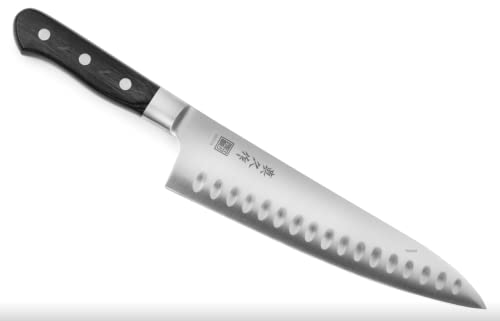 MAC Professional 8" Chef's Knife with Dimples (MTH-80) | The one-knife kitchen | 8.8 | |
| 2 | 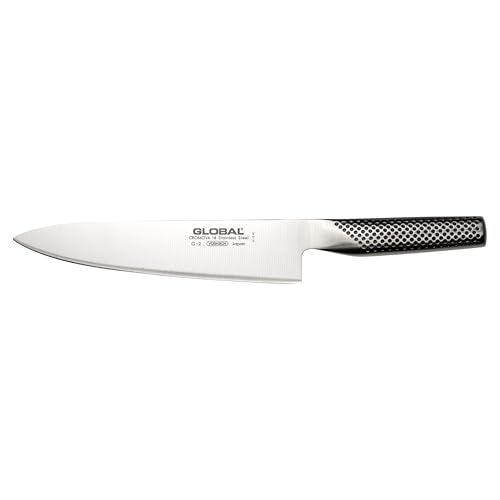 Global G-2 8" Chef's Knife | Cooks who want the lightest knife in the drawer | 7.6 | |
| 3 |  Tojiro DP Gyuto 210mm (F-808) | First Japanese knife | 8.6 |
These two get compared constantly because they share a shelf and a price neighbourhood, and because both are Japanese knives built for Western hands rather than traditional wa-handled blades. They are not variations on a theme. One is a hard, thin, conventional knife with a wooden handle. The other is a single piece of stainless with a hollow dimpled grip and a reputation for either delighting or repelling whoever picks it up.
The published numbers
| MAC MTH-80 | Global G-2 | |
|---|---|---|
| Blade length | 8 in (approx. 200 mm) | 8 in (200 mm) |
| Steel | Sub-zero tempered high-carbon moly-vanadium | CROMOVA 18 stainless |
| Hardness | 61 HRC | 56-58 HRC |
| Factory edge | 15° per side | 10-15° per side |
| Blade height | 1 7/8 in (approx. 47.6 mm) | 1.7 in (45 mm) |
| Spine at heel | 2.5 mm | 2 mm |
| Weight | 6.8 oz | 6 oz (170 g) |
| Construction | Mono-steel blade, riveted Pakkawood, integrated bolster | One-piece steel, hollow dimpled handle |
Three Rockwell points is the real gap
MAC publishes 61 HRC. Global publishes 56 to 58 for CROMOVA 18. That spread is the whole argument. A blade at 61 HRC can carry a 15-degree bevel through weeks of home prep before the edge starts to roll; the same geometry on 57 HRC steel deflects sooner, which is why Global owners reach for a ceramic rod so often and MAC owners mostly do not.
The trade runs the other way on repair. Softer steel grinds faster and burrs more willingly, so a Global comes back on a 1000-grit stone in a couple of minutes and forgives a clumsy session. The MAC asks for a lighter touch and rewards it with an edge that stays. If you have not yet learned to hold an angle, our sharpening angle guide matters more to this decision than either brand name does.
Global's published figure is 10 to 15 degrees per side, and its own MinoSharp ceramic water stone sharpener produces a 15-degree resulting angle. MAC publishes a flat 15. So whichever you buy, the same stone setting, the same angle guide and the same 15-degree rolling sharpener serve it. That is unusual in this category, and it makes the choice purely about the knife rather than the kit around it.
The handle is the decision
Everything above is close. The handles are not. The Global G-2 is a single piece of stainless steel: blade, bolster and handle are one, the grip is hollow and weighted to set the balance, and the surface is dimpled polished steel. There are no rivets, no seams, no wood to dry out and nowhere for anything to collect. It is the easiest knife in this comparison to keep clean and the hardest to hold when your hands are greasy.
The MAC is conventional: a riveted Pakkawood scale with an integrated bolster. It is warmer in the hand, more secure when wet, and it needs the ordinary courtesy of being dried rather than left in the sink. If you have never held a Global, do not buy one on specification alone. The 170 g balance sits further back than most cooks expect and the knife feels nervous until you adapt, which some people never do and others never want to give up.
Height, spine, and what they do to an onion
The Global is the thinner knife at the spine, 2 mm against 2.5, and the MAC is the taller one, publishing 1 7/8 in at the heel against Global's 1.7 in. In practice the Global parts dense produce with marginally less wedging while the MAC gives you more knuckle clearance on a full chop. Neither difference is dramatic. Both are far thinner than the German knife most readers of this site are replacing, which runs 3 mm at the spine, and that is the step change people actually feel on the first cut.
The MAC's dimples get more credit than they deserve. They reduce stiction on potato and courgette a little; they do not make the knife release like a hollow-ground slicer. If release is your complaint, blade height and a thinner grind do far more, which is the argument our vegetable knife roundup makes at length.
Which one to buy
- You sharpen rarely and want the edge to last. MAC MTH-80. 61 HRC at 15 degrees is the longest working edge of the two by a clear margin.
- You want the lightest knife and the easiest cleaning. Global G-2. 170 g, one piece of steel, no rivets, no wood, no seams.
- Your hands are often wet and you work fast. MAC. Pakkawood does not get slick the way polished steel does.
- You want the thin Japanese cut for much less money. Neither: the Tojiro DP gyuto at 210 mm gives you VG-10 at 59 to 60 HRC and a 1.9 mm spine for a fraction of either, with a plain handle as the price of admission.
The verdict
The MAC is the better knife on paper and the safer buy unhandled: harder steel, a taller blade, a grip that behaves when wet. The Global is the better object and an acquired taste, lighter than anything else here, seamless, and either exactly right in your hand or completely wrong. Hold one if you possibly can; if you cannot, buy the MAC. The full write-ups are in our MAC Professional review and Global G-2 review, and MAC against Shun covers the other comparison most MAC buyers make.
The picks in detail
#1 · The one-knife kitchen
MAC Professional 8" Chef's Knife with Dimples (MTH-80)
The knife that wins the most side-by-side tests and asks the least of you. Thin, light, 61 HRC, and forgiving enough that a mediocre sharpening job still cuts well.
What it does well
- 6.8 oz with a 2.5 mm spine — genuinely light in the hand over a long prep session
- 15 degrees per side from the factory, which is the angle you will maintain anyway
- 25-year warranty and a reputation for consistency unit to unit
Where it gives way
- Costs meaningfully more than a Tojiro DP for a similar hardness
- Mono-steel, so no cladding to protect the core if you drop it edge-first
- The dimples do less for release than the marketing implies
Skip it if: Anyone chasing maximum edge retention. At 61 HRC in a mono-steel it will not out-last a powder-steel blade, and the dimples are cosmetic more often than useful.
| Blade length | 8 in (approx. 200 mm) |
|---|---|
| Steel | Sub-zero tempered high-carbon molybdenum vanadium alloy |
| Hardness | 61 HRC |
| Edge angle | 15 degrees per side (double bevel) |
| Blade height | 1 7/8 in |
| Spine at heel | 2.5 mm |
| Weight | 6.8 oz |
| Handle | Riveted Pakkawood with integrated bolster |
#2 · Cooks who want the lightest knife in the drawer
Global G-2 8" Chef's Knife
One piece of steel, dimpled hollow handle, 170 g. Nothing else feels like it — which is exactly why you should hold one before you buy.
What it does well
- 170 g and perfectly balanced — the least tiring knife here over two hours of prep
- One-piece construction with no rivets or bolster to trap food
- 2 mm spine means it is thin behind the edge out of the box
Where it gives way
- 56-58 HRC is soft for a Japanese knife; expect to hone it often
- The dimpled steel handle is polarizing and slick when wet
- CROMOVA 18 does not take as fine a finishing edge as VG-10
Skip it if: Anyone with wet hands and no patience: the smooth steel handle gets slippery, and at 56-58 HRC it will not hold an edge like a 61 HRC blade.
| Blade length | 8 in (200 mm) |
|---|---|
| Steel | CROMOVA 18 stainless |
| Hardness | 56-58 HRC |
| Edge angle | 10-15 degrees, double bevel |
| Blade height | 1.7 in (45 mm) |
| Spine | 2 mm |
| Weight | 6 oz (170 g) |
#3 · First Japanese knife
Tojiro DP Gyuto 210mm (F-808)
The default answer to 'my first real Japanese knife'. VG-10 at around 60 HRC in a plain three-layer build, at a price that makes the inevitable first chip survivable.
What it does well
- VG-10 at 59-60 HRC takes a genuinely fine edge and holds it far longer than a German knife at 56-58
- 1.9 mm spine and 43 mm heel make it thin behind the edge without being fragile
- Cheap enough that learning to sharpen on it is not frightening
Where it gives way
- Handle finish is functional and unlovely; some units need the bolster easing with sandpaper
- Stainless cladding is soft and scratches readily
- Nothing about the fit and finish will impress anyone
Skip it if: Anyone who wants the knife to be beautiful. The handle is a workmanlike composite with a stainless bolster and nothing about it is charming.
| Blade length | 210 mm (8.3 in) |
|---|---|
| Steel | VG-10 core, 13-chrome stainless cladding (san mai) |
| Hardness | 59-60 HRC |
| Heel height | 43 mm |
| Spine at heel | 1.9 mm |
| Weight | approx. 187 g |
| Handle | Western, laminated composite wood with stainless bolster |
Common questions
Is MAC better than Global?
Why do people find Global handles slippery?
What angle are Global knives sharpened at?
Which one lasts longer?
Sources
Read next
Brands
MAC vs Shun
Brands
Shun vs Global
Brands
Global G-2 Review
Brands
MAC vs Miyabi
Japanese Knives