Brands
Global G-2 Review
What this is based on: published manufacturer specifications and retailer listings, cited on each product; the weight of professional and owner reviews across multiple retailers; and hands-on experience sharpening and cooking with knives of this type. We have not individually tested every model listed, we do not run instrumented sharpness testing, and we do not claim a test we did not run.
Quick picks
| # | Product | Best for | Score | Price |
|---|---|---|---|---|
| 1 | 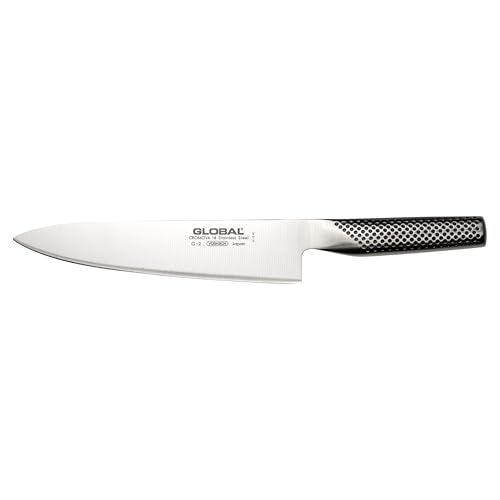 Global G-2 8" Chef's Knife | Cooks who want the lightest knife in the drawer | 7.6 | |
| 2 |  Tojiro DP Gyuto 210mm (F-808) | First Japanese knife | 8.6 | |
| 3 | 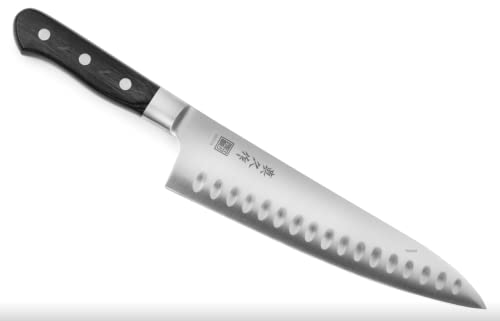 MAC Professional 8" Chef's Knife with Dimples (MTH-80) | The one-knife kitchen | 8.8 |
Nothing else in this category is as instantly recognizable. The one-piece stainless body with its field of dimples has been in professional kitchens since the 1980s and in design museums since not long after. The question this review answers is narrower: does it earn its place against the knives it now competes with on price?
| Global G-2 | |
|---|---|
| Blade length | 200 mm (8 in) |
| Steel | CROMOVA 18 stainless, mono-steel |
| Hardness | 56-58 HRC |
| Edge angle | 10-15°, double bevel |
| Blade height | 45 mm (1.7 in) |
| Spine | 2 mm |
| Weight | 170 g (6 oz) |
The handle, first, because it decides everything
The grip is a hollow stainless tube, sand-filled to place the balance point just forward of the index finger, textured with the dimples that give the knife its name. There is no seam anywhere on the knife, so there is nowhere for food to lodge and nothing to loosen — in a professional kitchen that is a hygiene and durability argument, not an aesthetic one.
It is also narrow, cold and hard, with no bolster and no swell to seat the palm. A meaningful minority of cooks find it uncomfortable within half an hour, and no amount of specification reading will tell you which group you are in. If you can hold one before buying, do.
CROMOVA 18 at 56-58 HRC
This is honest mid-hardness stainless. It resists corrosion well, sharpens quickly on almost any stone, and takes a fine edge without drama. What it does not do is hold that edge the way VG-10 at 59-60 HRC does — expect to touch it up noticeably more often than a clad Japanese knife in the same price band.
Global's published bevel range of 10 to 15 degrees is the detail that trips people up. A new G-2 arrives extremely keen and loses that keenness fast, which reads as a quality problem and is really a geometry mismatch: there is not enough hardness behind a 10-degree bevel to support it. Sharpen it back to roughly 15 degrees per side and it becomes a much more consistent knife. Our angle chart covers how to hold it.
How it behaves on the board
- Light and quick. At 170 g it is one of the lighter 8-inch knives available and the fastest to change direction. Long prep sessions are genuinely less tiring than with a 265 g German knife.
- Shorter than it looks. 200 mm with a 45 mm heel. On a crowded board that is slightly less clearance than a 210 mm gyuto; see the size guide.
- Slippery when truly wet. The dimples work well with damp hands and less well with oil. A towel within reach solves it.
- Easy to clean, and not dishwasher-safe anyway. No seam, no wood, no rivets. Hand wash and dry it like any good knife.
Anyone who has never held one. The handle is the product and it is divisive.
Anyone chasing edge retention. A clad VG-10 knife at a similar price holds its edge longer; see Tojiro against Global.
Anyone who wants a bolster or a heavy knife. Neither exists here by design.
Living with it
CROMOVA 18 is one of the easier steels in a home kitchen to keep sharp, which partly offsets the shorter interval. A 1000-grit stone is all it needs; the burr comes up quickly and the steel does not fight you. Finish with a few light edge-trailing passes and strop if you have one — the stroke is here.
Between sharpenings a ceramic rod does more for this knife than a steel one, because 56-58 HRC steel rolls and a fine ceramic straightens it in seconds without removing material. The practical rhythm for a G-2 in daily use is a rod weekly and a stone every couple of months — more often than a VG-10 knife needs, less often than a soft German blade.
Do not put it in a dishwasher. The one-piece stainless body means there is no handle to loosen, but the hot alkaline cycle still attacks the edge and the blade will rattle against the rack. Why.
Against the alternatives
At its current price the G-2 sits beside clad VG-10 knives that are harder and thinner. The Tojiro DP gyuto is 59-60 HRC with a 1.9 mm spine and costs less; the MAC MTH-80 is 61 HRC at 15 degrees with a Pakkawood handle and costs more. On paper the G-2 is behind both.
What neither replicates is the feel. The seamless body, the 170 g weight and the forward balance point are specific to this knife, and plenty of cooks who have tried the alternatives come back to it anyway. That is a legitimate reason to buy a knife; it is just not one a table can show you. The side-by-side is in Tojiro against Global.
The verdict
The G-2 is a good knife with an unusual sales pitch: its advantages are tactile and its disadvantages are on the spec sheet. Light, seamless, hygienic, quick, endlessly resharpenable, and softer than the Japanese competition it now sits alongside on price.
Buy it because you like how it feels. If you are choosing from a screen and edge retention matters more than feel, the Tojiro DP is the better value and the MAC MTH-80 is the better knife. If the Global's balance is what you are after, nothing else replicates it.
If you are weighing this against the other thin Japanese classic, our MAC against Global comparison puts the two spec sheets side by side, and the Global sharpening angle guide settles what to set your stone at.
If this review has talked you out of it rather than into it, Global knives alternatives matches five knives to the four specific reasons people shop away - the slick steel handle, 56-58 HRC, the finishing edge and the price - and names the one axis nothing here beats it on.
The picks in detail
#1 · Cooks who want the lightest knife in the drawer
Global G-2 8" Chef's Knife
One piece of steel, dimpled hollow handle, 170 g. Nothing else feels like it — which is exactly why you should hold one before you buy.
What it does well
- 170 g and perfectly balanced — the least tiring knife here over two hours of prep
- One-piece construction with no rivets or bolster to trap food
- 2 mm spine means it is thin behind the edge out of the box
Where it gives way
- 56-58 HRC is soft for a Japanese knife; expect to hone it often
- The dimpled steel handle is polarizing and slick when wet
- CROMOVA 18 does not take as fine a finishing edge as VG-10
Skip it if: Anyone with wet hands and no patience: the smooth steel handle gets slippery, and at 56-58 HRC it will not hold an edge like a 61 HRC blade.
| Blade length | 8 in (200 mm) |
|---|---|
| Steel | CROMOVA 18 stainless |
| Hardness | 56-58 HRC |
| Edge angle | 10-15 degrees, double bevel |
| Blade height | 1.7 in (45 mm) |
| Spine | 2 mm |
| Weight | 6 oz (170 g) |
#2 · First Japanese knife
Tojiro DP Gyuto 210mm (F-808)
The default answer to 'my first real Japanese knife'. VG-10 at around 60 HRC in a plain three-layer build, at a price that makes the inevitable first chip survivable.
What it does well
- VG-10 at 59-60 HRC takes a genuinely fine edge and holds it far longer than a German knife at 56-58
- 1.9 mm spine and 43 mm heel make it thin behind the edge without being fragile
- Cheap enough that learning to sharpen on it is not frightening
Where it gives way
- Handle finish is functional and unlovely; some units need the bolster easing with sandpaper
- Stainless cladding is soft and scratches readily
- Nothing about the fit and finish will impress anyone
Skip it if: Anyone who wants the knife to be beautiful. The handle is a workmanlike composite with a stainless bolster and nothing about it is charming.
| Blade length | 210 mm (8.3 in) |
|---|---|
| Steel | VG-10 core, 13-chrome stainless cladding (san mai) |
| Hardness | 59-60 HRC |
| Heel height | 43 mm |
| Spine at heel | 1.9 mm |
| Weight | approx. 187 g |
| Handle | Western, laminated composite wood with stainless bolster |
#3 · The one-knife kitchen
MAC Professional 8" Chef's Knife with Dimples (MTH-80)
The knife that wins the most side-by-side tests and asks the least of you. Thin, light, 61 HRC, and forgiving enough that a mediocre sharpening job still cuts well.
What it does well
- 6.8 oz with a 2.5 mm spine — genuinely light in the hand over a long prep session
- 15 degrees per side from the factory, which is the angle you will maintain anyway
- 25-year warranty and a reputation for consistency unit to unit
Where it gives way
- Costs meaningfully more than a Tojiro DP for a similar hardness
- Mono-steel, so no cladding to protect the core if you drop it edge-first
- The dimples do less for release than the marketing implies
Skip it if: Anyone chasing maximum edge retention. At 61 HRC in a mono-steel it will not out-last a powder-steel blade, and the dimples are cosmetic more often than useful.
| Blade length | 8 in (approx. 200 mm) |
|---|---|
| Steel | Sub-zero tempered high-carbon molybdenum vanadium alloy |
| Hardness | 61 HRC |
| Edge angle | 15 degrees per side (double bevel) |
| Blade height | 1 7/8 in |
| Spine at heel | 2.5 mm |
| Weight | 6.8 oz |
| Handle | Riveted Pakkawood with integrated bolster |
Common questions
Is the Global G-2 worth buying?
What steel is the Global G-2?
What angle is the Global G-2 sharpened to?
Why is the Global handle hollow?
Sources
Read next
Brands
Tojiro vs Global
Brands
Shun vs Global
Japanese Knives
Best 8-Inch Chef Knives
Japanese Knives