Steel & Care
Can You Put Japanese Knives in the Dishwasher?
What this is based on: published manufacturer specifications and retailer listings, cited on each product; the weight of professional and owner reviews across multiple retailers; and hands-on experience sharpening and cooking with knives of this type. We have not individually tested every model listed, we do not run instrumented sharpness testing, and we do not claim a test we did not run.
Quick picks
| # | Product | Best for | Score | Price |
|---|---|---|---|---|
| 1 | 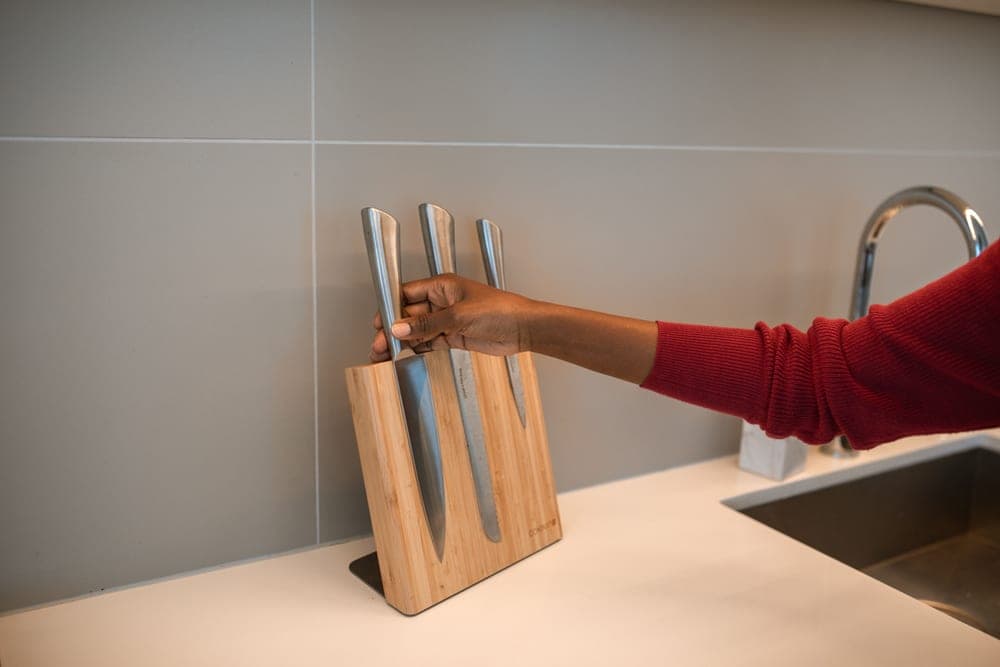 Saya / Magnetic Blade Guard | Anyone whose knives live in a drawer | 8.9 | |
| 2 |  Tsubaki (Camellia) Blade Oil | Anyone who owns carbon steel | 8.6 | |
| 3 |  Hasegawa Wood-Core Cutting Board | The last board you buy | 8.5 |
It is worth being specific about the mechanisms, because "hand wash only" without a reason is easy to dismiss — especially when the knife appears to survive the first few cycles. The damage is real, it is cumulative, and three of the four have nothing to do with corrosion.
1. Impact: the edge chips
A dishwasher is a machine for moving water fast. Items shift, racks flex, and anything loose taps against anything else. A 59 to 61 HRC Japanese edge is hard, thin and brittle at the apex — it does not roll over the way a 56 HRC German edge does, it breaks off in flakes too small to see. After a dozen cycles the edge is a line of micro-chips, which is why the knife feels dull long before you expect it to. The other causes of chipping are worth knowing too, because the symptom looks identical.
2. Detergent: it is far harsher than dish soap
Dishwasher detergent is strongly alkaline and often contains chlorides and enzymes designed to break down protein and fat without scrubbing. That chemistry attacks the passive chromium oxide layer that makes stainless steel stainless, so a blade comes out dulled in finish and more prone to pitting than it was. On a clad blade it can etch the join line between core and cladding. On a wooden or pakkawood handle it strips the finish.
This is the part that surprises people with stainless knives. Stainless means corrosion-resistant, not corrosion-proof, and the resistance depends on a microscopically thin oxide layer that alkaline detergent is specifically good at removing.
3. Heat: the handle is the casualty
A drying cycle runs well above anything a knife handle experiences in normal use. Pakkawood is resin-impregnated wood laminate and it swells and contracts with repeated heat cycling; natural wood handles crack; riveted and bolstered handles loosen as the materials expand at different rates and the gap between scale and tang opens up. Once water can get into that gap the tang corrodes from inside, which is unfixable.
The knives that survive dishwashers best are the ones with molded synthetic handles and soft blades — a Victorinox Fibrox is genuinely tolerant of it. That is an argument for owning one as a beater, not an argument for washing your gyuto.
4. Standing water: pitting and the unloaded cycle
Knives usually go into a dishwasher hours before it runs and sit wet for hours after. That is a long time in contact with water, food residue and a steel rack. Even stainless pits under a stationary droplet given long enough; carbon steel and clad carbon cores will have visible rust spots by the time the cycle finishes. Why a stainless knife rusts anyway covers this in detail, and patina versus rust explains which marks are harmless.
What to do instead
- Wash it as you finish with it, not at the end of the meal. Warm water, one drop of dish soap on a sponge or cloth.
- Wipe spine to edge, never along the edge. Lay the blade flat and wipe from the spine down, on each side in turn. This is the habit that prevents cuts.
- Dry immediately with a towel. Air drying is where spotting comes from. Ten seconds with a cloth is the whole rust-prevention routine for a stainless knife.
- Oil it, if it is carbon. A thin film of camellia oil on a clean dry blade, and a carbon knife will keep a stable patina instead of spotting.
- Store it protected. A saya, a magnetic rack or a block. Loose in a drawer is the second most common cause of chipped edges after the dishwasher. Storage options are here.
Most cutting boards are not dishwasher safe either. Asahi rubber boards are hand wash only; hinoki and other wooden boards will warp and split. The Hasegawa wood-core board is the exception on this site — its polyethylene surface is rated dishwasher safe. Our board picks list the care requirements per board.
The verdict
Keep Japanese knives out of the dishwasher permanently, and keep one cheap tough knife that you genuinely do not care about for anyone in the house who will not follow the rule. Twenty seconds of hand washing per use is the difference between a knife that lasts three years and one that lasts thirty — which is the subject of its own page. The rest of the routine lives in our full care guide.
The picks in detail
#1 · Anyone whose knives live in a drawer
Saya / Magnetic Blade Guard
The cheapest way to stop a drawer from ruining a good edge. A sheath costs a few dollars; re-profiling a chipped tip costs an evening.
What it does well
- Stops the single most common cause of chipped tips: loose drawer storage
- Cheap enough to buy one per knife
- Makes it safe to reach into a drawer
Where it gives way
- A wet knife sheathed in wood will corrode — dry it properly first
- Sizes are fussy; a loose saya is worse than none
- Adds a step to putting the knife away
Skip it if: Nobody, really — but if you already have a magnetic rack or a proper block, you do not need one too.
| Function | Edge protection in storage and transit |
|---|---|
| Materials | Wood (saya), plastic, or magnet-lined guards |
#2 · Anyone who owns carbon steel
Tsubaki (Camellia) Blade Oil
Food-safe, non-drying oil traditionally used on Japanese blades. A few drops after washing is what stands between a carbon-steel knife and a rust bloom.
What it does well
- Genuinely prevents flash rust on carbon steel between uses
- Food safe and effectively odorless
- One small bottle lasts years
Where it gives way
- Unnecessary for most stainless knives
- Needs reapplying after every wash to actually work
- Does nothing for rust that has already started
Skip it if: Stainless owners, mostly. If your knife is VG-10 or CROMOVA and you dry it, you do not need this.
| Type | Non-drying, food-safe plant oil |
|---|---|
| Use | Wipe a thin film on a clean, dry blade |
| Applies to | Carbon steel and clad carbon core blades |
#3 · The last board you buy
Hasegawa Wood-Core Cutting Board
A wood core faced with soft polyethylene: rigid enough not to warp, soft enough that it does not blunt a thin Japanese edge. Dishwasher safe, and the surface can be re-planed.
What it does well
- Wood core keeps it rigid and light — it will not bow like a solid plastic board
- Soft face does not catch or roll a freshly stoned edge
- Dishwasher safe, unlike rubber boards and unlike end-grain wood
Where it gives way
- Expensive
- Plain white utility look, not a serving board
- Re-planing is a service, not a weekend job
Skip it if: A modest budget. This is the expensive answer, and a rubber board gets you most of the way.
| Construction | Wood core with soft polyethylene surface layers |
|---|---|
| Dishwasher | Yes |
| Serviceable | Surface can be re-planed |
Common questions
Can you put Japanese knives in the dishwasher?
What about stainless Japanese knives, are they safe?
Will one dishwasher cycle ruin a knife?
How should I wash a Japanese knife?
Sources
Read next

Steel & Care
Japanese Knife Care Guide
Steel & Care
Why Is My Knife Rusting?
Steel & Care
Why Is My Knife Chipping?
Steel & Care
Knife Storage Guide
Steel & Care
Carbon Steel Patina vs Rust
Steel & Care