Steel & Care
Why Is My Knife Rusting?
What this is based on: published manufacturer specifications and retailer listings, cited on each product; the weight of professional and owner reviews across multiple retailers; and hands-on experience sharpening and cooking with knives of this type. We have not individually tested every model listed, we do not run instrumented sharpness testing, and we do not claim a test we did not run.
Quick picks
| # | Product | Best for | Score | Price |
|---|---|---|---|---|
| 1 |  Tsubaki (Camellia) Blade Oil | Anyone who owns carbon steel | 8.6 | |
| 2 | 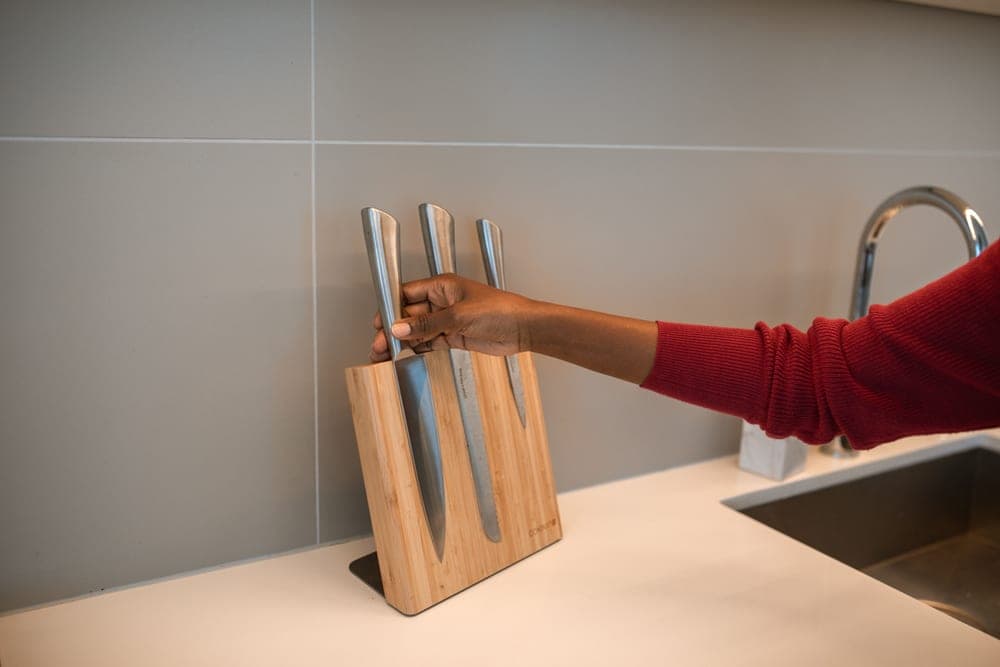 Saya / Magnetic Blade Guard | Anyone whose knives live in a drawer | 8.9 | |
| 3 |  Tojiro DP Gyuto 210mm (F-808) | First Japanese knife | 8.6 |
1. The dishwasher
The most common cause by a wide margin. Dishwasher detergent is alkaline and mildly abrasive, dishwasher salt attacks the passive chromium layer, and the drying cycle leaves the blade hot and damp in a sealed box.
Fix: hand wash, always, every knife. This is not a Japanese-knife rule; it applies to a Victorinox too.
2. Leaving it wet
A knife in the sink, in a drying rack, or washed and left on the counter is a knife sitting in water. On carbon steel that is minutes to visible rust; on stainless it is hours to days, but it still happens.
Fix: wash, dry with a cloth, put away. Treat the drying as part of the washing rather than something that happens later.
3. The knife block
A wooden block is absorbent and has no airflow. A knife put away slightly damp sits in a sealed wooden slot in its own moisture, sometimes for days.
Fix: dry properly before storing, and consider a magnetic rack, which lets air reach the whole blade. Storage options.
4. Acidic and salty food left on the blade
Tomato, citrus, onion, vinegar and anything brined or cured will attack the passive layer given time. Cutting them is fine; leaving the residue on the blade for an hour is not.
Fix: keep a damp cloth beside the board and wipe the blade after anything acidic. On a carbon knife this is not optional.
5. The steel is not stainless
A great many Japanese knives have a carbon core, and some are carbon throughout. If the rust appears in a fine line along the edge bevel while the rest of the blade stays bright, you almost certainly have a stainless-clad carbon-core knife and what you are seeing is normal for that construction.
Fix: treat it as carbon — wipe while working, dry immediately, oil before storage. The carbon routine.
Reading the pattern
| Pattern | Likely cause |
|---|---|
| Fine line along the edge only | Carbon core in a stainless-clad blade — normal |
| Spots scattered over the whole blade | Dishwasher, or stored wet |
| Rust where the blade meets the handle | Water trapped at the bolster or in the rivets |
| Rust on one face only | Stored lying on a damp surface |
| Rust patterned like food residue | Acidic food left on the blade |
Removing it
- Light surface rust: a rust eraser or a baking-soda paste on a cloth, worked along the blade.
- Heavier rust: fine wet-and-dry paper from 800 grit upward, with water.
- Rust on the edge: sharpen it back to clean steel on a stone.
- Then dry and oil. Freshly cleaned steel is more vulnerable than it was before.
If what you are looking at is blue-gray and will not wipe off, it is not rust at all — it is a patina, and you should leave it alone.
The picks in detail
#1 · Anyone who owns carbon steel
Tsubaki (Camellia) Blade Oil
Food-safe, non-drying oil traditionally used on Japanese blades. A few drops after washing is what stands between a carbon-steel knife and a rust bloom.
What it does well
- Genuinely prevents flash rust on carbon steel between uses
- Food safe and effectively odorless
- One small bottle lasts years
Where it gives way
- Unnecessary for most stainless knives
- Needs reapplying after every wash to actually work
- Does nothing for rust that has already started
Skip it if: Stainless owners, mostly. If your knife is VG-10 or CROMOVA and you dry it, you do not need this.
| Type | Non-drying, food-safe plant oil |
|---|---|
| Use | Wipe a thin film on a clean, dry blade |
| Applies to | Carbon steel and clad carbon core blades |
#2 · Anyone whose knives live in a drawer
Saya / Magnetic Blade Guard
The cheapest way to stop a drawer from ruining a good edge. A sheath costs a few dollars; re-profiling a chipped tip costs an evening.
What it does well
- Stops the single most common cause of chipped tips: loose drawer storage
- Cheap enough to buy one per knife
- Makes it safe to reach into a drawer
Where it gives way
- A wet knife sheathed in wood will corrode — dry it properly first
- Sizes are fussy; a loose saya is worse than none
- Adds a step to putting the knife away
Skip it if: Nobody, really — but if you already have a magnetic rack or a proper block, you do not need one too.
| Function | Edge protection in storage and transit |
|---|---|
| Materials | Wood (saya), plastic, or magnet-lined guards |
#3 · First Japanese knife
Tojiro DP Gyuto 210mm (F-808)
The default answer to 'my first real Japanese knife'. VG-10 at around 60 HRC in a plain three-layer build, at a price that makes the inevitable first chip survivable.
What it does well
- VG-10 at 59-60 HRC takes a genuinely fine edge and holds it far longer than a German knife at 56-58
- 1.9 mm spine and 43 mm heel make it thin behind the edge without being fragile
- Cheap enough that learning to sharpen on it is not frightening
Where it gives way
- Handle finish is functional and unlovely; some units need the bolster easing with sandpaper
- Stainless cladding is soft and scratches readily
- Nothing about the fit and finish will impress anyone
Skip it if: Anyone who wants the knife to be beautiful. The handle is a workmanlike composite with a stainless bolster and nothing about it is charming.
| Blade length | 210 mm (8.3 in) |
|---|---|
| Steel | VG-10 core, 13-chrome stainless cladding (san mai) |
| Hardness | 59-60 HRC |
| Heel height | 43 mm |
| Spine at heel | 1.9 mm |
| Weight | approx. 187 g |
| Handle | Western, laminated composite wood with stainless bolster |
Common questions
Why is my stainless steel knife rusting?
Can the dishwasher rust a knife?
Why does my knife rust in the knife block?
What foods make knives rust fastest?
Is a rusty knife safe to use?
Sources
Read next
Steel & Care
Carbon Steel Patina vs Rust

Steel & Care
Japanese Knife Care Guide
Steel & Care
Carbon vs Stainless Kitchen Knives
Steel & Care
Knife Storage Guide
Steel & Care
Knife Steel Guide
Steel & Care