Steel & Care
Carbon Steel Patina vs Rust
What this is based on: published manufacturer specifications and retailer listings, cited on each product; the weight of professional and owner reviews across multiple retailers; and hands-on experience sharpening and cooking with knives of this type. We have not individually tested every model listed, we do not run instrumented sharpness testing, and we do not claim a test we did not run.
Quick picks
| # | Product | Best for | Score | Price |
|---|---|---|---|---|
| 1 | Tsubaki (Camellia) Blade Oil | Anyone who owns carbon steel | 8.6 | |
| 2 | 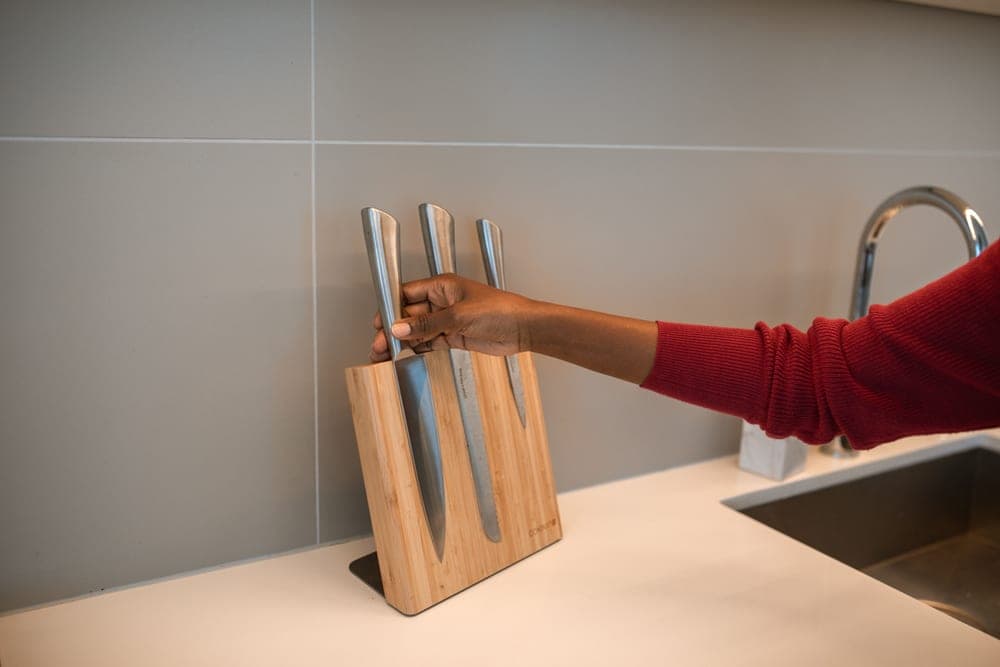 Saya / Magnetic Blade Guard | Anyone whose knives live in a drawer | 8.9 | |
| 3 |  Tojiro DP Gyuto 210mm (F-808) | First Japanese knife | 8.6 |
| Patina | Rust | |
|---|---|---|
| Color | Blue-gray, brown, purple, near-black | Orange or reddish-brown |
| Texture | Smooth, bonded to the surface | Powdery, flaky, raised |
| Wipe test | Stays put | Comes off on the cloth |
| Underneath | Sound steel | A pit |
| Effect | Protects against further oxidation | Continues to consume the steel |
| Action needed | None — leave it | Remove it now |
The wipe test
Take a dry cloth and rub the discolored area firmly. If nothing comes off and the color stays, it is a patina and you should leave it alone. If orange comes off on the cloth and there is a small pit or dull spot underneath, it was rust.
A carbon blade in use develops a mottled, uneven patina — darker where acid has contacted it, lighter along the edge where the steel is refreshed by sharpening. That patchiness is expected and it is not a sign of neglect.
Forcing a patina
A new carbon blade is bright, reactive and vulnerable. Many owners accelerate the process deliberately, which is standard practice rather than a trick:
- Clean the blade thoroughly and dry it.
- Apply the agent. Warm vinegar (submerge or wipe on), strong black tea, or a thin coat of yellow mustard.
- Leave for 15 to 30 minutes. The blade will darken visibly.
- Rinse, dry completely, and oil. Tsubaki (camellia) oil is the traditional choice.
The result is a darker knife that rusts far less readily and stops leaving a metallic tinge on pale fish or apple.
Removing rust
- Light surface rust: a rust eraser, or a paste of baking soda and water on a cloth. Work along the blade, not across it.
- Heavier rust: fine wet-and-dry paper, 800 grit and up, with water. Accept that this removes some patina too.
- Rust on the edge itself: this needs a stone. Sharpen back to clean steel.
- Afterwards, always: dry completely and oil. Bare steel that has just had rust removed is more vulnerable than before.
If rust keeps returning, the cause is a habit rather than the knife — the diagnostic is here.
What about stainless?
Stainless steels form an invisible passive chromium oxide layer instead of a visible patina, which is what makes them stain resistant. They can still spot if left in contact with salt, acid or standing water — that is corrosion, not patina, and it should be cleaned off.
Note that many Japanese knives are clad: a stainless outer with a carbon core, or the reverse. On a stainless-clad carbon-core knife, only the exposed edge bevel will patina, which produces a distinctive dark line along an otherwise bright blade. Carbon against stainless.
The picks in detail
#1 · Anyone who owns carbon steel
Tsubaki (Camellia) Blade Oil
Food-safe, non-drying oil traditionally used on Japanese blades. A few drops after washing is what stands between a carbon-steel knife and a rust bloom.
What it does well
- Genuinely prevents flash rust on carbon steel between uses
- Food safe and effectively odorless
- One small bottle lasts years
Where it gives way
- Unnecessary for most stainless knives
- Needs reapplying after every wash to actually work
- Does nothing for rust that has already started
Skip it if: Stainless owners, mostly. If your knife is VG-10 or CROMOVA and you dry it, you do not need this.
| Type | Non-drying, food-safe plant oil |
|---|---|
| Use | Wipe a thin film on a clean, dry blade |
| Applies to | Carbon steel and clad carbon core blades |
#2 · Anyone whose knives live in a drawer
Saya / Magnetic Blade Guard
The cheapest way to stop a drawer from ruining a good edge. A sheath costs a few dollars; re-profiling a chipped tip costs an evening.
What it does well
- Stops the single most common cause of chipped tips: loose drawer storage
- Cheap enough to buy one per knife
- Makes it safe to reach into a drawer
Where it gives way
- A wet knife sheathed in wood will corrode — dry it properly first
- Sizes are fussy; a loose saya is worse than none
- Adds a step to putting the knife away
Skip it if: Nobody, really — but if you already have a magnetic rack or a proper block, you do not need one too.
| Function | Edge protection in storage and transit |
|---|---|
| Materials | Wood (saya), plastic, or magnet-lined guards |
#3 · First Japanese knife
Tojiro DP Gyuto 210mm (F-808)
The default answer to 'my first real Japanese knife'. VG-10 at around 60 HRC in a plain three-layer build, at a price that makes the inevitable first chip survivable.
What it does well
- VG-10 at 59-60 HRC takes a genuinely fine edge and holds it far longer than a German knife at 56-58
- 1.9 mm spine and 43 mm heel make it thin behind the edge without being fragile
- Cheap enough that learning to sharpen on it is not frightening
Where it gives way
- Handle finish is functional and unlovely; some units need the bolster easing with sandpaper
- Stainless cladding is soft and scratches readily
- Nothing about the fit and finish will impress anyone
Skip it if: Anyone who wants the knife to be beautiful. The handle is a workmanlike composite with a stainless bolster and nothing about it is charming.
| Blade length | 210 mm (8.3 in) |
|---|---|
| Steel | VG-10 core, 13-chrome stainless cladding (san mai) |
| Hardness | 59-60 HRC |
| Heel height | 43 mm |
| Spine at heel | 1.9 mm |
| Weight | approx. 187 g |
| Handle | Western, laminated composite wood with stainless bolster |
Common questions
Is patina on a carbon steel knife bad?
How do I tell patina from rust?
How do I force a patina on a new carbon knife?
Should I remove rust from a carbon knife?
Do stainless knives get a patina?
Sources
Read next
Steel & Care
Why Is My Knife Rusting?
Steel & Care
Carbon vs Stainless Kitchen Knives

Steel & Care
Japanese Knife Care Guide
Steel & Care
Knife Steel Guide
Steel & Care
Knife Storage Guide
Japanese Knives