Japanese Knives
How Much Should You Spend on a Chef Knife?
What this is based on: published manufacturer specifications and retailer listings, cited on each product; the weight of professional and owner reviews across multiple retailers; and hands-on experience sharpening and cooking with knives of this type. We have not individually tested every model listed, we do not run instrumented sharpness testing, and we do not claim a test we did not run.
Quick picks
| # | Product | Best for | Score | Price |
|---|---|---|---|---|
| 1 | 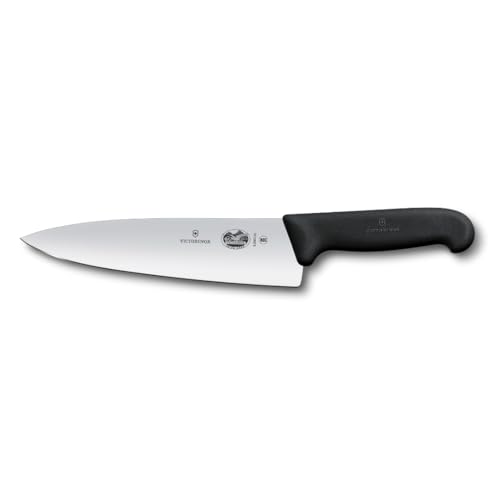 Victorinox Fibrox Pro 8" Chef's Knife | A beater, or a sanity check before you spend more | 7.0 | |
| 2 |  Tojiro DP Gyuto 210mm (F-808) | First Japanese knife | 8.6 | |
| 3 | 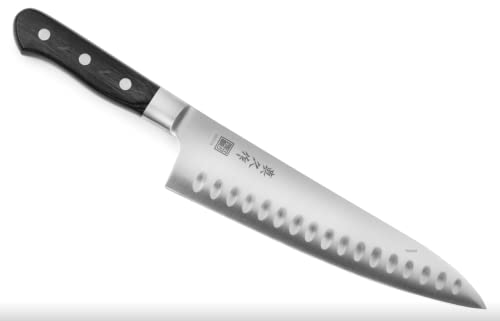 MAC Professional 8" Chef's Knife with Dimples (MTH-80) | The one-knife kitchen | 8.8 | |
| 4 | 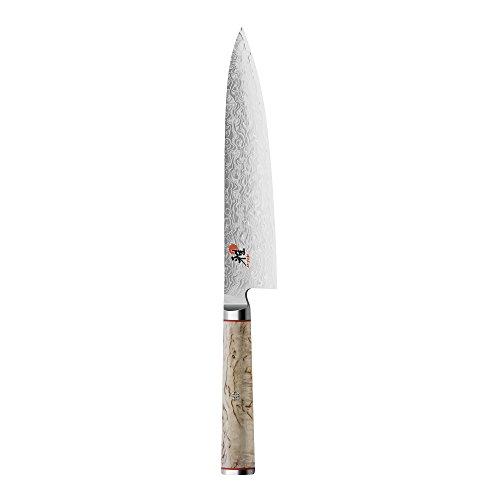 Miyabi Birchwood SG2 8" Chef's Knife | Someone who already sharpens their own | 8.6 |
The question behind the question is usually “am I about to be overcharged?” So here is the shape of the answer before the detail: knife prices rise roughly linearly, and cutting performance rises steeply up to about $150 and then almost flat. Everything above that is edge retention, fit, finish and pleasure. Those are real, and they are not what a first-time buyer thinks they are paying for.
The four bands
Under $50 — enough knife
You get soft stainless around 55 to 57 HRC, a stamped blade, an 18-degree edge and a comfortable synthetic handle. The Victorinox Fibrox Pro is the honest end of this band: 56 HRC, 5.6 oz, no bolster, and the knife most restaurant lines in the country actually run. It dulls faster than anything above it and comes back on a steel rod in thirty seconds, which is exactly the right trade for a knife that will be used by other people.
What you are giving up is thinness. A soft blade has to be thicker to survive, so it wedges in dense vegetables and crushes the shoulder of a ripe tomato instead of parting it.
$100 to $160 — the sweet spot
This is where VG-10 and its equivalents arrive: 59 to 61 HRC, three-layer clad construction, a spine around 1.9 mm, and a factory bevel near 15 degrees per side. The Tojiro DP gyuto is the plain-wrapper version of this band and the Shun Classic is the pretty one. Both cut dramatically better than the band below and hold an edge for weeks rather than days.
This is the answer for most people asking the question. One knife here plus a 1000-grit stone is a better kitchen than three knives from the band below.
$160 to $300 — buying retention and finish
Powder steels appear: SG2 at 63 HRC, hand-finished bevels, real wood handles, rounded spines. Edge life roughly doubles against a 58 HRC German blade. What does not change much is the first cut — a 2.1 mm Miyabi spine is thicker than the 1.9 mm Tojiro below it. Our sub-$300 roundup works through this band knife by knife.
Above $300 — the object
Hand-forged, named-smith, single-bevel and boutique laminate knives live here. They can be extraordinary and they are not a value proposition. If you are asking how much to spend, you are not in this band yet, and nothing in it will make your onions smaller.
Where the money stops helping
| Band | Typical hardness | What improves | What does not |
|---|---|---|---|
| Under $50 | 55-57 HRC | Comfort, durability, replaceability | Thinness, edge life, keenness |
| $100-$160 | 59-61 HRC | Thinness, keenness, edge life | Handle materials, finish |
| $160-$300 | 61-63 HRC | Edge retention, fit and finish | How well it cuts on day one |
| Above $300 | 61-66 HRC | Craft, rarity, character | Anything a home cook can measure |
How to split a fixed budget
If you have $200 total, do not spend $200 on a knife. Spend roughly $140 on the knife, $40 on a 1000-grit stone and the rest on a board that is not bamboo. That kitchen out-cuts a $200 knife on a glass board every week of the year, because the limiting factor in almost every home kitchen is not the knife, it is the edge on it.
- $100: Victorinox Fibrox Pro, a cheap rubber board, a ceramic rod. Nothing here will disappoint you.
- $200: Tojiro DP gyuto plus a beginner whetstone. This is the best $200 in the category.
- $350: MAC MTH-80, a 1000-grit stone, a ceramic rod and a soft rubber board. A kitchen that will not need anything else for a decade.
- $500+: now the Miyabi makes sense, because the rest of the system exists to keep it sharp.
Buying a set. Most of the cost goes into a bread knife, a utility knife and six steak knives you will not use, and the chef's knife in the box is always worse than the one you would have bought alone.
Buying hard steel with no way to sharpen it. A 63 HRC edge in a carbide pull-through slot is money converted into chips. Why.
When a second knife beats a better one
Once you own a competent 8-inch knife, the next $100 buys more capability as a second shape than as a better version of the first. A 165 mm nakiri does vegetable volume in a way no chef's knife matches, and a petty handles the small work that an 8-inch blade makes clumsy. Both cost less than the upgrade step from a $150 gyuto to a $300 one, and both change what you can do rather than how long the edge lasts.
The practical sequence for most kitchens: one 8-inch knife, a stone, a board, then a nakiri or santoku, then a paring knife. Spending the whole budget on step one is what leaves people with an excellent knife and no way to cut a lime. How many knives you actually need.
Two things that are not worth paying for
- Brand prestige without a spec difference. Two knives with the same core steel, the same hardness and the same bevel angle cut the same way regardless of the name. Compare published figures before you compare logos — the brand pages on this site all lead with them.
- Damascus cladding. It is a jacket over the hard core and it contributes nothing to the cut. The explanation.
What is worth paying for, in order: a spine under 2 mm, hardness of 59 HRC or above, a handle that fits your hand, and a factory bevel you can maintain. Those four things are available for around $140, which is why that is the number this page keeps coming back to.
The short answer
One knife, $120 to $160, 8 inches, Japanese stainless at 59-61 HRC. Add a stone before you add a second knife. Revisit the question in two years, when you know which specific thing your knife cannot do — that is the only moment when a more expensive knife is a rational purchase rather than a hopeful one.
If you are weighing the whole category rather than a price, read are Japanese knives worth it next.
For the bottom of that curve specifically, best chef knives under $100 is the shortlist: what the sub-$100 band genuinely contains once the knife sets and the no-name Damascus are thrown out.
The picks in detail
#1 · A beater, or a sanity check before you spend more
Victorinox Fibrox Pro 8" Chef's Knife
Not a Japanese knife and not pretending to be. It is the control sample: if your cooking does not improve after upgrading from this, the knife was never the problem.
What it does well
- Stamped, light and genuinely non-slip when wet
- Soft enough that a pull-through sharpener will not destroy it
- Costs a fraction of everything else here
Where it gives way
- 56 HRC means frequent honing and frequent sharpening
- 18-degree edge is blunt by Japanese standards
- No bolster, no heft, no presence — it feels like a tool because it is one
Skip it if: This site's usual reader. At 56 HRC with an 18-degree edge it is a softer, blunter tool than anything else on this page.
| Blade length | 8 in |
|---|---|
| Steel | X55CrMo14 high-carbon stainless |
| Hardness | 56 HRC |
| Edge angle | 18 degrees |
| Weight | 5.6 oz |
| Handle | Fibrox Pro thermoplastic elastomer, no bolster |
#2 · First Japanese knife
Tojiro DP Gyuto 210mm (F-808)
The default answer to 'my first real Japanese knife'. VG-10 at around 60 HRC in a plain three-layer build, at a price that makes the inevitable first chip survivable.
What it does well
- VG-10 at 59-60 HRC takes a genuinely fine edge and holds it far longer than a German knife at 56-58
- 1.9 mm spine and 43 mm heel make it thin behind the edge without being fragile
- Cheap enough that learning to sharpen on it is not frightening
Where it gives way
- Handle finish is functional and unlovely; some units need the bolster easing with sandpaper
- Stainless cladding is soft and scratches readily
- Nothing about the fit and finish will impress anyone
Skip it if: Anyone who wants the knife to be beautiful. The handle is a workmanlike composite with a stainless bolster and nothing about it is charming.
| Blade length | 210 mm (8.3 in) |
|---|---|
| Steel | VG-10 core, 13-chrome stainless cladding (san mai) |
| Hardness | 59-60 HRC |
| Heel height | 43 mm |
| Spine at heel | 1.9 mm |
| Weight | approx. 187 g |
| Handle | Western, laminated composite wood with stainless bolster |
#3 · The one-knife kitchen
MAC Professional 8" Chef's Knife with Dimples (MTH-80)
The knife that wins the most side-by-side tests and asks the least of you. Thin, light, 61 HRC, and forgiving enough that a mediocre sharpening job still cuts well.
What it does well
- 6.8 oz with a 2.5 mm spine — genuinely light in the hand over a long prep session
- 15 degrees per side from the factory, which is the angle you will maintain anyway
- 25-year warranty and a reputation for consistency unit to unit
Where it gives way
- Costs meaningfully more than a Tojiro DP for a similar hardness
- Mono-steel, so no cladding to protect the core if you drop it edge-first
- The dimples do less for release than the marketing implies
Skip it if: Anyone chasing maximum edge retention. At 61 HRC in a mono-steel it will not out-last a powder-steel blade, and the dimples are cosmetic more often than useful.
| Blade length | 8 in (approx. 200 mm) |
|---|---|
| Steel | Sub-zero tempered high-carbon molybdenum vanadium alloy |
| Hardness | 61 HRC |
| Edge angle | 15 degrees per side (double bevel) |
| Blade height | 1 7/8 in |
| Spine at heel | 2.5 mm |
| Weight | 6.8 oz |
| Handle | Riveted Pakkawood with integrated bolster |
#4 · Someone who already sharpens their own
Miyabi Birchwood SG2 8" Chef's Knife
SG2 powder steel at 63 HRC behind a 9.5-to-12-degree edge and 101 layers of Damascus. The sharpest knife here out of the box, and the least forgiving.
What it does well
- 63 HRC SG2 holds an edge appreciably longer than VG-10 at 60 — commonly cited as roughly twice as long
- A sub-12-degree factory edge is genuinely rare and it shows on the first cut
- 178 g with a 2.1 mm spine — light and thin for a Damascus-clad knife
Where it gives way
- 63 HRC and a very acute edge is a chipping risk on any hard board
- Powder steel is slow on a soft clay stone; you want a hard stone or diamond
- Costs several times what a Tojiro DP does
Skip it if: A first Japanese knife. At 63 HRC with an edge under 12 degrees per side it will chip on a hard board or a careless twist, and it is slow to sharpen on a soft stone.
| Blade length | 8 in |
|---|---|
| Steel | SG2 micro-carbide powder steel core, 50 Damascus layers each side |
| Hardness | 63 HRC, Cryodur ice-hardened |
| Edge angle | approx. 9.5-12 degrees per side, double bevel |
| Blade height | 1.75 in |
| Spine at heel | 2.1 mm |
| Weight | 6.2 oz (178 g) |
| Handle | Karelian birch with stainless bolster and mosaic pin |
| Origin | Seki, Japan |
Common questions
How much should I spend on a chef knife?
Is a $50 chef knife good enough?
Is it worth spending $300 on a chef knife?
Should I buy one good knife or a set?
Sources
Read next
Japanese Knives
Best Gyuto Under $200
Japanese Knives
Best Gyuto Under $300
Japanese Knives
Are Japanese Knives Worth It?
Japanese Knives
Why Are Japanese Knives So Expensive?
Japanese Knives
Best 8-Inch Chef Knives
Japanese Knives