Japanese Knives
Best Gyuto Under $300
What this is based on: published manufacturer specifications and retailer listings, cited on each product; the weight of professional and owner reviews across multiple retailers; and hands-on experience sharpening and cooking with knives of this type. We have not individually tested every model listed, we do not run instrumented sharpness testing, and we do not claim a test we did not run.
Quick picks
| # | Product | Best for | Score | Price |
|---|---|---|---|---|
| 1 | 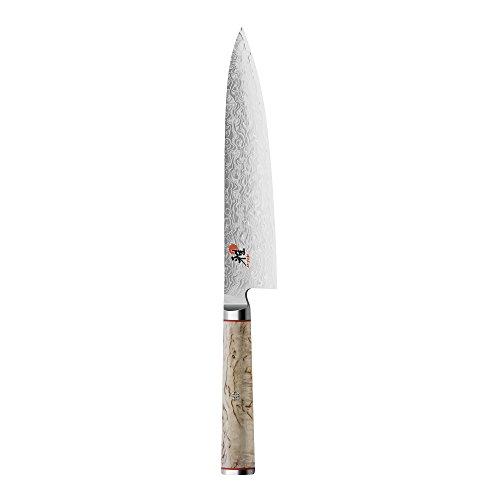 Miyabi Birchwood SG2 8" Chef's Knife | Someone who already sharpens their own | 8.6 | |
| 2 | 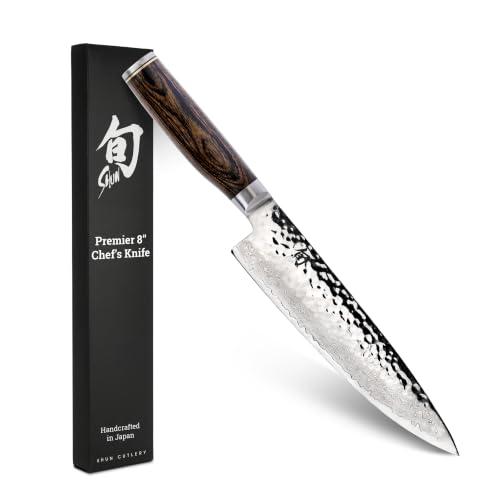 Shun Premier 8" Chef's Knife (TDM0706) | A right- or left-handed cook who wants the Shun edge without a D-handle | 8.2 | |
| 3 | 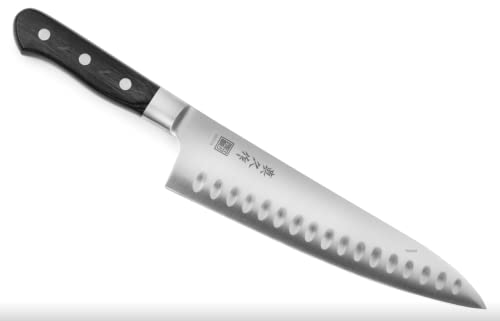 MAC Professional 8" Chef's Knife with Dimples (MTH-80) | The one-knife kitchen | 8.8 | |
| 4 |  Tojiro DP Gyuto 210mm (F-808) | First Japanese knife | 8.6 |
We already have a page on the sub-$200 band, and its conclusion was blunt: somewhere around $150 the cutting performance curve goes flat. This page is about what happens when you keep spending anyway — because the answer is not nothing, it is just not what most buyers assume.
What the extra hundred actually changes
Three things change between $200 and $300, and only one of them is about how the knife cuts on day one.
- Steel class. Below $200 you are buying VG-10 or a good moly-vanadium alloy at 59 to 61 HRC. At the top of this band you can buy SG2 micro-carbide powder steel at 63 HRC. That is a genuine metallurgical step up, and it shows in how long the edge lasts, not in how sharp it gets.
- Finish and fit. Rounded spines and chokes, hand-finished bevels, a handle made of actual wood rather than resin-impregnated composite. None of this cuts anything. All of it is the difference between a tool and a knife you look forward to using.
- Geometry gets slightly better, not dramatically. The Miyabi is 2.1 mm at the spine; the $140 Tojiro is 1.9 mm. The cheaper knife is thinner. Read that twice before you spend.
The four compared
| Steel | Hardness | Edge angle | Spine | |
|---|---|---|---|---|
| Miyabi Birchwood SG2 | SG2 powder core, 50 Damascus layers each side | 63 HRC, ice-hardened | approx. 9.5-12° per side | 2.1 mm |
| Shun Premier 8" | VG-MAX core, 34-layer Damascus each side | 60-61 HRC | approx. 16° per side | 1.9 mm |
| MAC MTH-80 | Sub-zero tempered moly-vanadium | 61 HRC | 15° per side | 2.5 mm |
| Tojiro DP 210 mm | VG-10 core, three-layer clad | 59-60 HRC | approx. 15° per side | 1.9 mm |
Which one to buy
Miyabi Birchwood SG2 if you own stones and use them. At 63 HRC with a sub-12-degree bevel it is the longest-lasting edge in this comparison by a wide margin, and the Karelian birch handle is the only genuinely beautiful object on this page. The catch is real: powder steel at 63 HRC does not forgive lateral twisting, frozen food or a hard board, and it needs a stone rather than a rod to come back properly. See VG-10 against SG2 for the full trade-off.
Shun Premier if the handle is what you are buying. Contoured walnut pakkawood, a hammered tsuchime finish that genuinely reduces stiction, and a 1.9 mm spine. It is 60-61 HRC rather than 63, and at 7.5 oz it is the heaviest Japanese knife here. It is also usable in either hand, unlike the D-handled Classic.
MAC MTH-80 if you want the most knife per dollar in the band. It is 61 HRC at a 15-degree edge with a Pakkawood handle and an integrated bolster, and it is the knife professionals quietly buy with their own money. Compared head to head with the German alternative in MAC vs Wüsthof.
Tojiro DP 210 mm if you want to test whether this band is worth it at all. It is thinner at the spine than every other knife here, VG-10 at 59-60 HRC, and it costs a fraction of the Miyabi. Buy it, buy a 1000-grit stone with the change, and you will know within a month whether you want the SG2.
Under $300 you are not buying a knife that cuts better. You are buying a knife that stays sharp longer and that you like more. Both of those are worth money. Neither of them is worth money if the knife is going to live in a drawer next to a bamboo board and get sharpened once a year.
210 mm, not 240
Every knife on this page is built around the 200 to 210 mm length, and that is the right choice for this band. A 240 mm gyuto in the same steel costs more, needs a board over 450 mm to work properly, and only repays the extra length if you prep in volume. Buying 240 mm because it sounds more serious is the most common way to spend $300 and end up using the knife less.
Blade height matters more than length here. The Miyabi is 1.75 in at the heel and the Shun Premier is 1.9 in, and that eighth of an inch of knuckle clearance is genuinely noticeable in a pinch grip. If your hands are large, take the taller blade. The full argument is in the size guide.
What to avoid in this band
- Damascus for its own sake. The cladding layers do nothing for cutting or for strength — the hard core is the knife. Paying a premium for 67 layers over 34 is paying for pattern. The full explanation.
- A set at this price. A three-piece set at $300 contains a $120 chef's knife and two pieces you will not use. One knife at $300 beats three at $100 every time.
- Powder steel with no stone. SG2 at 63 HRC will not come back on a rod, a pull-through or a block-set steel. If there is no whetstone in the plan, buy the MAC and keep the change.
- A D-shaped handle if you are left-handed. The Shun Classic line is right-biased; the Premier on this page is symmetrical. Left-handed guide.
The verdict
The Miyabi Birchwood SG2 is the best gyuto under $300 on the merits — hardest steel, thinnest bevel, longest edge life, nicest object. It is the right purchase for a cook who has already bought a stone and learned to hold an angle.
For everyone else in this band, the MAC is the better buy and the Tojiro is the smarter one. The band under $300 rewards people who maintain their knives and punishes people who do not, more sharply than any cheaper band does. If you are not sure which you are yet, start with a first stone and come back.
The picks in detail
#1 · Someone who already sharpens their own
Miyabi Birchwood SG2 8" Chef's Knife
SG2 powder steel at 63 HRC behind a 9.5-to-12-degree edge and 101 layers of Damascus. The sharpest knife here out of the box, and the least forgiving.
What it does well
- 63 HRC SG2 holds an edge appreciably longer than VG-10 at 60 — commonly cited as roughly twice as long
- A sub-12-degree factory edge is genuinely rare and it shows on the first cut
- 178 g with a 2.1 mm spine — light and thin for a Damascus-clad knife
Where it gives way
- 63 HRC and a very acute edge is a chipping risk on any hard board
- Powder steel is slow on a soft clay stone; you want a hard stone or diamond
- Costs several times what a Tojiro DP does
Skip it if: A first Japanese knife. At 63 HRC with an edge under 12 degrees per side it will chip on a hard board or a careless twist, and it is slow to sharpen on a soft stone.
| Blade length | 8 in |
|---|---|
| Steel | SG2 micro-carbide powder steel core, 50 Damascus layers each side |
| Hardness | 63 HRC, Cryodur ice-hardened |
| Edge angle | approx. 9.5-12 degrees per side, double bevel |
| Blade height | 1.75 in |
| Spine at heel | 2.1 mm |
| Weight | 6.2 oz (178 g) |
| Handle | Karelian birch with stainless bolster and mosaic pin |
| Origin | Seki, Japan |
#2 · A right- or left-handed cook who wants the Shun edge without a D-handle
Shun Premier 8" Chef's Knife (TDM0706)
The same VG-MAX core and 16-degree edge as the Classic, in a thinner blade with a hammered tsuchime face and a contoured walnut handle. You are buying the finish and the grip, not a better cutter.
What it does well
- Contoured symmetrical handle works in either hand, unlike the Classic D-handle
- 1.9 mm spine is thinner than the Classic at the same blade height, so it wedges less
- Hammered face measurably reduces how much wet food clings to the blade
Where it gives way
- List price sits above the Classic for the same steel, hardness and edge angle, though street prices often overlap
- The walnut handle has no bolster, which some cooks read as less secure
- Hammered finish is cosmetic above the first few millimeters of the edge
Skip it if: Anyone chasing cutting performance per dollar. A MAC MTH-80 or a Tojiro DP cuts as well or better for less.
| Blade length | 8 in (200 mm) |
|---|---|
| Blade height | 1.9 in (47 mm) |
| Spine thickness | 1.9 mm |
| Steel | VG-MAX core, 34-layer SUS410/SUS431 Damascus each side |
| Hardness | 60-61 HRC |
| Edge angle | Approximately 16 degrees per side, double bevel |
| Finish | Hammered tsuchime |
| Handle | Contoured walnut PakkaWood, stainless end cap, 5 in |
| Weight | 7.5 oz (215 g) |
| Origin | Seki, Japan |
| Warranty | Limited lifetime |
#3 · The one-knife kitchen
MAC Professional 8" Chef's Knife with Dimples (MTH-80)
The knife that wins the most side-by-side tests and asks the least of you. Thin, light, 61 HRC, and forgiving enough that a mediocre sharpening job still cuts well.
What it does well
- 6.8 oz with a 2.5 mm spine — genuinely light in the hand over a long prep session
- 15 degrees per side from the factory, which is the angle you will maintain anyway
- 25-year warranty and a reputation for consistency unit to unit
Where it gives way
- Costs meaningfully more than a Tojiro DP for a similar hardness
- Mono-steel, so no cladding to protect the core if you drop it edge-first
- The dimples do less for release than the marketing implies
Skip it if: Anyone chasing maximum edge retention. At 61 HRC in a mono-steel it will not out-last a powder-steel blade, and the dimples are cosmetic more often than useful.
| Blade length | 8 in (approx. 200 mm) |
|---|---|
| Steel | Sub-zero tempered high-carbon molybdenum vanadium alloy |
| Hardness | 61 HRC |
| Edge angle | 15 degrees per side (double bevel) |
| Blade height | 1 7/8 in |
| Spine at heel | 2.5 mm |
| Weight | 6.8 oz |
| Handle | Riveted Pakkawood with integrated bolster |
#4 · First Japanese knife
Tojiro DP Gyuto 210mm (F-808)
The default answer to 'my first real Japanese knife'. VG-10 at around 60 HRC in a plain three-layer build, at a price that makes the inevitable first chip survivable.
What it does well
- VG-10 at 59-60 HRC takes a genuinely fine edge and holds it far longer than a German knife at 56-58
- 1.9 mm spine and 43 mm heel make it thin behind the edge without being fragile
- Cheap enough that learning to sharpen on it is not frightening
Where it gives way
- Handle finish is functional and unlovely; some units need the bolster easing with sandpaper
- Stainless cladding is soft and scratches readily
- Nothing about the fit and finish will impress anyone
Skip it if: Anyone who wants the knife to be beautiful. The handle is a workmanlike composite with a stainless bolster and nothing about it is charming.
| Blade length | 210 mm (8.3 in) |
|---|---|
| Steel | VG-10 core, 13-chrome stainless cladding (san mai) |
| Hardness | 59-60 HRC |
| Heel height | 43 mm |
| Spine at heel | 1.9 mm |
| Weight | approx. 187 g |
| Handle | Western, laminated composite wood with stainless bolster |
Common questions
Is a $300 gyuto better than a $150 one?
Is SG2 powder steel worth it?
What is the best gyuto size under $300?
Should I spend the $300 on a knife or on sharpening gear?
Sources
Read next
Japanese Knives
Best Gyuto Under $200
Japanese Knives
Best Gyuto Knives
Japanese Knives
How Much Should You Spend on a Chef Knife?
Steel & Care
VG-10 vs SG2 Steel
Brands
Shun vs Miyabi
Japanese Knives