Brands
Tojiro vs Global
What this is based on: published manufacturer specifications and retailer listings, cited on each product; the weight of professional and owner reviews across multiple retailers; and hands-on experience sharpening and cooking with knives of this type. We have not individually tested every model listed, we do not run instrumented sharpness testing, and we do not claim a test we did not run.
Quick picks
| # | Product | Best for | Score | Price |
|---|---|---|---|---|
| 1 | 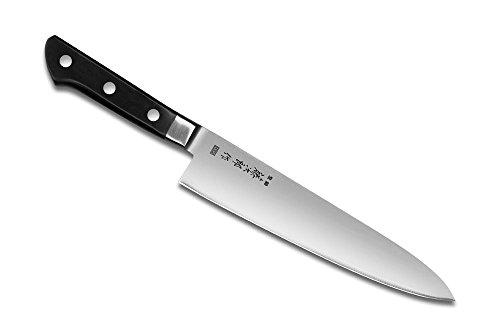 Tojiro DP Gyuto 210mm (F-808) | First Japanese knife | 8.6 | |
| 2 | 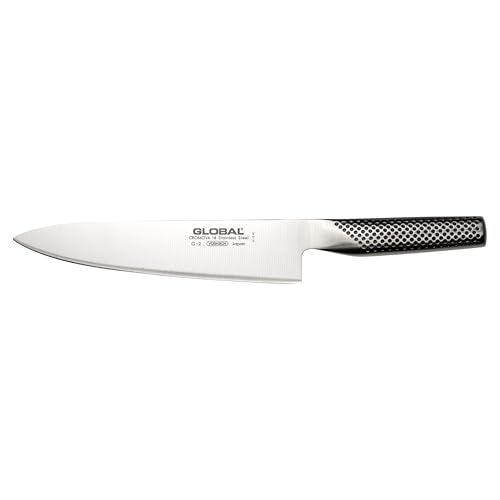 Global G-2 8" Chef's Knife | Cooks who want the lightest knife in the drawer | 7.6 | |
| 3 | 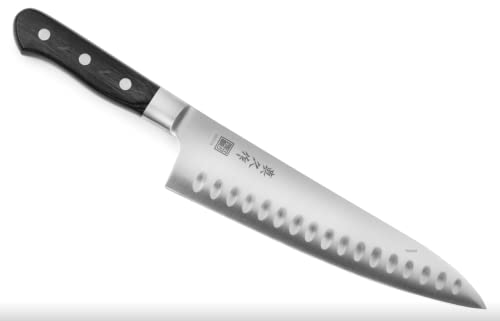 MAC Professional 8" Chef's Knife with Dimples (MTH-80) | The one-knife kitchen | 8.8 |
These two are often shortlisted together because they sit in the same price band and both say “made in Japan”. That is where the similarity ends. One is a laminated knife with a wood-composite Western handle built down to a price; the other is a single piece of mid-hardness stainless with a hollow, sand-filled grip built around a feel.
| Tojiro DP 210 mm | Global G-2 | |
|---|---|---|
| Blade length | 210 mm (8.3 in) | 200 mm (8 in) |
| Steel | VG-10 core, 13-chrome cladding (san mai) | CROMOVA 18 stainless, mono-steel |
| Hardness | 59-60 HRC | 56-58 HRC |
| Factory edge | approx. 15° per side | 10-15°, double bevel |
| Heel height | 43 mm | 45 mm (1.7 in) |
| Spine at heel | 1.9 mm | 2 mm |
| Weight | approx. 187 g | 170 g (6 oz) |
| Handle | Laminated composite wood, stainless bolster | One-piece dimpled stainless, sand-filled |
The steel is the real gap
Two to four points of hardness and a different construction add up to a noticeable difference in how long these knives stay sharp. VG-10 at 59-60 HRC is a genuine step above CROMOVA 18, and Tojiro's san mai build lets them run that hardness without the blade being brittle across its whole width.
Global's published bevel range of 10 to 15 degrees is the detail worth knowing. A 56-58 HRC steel at 10 degrees is very sharp out of the box and does not stay that way, because there is not enough hardness behind that angle to hold it. Most Global owners end up maintaining nearer 15 degrees, which is where the steel is happy.
The handle is the actual decision
The Tojiro's handle is a resin-impregnated wood composite with a stainless bolster. It is competent, charmless and fits essentially every hand, left or right. Nobody buys a Tojiro for the handle; nobody is bothered by it either.
The Global is the opposite. The hollow stainless grip with its dimpled texture is the entire personality of the knife. It is seamless, so there is nowhere for food to collect, and it is grippy wet in a way smooth steel is not. It is also cold, hard and narrow, and a meaningful minority of cooks find it uncomfortable within twenty minutes. There is no way to know which group you are in without holding one.
Who each one is for
- Tojiro DP — stepping up from a block set, wants the hard-steel experience cheaply, does not care what the knife looks like, may well buy a whetstone next. The default answer in your first Japanese knife.
- Global G-2 — has held one and liked it, wants a seamless easy-clean knife, prefers a lighter blade and a very grippy wet handle, is happy to touch up more often.
- Neither — if the handle on the Tojiro puts you off and the Global feels wrong in the hand, the MAC MTH-80 is the knife that solves both complaints at a higher price. It runs 61 HRC with a Pakkawood handle and a 15-degree edge.
The Global is 200 mm and the Tojiro is 210 mm. On a small board that 10 mm is the difference between the heel clearing the edge and not. Size guide.
Maintenance is nearly identical
Both knives are stainless, both are double bevels, and both are happiest at around 15 degrees per side on a 1000-grit stone. Neither belongs in a dishwasher and neither should meet a carbide pull-through. In practice:
- The Global comes back faster. Softer steel raises a burr in fewer strokes, so a dull G-2 is a shorter session than a dull Tojiro.
- The Tojiro needs it less often. Two to four points of hardness buys real interval, which is the whole point of the harder core.
- A ceramic rod helps both. At 56-60 HRC a ceramic rod is harder than either blade and will straighten a rolled edge in seconds. Honing rods.
- The Tojiro gets easier with age. Clad construction means that thinning the blade later only grinds the soft jacket until you reach the core.
What goes wrong with each
The Tojiro's known weakness is the handle junction: the composite scales meet a stainless bolster, and a knife left standing in water can eventually suffer at that seam. Dry it and it is a non-issue for decades. The blade itself is a hard VG-10 core, so the failure mode is chipping — most often from a bone, a frozen edge or a hard board.
The Global has no seam to fail, which is its structural advantage. Its weakness is the edge: at 56-58 HRC, held at an acute factory angle, it rolls quickly and needs more frequent attention. Owners who assume a premium Japanese knife should hold an edge for months are usually disappointed, and the fix is to maintain it at 15 degrees rather than chase the factory 10.
The verdict
The Tojiro DP is the better knife on paper and in a tomato: harder core, thinner spine, longer edge life, lower price. It is the one to buy if you are choosing between them from a screen.
The Global is the one to buy if you have used one. Its appeal is tactile and it does not show up in a specification table, which is exactly why a spec table should not be the only thing you read. If you are choosing between Japanese brands more broadly, start with who makes what.
The picks in detail
#1 · First Japanese knife
Tojiro DP Gyuto 210mm (F-808)
The default answer to 'my first real Japanese knife'. VG-10 at around 60 HRC in a plain three-layer build, at a price that makes the inevitable first chip survivable.
What it does well
- VG-10 at 59-60 HRC takes a genuinely fine edge and holds it far longer than a German knife at 56-58
- 1.9 mm spine and 43 mm heel make it thin behind the edge without being fragile
- Cheap enough that learning to sharpen on it is not frightening
Where it gives way
- Handle finish is functional and unlovely; some units need the bolster easing with sandpaper
- Stainless cladding is soft and scratches readily
- Nothing about the fit and finish will impress anyone
Skip it if: Anyone who wants the knife to be beautiful. The handle is a workmanlike composite with a stainless bolster and nothing about it is charming.
| Blade length | 210 mm (8.3 in) |
|---|---|
| Steel | VG-10 core, 13-chrome stainless cladding (san mai) |
| Hardness | 59-60 HRC |
| Heel height | 43 mm |
| Spine at heel | 1.9 mm |
| Weight | approx. 187 g |
| Handle | Western, laminated composite wood with stainless bolster |
#2 · Cooks who want the lightest knife in the drawer
Global G-2 8" Chef's Knife
One piece of steel, dimpled hollow handle, 170 g. Nothing else feels like it — which is exactly why you should hold one before you buy.
What it does well
- 170 g and perfectly balanced — the least tiring knife here over two hours of prep
- One-piece construction with no rivets or bolster to trap food
- 2 mm spine means it is thin behind the edge out of the box
Where it gives way
- 56-58 HRC is soft for a Japanese knife; expect to hone it often
- The dimpled steel handle is polarizing and slick when wet
- CROMOVA 18 does not take as fine a finishing edge as VG-10
Skip it if: Anyone with wet hands and no patience: the smooth steel handle gets slippery, and at 56-58 HRC it will not hold an edge like a 61 HRC blade.
| Blade length | 8 in (200 mm) |
|---|---|
| Steel | CROMOVA 18 stainless |
| Hardness | 56-58 HRC |
| Edge angle | 10-15 degrees, double bevel |
| Blade height | 1.7 in (45 mm) |
| Spine | 2 mm |
| Weight | 6 oz (170 g) |
#3 · The one-knife kitchen
MAC Professional 8" Chef's Knife with Dimples (MTH-80)
The knife that wins the most side-by-side tests and asks the least of you. Thin, light, 61 HRC, and forgiving enough that a mediocre sharpening job still cuts well.
What it does well
- 6.8 oz with a 2.5 mm spine — genuinely light in the hand over a long prep session
- 15 degrees per side from the factory, which is the angle you will maintain anyway
- 25-year warranty and a reputation for consistency unit to unit
Where it gives way
- Costs meaningfully more than a Tojiro DP for a similar hardness
- Mono-steel, so no cladding to protect the core if you drop it edge-first
- The dimples do less for release than the marketing implies
Skip it if: Anyone chasing maximum edge retention. At 61 HRC in a mono-steel it will not out-last a powder-steel blade, and the dimples are cosmetic more often than useful.
| Blade length | 8 in (approx. 200 mm) |
|---|---|
| Steel | Sub-zero tempered high-carbon molybdenum vanadium alloy |
| Hardness | 61 HRC |
| Edge angle | 15 degrees per side (double bevel) |
| Blade height | 1 7/8 in |
| Spine at heel | 2.5 mm |
| Weight | 6.8 oz |
| Handle | Riveted Pakkawood with integrated bolster |
Common questions
Is Tojiro better than Global?
Why do chefs use Global knives?
Is Global CROMOVA 18 good steel?
Which is easier to sharpen?
Sources
Read next
Brands
Tojiro vs Shun
Brands
Shun vs Global
Brands
Tojiro vs MAC
Japanese Knives
Best Japanese Knives Under $100
Japanese Knives
Best 8-Inch Chef Knives