Brands
Victorinox vs Zwilling
What this is based on: published manufacturer specifications and retailer listings, cited on each product; the weight of professional and owner reviews across multiple retailers; and hands-on experience sharpening and cooking with knives of this type. We have not individually tested every model listed, we do not run instrumented sharpness testing, and we do not claim a test we did not run.
Quick picks
| # | Product | Best for | Score | Price |
|---|---|---|---|---|
| 1 | 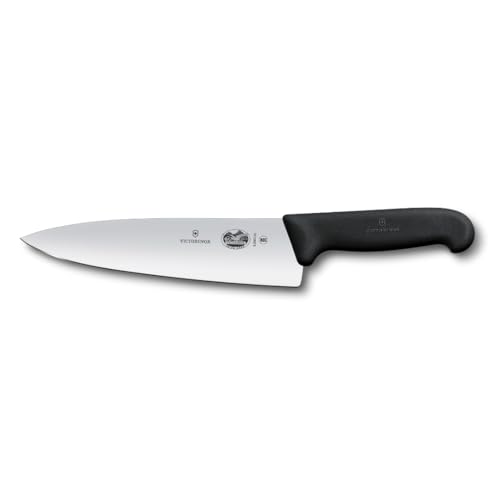 Victorinox Fibrox Pro 8" Chef's Knife | A beater, or a sanity check before you spend more | 7.0 | |
| 2 | 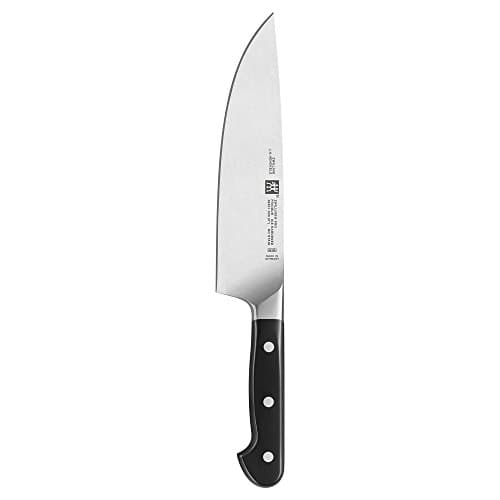 Zwilling Pro 8" Chef's Knife (38401-203) | Cooks who choke up on the blade | 7.3 | |
| 3 |  Tojiro DP Gyuto 210mm (F-808) | First Japanese knife | 8.6 |
This is the stamped-against-forged question, and it is usually asked the wrong way round. People assume the forged knife must cut better and are looking for permission to spend the money. The published numbers say something more interesting: the two knives are nearly identical where sharpness is decided, and wildly different everywhere you actually feel a knife.
The published numbers
| Victorinox Fibrox Pro 8" | Zwilling Pro 8" | |
|---|---|---|
| Blade length | 8 in | 8 in |
| Construction | Stamped, no bolster | Forged, full tang, curved half bolster |
| Steel | X55CrMo14 high-carbon stainless | Friodur X2 ice-hardened high-carbon stainless |
| Hardness | 56 HRC | 57 HRC |
| Factory edge | 18° | approx. 15° per side, double bevel |
| Blade height | Not published | 1.87 in |
| Spine at heel | Not published | 3.25 mm |
| Weight | 5.6 oz | 9.3 oz (266 g) |
| Handle | Fibrox Pro thermoplastic elastomer | Triple-riveted resin, curved half bolster |
| Origin | Switzerland | Made in Germany |
| Warranty | Lifetime against defects | Lifetime |
Victorinox does not publish a spine thickness or a blade height for the Fibrox Pro, so those cells stay empty rather than filled with a guess. The weight it does publish tells you most of what you need: 5.6 oz against 9.3 oz is not a refinement, it is a different class of object.
Stamped against forged, and what forging does not do
A stamped blade is cut from rolled sheet steel and ground. A forged blade starts as a billet, is hammered to shape, and emerges with a bolster and a full tang as part of the same piece of metal. Forging buys three real things: mass, a bolster, and a tang that runs the length of the handle.
What it does not buy is hardness or a finer edge. Hardness comes from the steel and the heat treatment, which is why these two land one point apart at 56 and 57 HRC despite one costing several times the other. Nor does forging make a blade thinner - it makes it thicker, which is the opposite of what improves cutting. The Zwilling's 3.25 mm spine is the thickest figure in our registry.
Three things decide how a knife cuts: how thin the blade is behind the edge, how acute the bevel is, and how hard the steel is so that bevel stays put. Forging affects none of them favorably. If you want the version of this with numbers, Japanese against German knives runs the whole comparison, and our knife steel guide puts the hardness ladder in one table.
One Rockwell point, and the honing habit both knives need
56 HRC and 57 HRC are, practically speaking, the same proposition. Both edges roll rather than chip. Both come back with a few passes on a grooved steel rod, which is the pairing these knives were designed around and the reason a steel rod lives in every German knife block. Honing is not sharpening, and on steel this soft the distinction is the whole maintenance routine: hone two or three times a week, sharpen on a stone a few times a year.
Zwilling's Friodur ice-hardening is a real process rather than a sticker - it is what lets a 57 HRC stainless carry an approximately 15-degree-per-side factory bevel and resist corrosion while doing it. But a heat treatment cannot move hardness far, and it has not moved it far here. The Victorinox's more obtuse 18-degree factory edge is the more honest setting for 56 HRC steel; it is blunter on arrival and it survives a careless cook better.
Both are easy, forgiving knives to learn freehand sharpening on, and that is a genuine recommendation rather than a consolation. Soft steel grinds fast and raises a burr quickly, which is exactly what you want when you are still learning what a burr feels like. How to use a whetstone is the place to start, and easiest knives to sharpen explains why these two sit near the top of that list.
5.6 oz against 9.3 oz
This is the difference you will notice in the first thirty seconds. The Zwilling drops through an onion under its own weight and feels like a tool with intent. The Victorinox feels like nothing in the hand, which is either its best feature or its worst depending on who you are.
Over an hour of prep most people prefer the lighter knife. Over a butternut squash most prefer the heavier one. Cooks with wrist or hand pain almost always prefer the Victorinox, and our knives for arthritis guide covers why mass works against you there. Cooks who learned on a heavy knife often find a 5.6 oz blade unnervingly insubstantial and never warm to it. Neither reaction is wrong; they are just different hands.
The curved half bolster is Zwilling's best idea
Most forged German knives carry a full bolster running down to the heel. It feels substantial and it causes two problems: you cannot choke your index finger up onto the blade for fine work, and you cannot sharpen the last half inch of edge, because the bolster stands proud of it. Over years that leaves a permanent un-sharpened stub at the heel.
The Zwilling Pro's bolster curves away instead, clearing the heel entirely. That is the reason this is the German knife we would hand to someone who sharpens their own, and it is a better answer than the Wusthof Classic gives. The Victorinox sidesteps the problem differently: it has no bolster at all, so the whole edge reaches the stone from day one.
The handles are a genuine split. Fibrox Pro is a textured thermoplastic elastomer that stays grippy when your hands are wet or greasy, which is why it is the handle you see in commercial kitchens and on fishing boats. Zwilling's triple-riveted resin is harder, smoother and better looking, and it is noticeably less secure wet. Both are symmetrical, so neither has any handedness.
Which one to buy
- You want the most knife for the least money. Victorinox Fibrox Pro. Nothing at its price is close, and it is the knife we use as the control sample on this site for exactly that reason.
- You want weight, a forged tang and a bolster you can sharpen past. Zwilling Pro. The curved half bolster is the single best design detail in this comparison.
- Your hands hurt after prep. Victorinox, clearly. 5.6 oz against 9.3 oz is the whole argument.
- Your complaint is that your knife wedges in dense produce. Neither. That is spine thickness, and the Zwilling is the thickest blade we list. Read on.
- The knife is going into a wet, busy or shared kitchen. Victorinox. The Fibrox handle is the most secure grip here when wet, and the knife is cheap enough to replace without resentment.
The third answer, if you are upgrading rather than replacing
This site exists for the cook who already owns a knife like one of these and wants the next one to cut better. If that is you, the honest answer is that neither of these knives is the upgrade, because they are a Rockwell point apart and both are thick behind the edge. The step that changes the cut is a thinner, harder blade.
The Tojiro DP gyuto is the cheapest honest version of that step: a VG-10 core at 59-61 HRC, a 1.9 mm spine against the Zwilling's 3.25 mm, 43 mm of heel height and about 187 g. It is thinner, harder and lighter than the Zwilling at a lower price, and the handle is the only part of it that is worse. Our Tojiro DP review is the full write-up and first Japanese knife covers the decision around it.
The warning that belongs with that recommendation: a 61 HRC blade chips where a 57 HRC blade would roll, it does not want a grooved steel rod, and it will not forgive a frozen chicken or a glass board. Why is my knife chipping is the page people reach for after making that mistake.
The verdict
The Victorinox Fibrox Pro wins on value by a margin that is not really arguable, and it is a legitimately good knife rather than a cheap one. The Zwilling Pro is the better object: forged, balanced, warranted, and carrying the one piece of handle geometry in this category that solves a real problem. Choose between them on weight and feel, because sharpness is not on the table - one Rockwell point never is.
And if the reason you are comparing them is that your current knife has stopped satisfying you, spend the Zwilling money on a thinner blade instead. Our Victorinox Fibrox Pro review explains why we keep it as the control sample, Shun against Zwilling is the same German knife measured against a Japanese one, and how much to spend on a chef's knife sets out where the money stops buying performance.
And if part of what you want from the next knife is the look, Shun against Dalstrong compares the two best-known Damascus-clad blades at opposite ends of the price range, and is blunt about what the pattern does and does not do.
Zwilling is not the only knife in that corporate group a Victorinox buyer cross-shops. Victorinox against Henckels takes on the cheaper Henckels Classic - forged, made in Spain, and published without a single performance figure.
The picks in detail
#1 · A beater, or a sanity check before you spend more
Victorinox Fibrox Pro 8" Chef's Knife
Not a Japanese knife and not pretending to be. It is the control sample: if your cooking does not improve after upgrading from this, the knife was never the problem.
What it does well
- Stamped, light and genuinely non-slip when wet
- Soft enough that a pull-through sharpener will not destroy it
- Costs a fraction of everything else here
Where it gives way
- 56 HRC means frequent honing and frequent sharpening
- 18-degree edge is blunt by Japanese standards
- No bolster, no heft, no presence — it feels like a tool because it is one
Skip it if: This site's usual reader. At 56 HRC with an 18-degree edge it is a softer, blunter tool than anything else on this page.
| Blade length | 8 in |
|---|---|
| Steel | X55CrMo14 high-carbon stainless |
| Hardness | 56 HRC |
| Edge angle | 18 degrees |
| Weight | 5.6 oz |
| Handle | Fibrox Pro thermoplastic elastomer, no bolster |
#2 · Cooks who choke up on the blade
Zwilling Pro 8" Chef's Knife (38401-203)
The German knife with the curved half bolster, which is the one real ergonomic idea in this category. 57 HRC and 3.25 mm at the spine, so it is tough rather than keen.
What it does well
- The curved half bolster leaves the heel clear, so you can sharpen the whole edge and choke up onto the blade
- Friodur ice-hardening and a forged full tang - this is a knife that tolerates a careless kitchen
- 15 degrees per side is more acute than the German reputation suggests
Where it gives way
- 3.25 mm at the spine is the thickest blade here; it wedges in dense produce
- 57 HRC gives up real edge retention to any 60+ HRC Japanese blade
- 266 g is heavy over a long prep session
Skip it if: Anyone whose complaint is wedging. At 3.25 mm the spine is the thickest in our registry, and no amount of sharpening thins a blade.
| Blade length | 8 in |
|---|---|
| Blade height | 1.87 in |
| Overall length | 13 in |
| Steel | Friodur X2 ice-hardened high-carbon stainless |
| Hardness | 57 HRC |
| Edge angle | approx. 15 degrees per side, double bevel |
| Spine at heel | 3.25 mm |
| Weight | 9.3 oz (266 g) |
| Handle | Triple-riveted resin with a curved half bolster |
| Origin | Made in Germany |
#3 · First Japanese knife
Tojiro DP Gyuto 210mm (F-808)
The default answer to 'my first real Japanese knife'. VG-10 at around 60 HRC in a plain three-layer build, at a price that makes the inevitable first chip survivable.
What it does well
- VG-10 at 59-60 HRC takes a genuinely fine edge and holds it far longer than a German knife at 56-58
- 1.9 mm spine and 43 mm heel make it thin behind the edge without being fragile
- Cheap enough that learning to sharpen on it is not frightening
Where it gives way
- Handle finish is functional and unlovely; some units need the bolster easing with sandpaper
- Stainless cladding is soft and scratches readily
- Nothing about the fit and finish will impress anyone
Skip it if: Anyone who wants the knife to be beautiful. The handle is a workmanlike composite with a stainless bolster and nothing about it is charming.
| Blade length | 210 mm (8.3 in) |
|---|---|
| Steel | VG-10 core, 13-chrome stainless cladding (san mai) |
| Hardness | 59-60 HRC |
| Heel height | 43 mm |
| Spine at heel | 1.9 mm |
| Weight | approx. 187 g |
| Handle | Western, laminated composite wood with stainless bolster |
Common questions
Is the Zwilling worth four times the price of the Victorinox?
Is a stamped knife worse than a forged one?
Which is better for learning to sharpen?
Are Zwilling, Henckels and Miyabi the same company?
Can I put either in the dishwasher?
Sources
Read next
Brands
Victorinox vs Wüsthof
Brands
Shun vs Zwilling
Japanese Knives
Japanese vs German Knives
Japanese Knives
How Much Should You Spend on a Chef Knife?