Sharpeners
Best Knife Sharpeners for German Knives
What this is based on: published manufacturer specifications and retailer listings, cited on each product; the weight of professional and owner reviews across multiple retailers; and hands-on experience sharpening and cooking with knives of this type. We have not individually tested every model listed, we do not run instrumented sharpness testing, and we do not claim a test we did not run.
Quick picks
| # | Product | Best for | Score | Price |
|---|---|---|---|---|
| 1 | 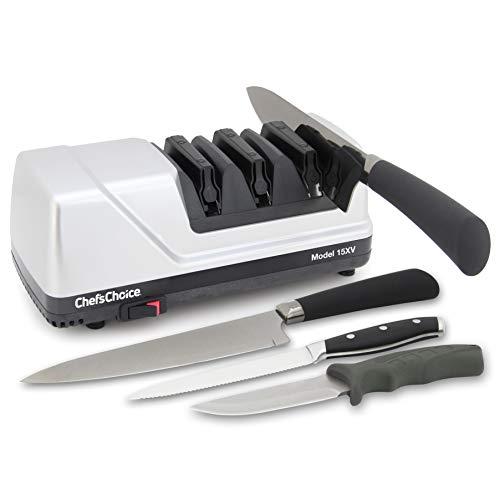 Chef'sChoice Trizor XV Model 15XV Electric Sharpener | A drawer of German knives you will never hand-sharpen | 7.6 | |
| 2 | 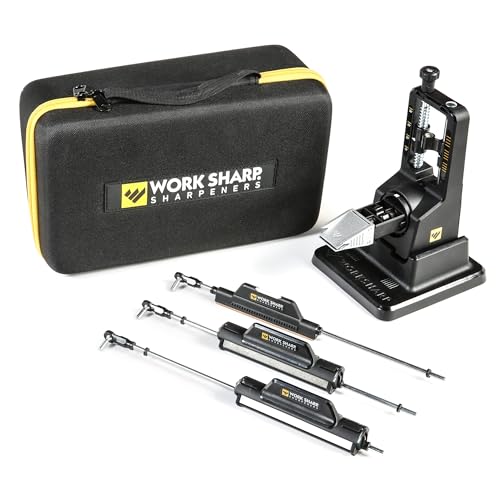 Work Sharp Precision Adjust Elite | Repeatable angles without years of practice | 8.2 | |
| 3 | 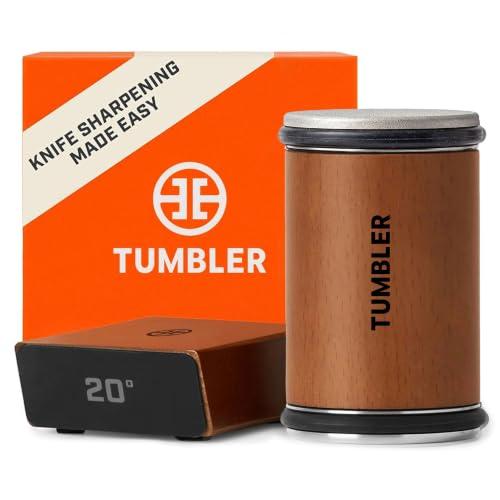 Tumbler Rolling Knife Sharpener | People who want a fixed angle and hate gear | 8.0 | |
| 4 | 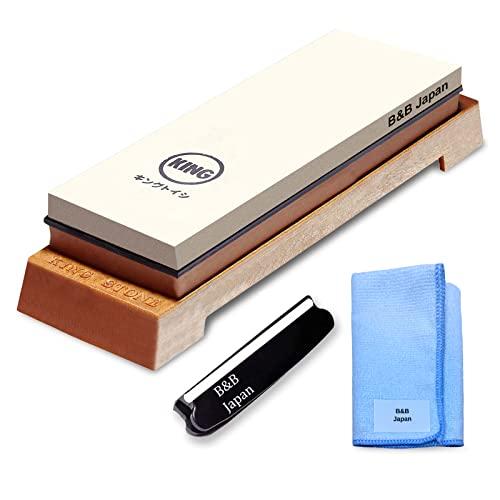 King 1000/6000 Combination Whetstone (Starter Set) | Your first stone | 8.4 |
German knives are a genuinely different sharpening problem from Japanese ones, and most buying advice ignores it. X50CrMoV15 at 58 HRC and X55CrMo14 at 56 HRC are softer, thicker and usually ground wider than VG-10 at 60. That changes three things: how the edge fails, how much abrasion it tolerates, and what angle is worth chasing.
Why soft steel changes the answer
- It rolls instead of chipping. A soft edge deforms sideways under load. That is damage a honing rod straightens in seconds, which is why a German knife lives happily with a rod and a Japanese knife does not.
- It tolerates aggressive abrasives. The carbide and diamond mechanisms that wreck a 61 HRC Japanese edge are survivable on 56-58 HRC steel. Survivable is not the same as ideal, but the risk calculus genuinely differs.
- Reprofiling is on the table. Converting a 20-degree German edge to 15 degrees makes a real difference to how it cuts. On a Japanese knife already ground at 15, there is nothing to convert.
- It needs sharpening more often. Lower hardness means shorter edge life, full stop. Plan on more frequent maintenance than a Japanese knife needs — see how often to sharpen.
What to look for
| Type | Angle control | Steel removed | Best for |
|---|---|---|---|
| Electric, 3-stage diamond | Fixed, 15° | High | Several German knives, no interest in technique |
| Guided clamp system | 15-30°, 1° steps | Controlled | Matching each knife's own factory angle |
| Rolling sharpener | Fixed, 15° or 20° | Low to moderate | Quick upkeep with almost no learning |
| Whetstone | Whatever you hold | Lowest | Cheapest and kindest, if you will learn |
The four picks
Chef'sChoice Trizor XV — best for a drawer of German knives
Three stages, 100 percent diamond abrasives in the first two, a stropping stage third, and a 15-degree Trizor triple bevel at the end of it. It also handles serrated edges. On a soft German blade the result is a genuine improvement over the factory grind, and the machine does the angle for you.
The honest caveat: a full conversion takes a lot of steel off, and it is permanent. Do not put a Japanese knife in it — that argument is in electric sharpener against whetstone.
Work Sharp Precision Adjust Elite — best guided system
A V-block clamp with an angle range of 15 to 30 degrees in one-degree increments, five diamond plates from 220 to 800 grit, a fine ceramic, a leather strop and a rod for serrations. If your German knives have different factory angles — a 14-degree Wüsthof Classic next to an 18-degree Victorinox — this is the only pick here that can respect both.
Tumbler Rolling Sharpener — best simple option
A magnetic holder and a rolling abrasive disc at a fixed 15 or 20 degrees. Twenty degrees is exactly where a lot of older German knives already sit, so upkeep is quick and there is nothing to learn. It removes far less steel than an electric and takes about a minute per knife. Compared with the alternatives in the rolling sharpener roundup.
King KDS 1000/6000 — best stone for German steel
The cheapest and kindest option by a distance. A soft clay-binder stone cuts soft steel quickly, and German blades raise a burr far faster than a hard Japanese core does — a dull Wüsthof is maybe ten minutes of work on the 1000 side. The 6000 side then puts a polish on it that no electric can.
The #1000 face wants a 10 to 15 minute soak; the #6000 face is splash-only. Start with how to use a whetstone.
A German knife with a honing rod beside the board stays usable for months. The rod does not sharpen — it straightens a rolled edge, which is the specific failure mode of soft steel. A ceramic rod is the single highest-value purchase for a German knife owner. Honing rods.
Check the angle before you convert anything
There is no single German sharpening angle, and the assumption that there is causes most of the bad outcomes here. Wüsthof publishes 14 degrees per side on the Classic. Victorinox grinds the Fibrox Pro nearer 18 degrees. Older German knives, and most knives that came in a block set, are frequently 20.
That matters because a fixed 15-degree machine does something different to each of them. On a 20-degree block-set knife it is a genuine improvement. On a 14-degree Wüsthof Classic it widens the edge and the knife cuts worse than it did — which is the opposite of what the buyer wanted and is not reversible without a lot of stone work. Look up your knife in the angle chart before you commit.
How often soft steel needs this
A German knife in daily home use wants honing weekly and sharpening perhaps three or four times a year. That is more frequent than a Japanese knife, and it is a direct consequence of hardness: 56-58 HRC steel deforms long before it wears away.
- Weekly: a few passes on a ceramic rod. This is the step that does most of the work and the one most people skip.
- Every few months: a stone or a machine, when the rod stops restoring the cut.
- Once: a reprofile from 20 degrees to 15, if the knife came that way and you want it to cut better. This is the one job an electric genuinely does best.
If you find yourself reaching for the sharpener far more often than that, the problem is probably the board rather than the steel — why does my knife get dull so fast.
The verdict
The Chef'sChoice Trizor XV is the right answer for the buyer this page is written for: several German knives, no Japanese knives, no interest in learning stones. It converts them to a 15-degree edge and keeps them there with no skill required.
If you own even one hard Japanese knife, buy the Work Sharp instead and set the angle per knife, or buy the King stone and learn — it costs less than either machine and takes nothing off that you did not intend.
The top pick here is reviewed in full in the Chef'sChoice Trizor XV review, including the three-stage sequence and when to skip stage one.
The picks in detail
#1 · A drawer of German knives you will never hand-sharpen
Chef'sChoice Trizor XV Model 15XV Electric Sharpener
A three-stage diamond machine that converts a 20-degree Western edge to a 15-degree triple bevel in about a minute. It works, and it removes a lot of steel doing it.
What it does well
- Genuinely converts a 20-degree factory edge to 15 degrees, which most people cannot do freehand
- About a minute per knife, repeatable, no skill required
- Handles serrated edges, which stones cannot
Where it gives way
- Removes far more steel than a stone; a knife has a finite number of passes in it
- Cannot follow an existing asymmetric or single-bevel grind
- Bulky and loud on a countertop
Skip it if: A thin, hard Japanese knife. It reprofiles rather than follows, and on a single-bevel or a 61+ HRC blade that is damage, not maintenance.
| Edge angle | 15 degrees (Trizor XV triple bevel) |
|---|---|
| Stages | 3 — diamond shaping, diamond sharpening, stropping/polishing |
| Abrasives | 100% diamond in stages 1 and 2 |
| Serrated | Yes, supported |
| Dimensions | 10 x 4.2 x 4.2 in, 4.2 lb |
#2 · Repeatable angles without years of practice
Work Sharp Precision Adjust Elite
A clamped, angle-guided system adjustable from 15 to 30 degrees in one-degree steps, with five diamond plates, a ceramic and a strop. It removes the one variable beginners cannot control.
What it does well
- One-degree angle increments mean you can actually match a 15-degree Japanese factory edge
- Seven abrasive options covers repair through polish
- Angle repeatability is the thing beginners lack, and this supplies it
Where it gives way
- Clamp limits blade length and height
- Slower per knife than a competent freehand session
- A lot of parts to store and lose
Skip it if: Long or very tall blades. A clamp-and-rod system fights a 240 mm gyuto, and it is slow compared to a stone once you can hold an angle.
| Angle range | 15-30 degrees, 1-degree increments |
|---|---|
| Abrasives | 220, 320, 400, 600, 800 diamond plates + fine ceramic |
| Also included | Leather strop and ceramic rod for serrations |
| Clamp | V-Block |
| Storage | Carry case and Tri-Brasive rack |
#3 · People who want a fixed angle and hate gear
Tumbler Rolling Knife Sharpener
A magnetic holder and a rolling abrasive disc that fixes your angle at 15 or 20 degrees. Two pieces, almost no learning curve.
What it does well
- Two pieces, nothing to assemble, nothing to set
- 15-degree setting is the correct angle for most Japanese kitchen knives
- Cheaper than the German alternative and, in side-by-side comparisons, as sharp
Where it gives way
- Magnetic holder limits you to the angles it offers
- Rolls less smoothly than the Horl 2
- Does nothing for a chipped or badly reprofiled edge
Skip it if: Anyone who wants to learn to sharpen. It works by removing the skill, which means you never acquire it.
| Angles | 15 degrees and 20 degrees |
|---|---|
| Components | Sharpening roller + magnetic knife holder |
| Origin | Made in China |
#4 · Your first stone
King 1000/6000 Combination Whetstone (Starter Set)
The stone almost everyone learns on. Soft, forgiving, cheap, and it tells you loudly when your angle wanders.
What it does well
- Two useful grits in one block for the price of half a premium stone
- Soft binder builds slurry readily, which gives beginners real feedback
- Almost impossible to damage a knife on it
Where it gives way
- Dishes quickly and needs flattening often
- The soak is a real commitment — you cannot sharpen on a whim
- Slow on hard powder steels like SG2
Skip it if: Impatient people. The 1000 side wants a 10-15 minute soak before every session and the clay binder dishes fast.
| Grits | #1000 / #6000, combination |
|---|---|
| Binder | Clay |
| Soaking | #1000 side: 10-15 minutes. #6000 side: splash only |
| Size | 207 x 66 x 36 mm |
| Weight | approx. 956 g |
| In the box | Stone, plastic base, angle holder and wiping cloth |
Common questions
What is the best sharpener for German knives?
Can you use a Japanese whetstone on German knives?
What angle should German knives be sharpened at?
Do German knives need honing more often than Japanese knives?
Sources
Read next
Sharpeners
Best Electric Knife Sharpeners
Whetstones & Skill
Knife Sharpening Angle Chart
Japanese Knives
Japanese vs German Knives
Sharpeners