Sharpeners
Do Electric Knife Sharpeners Ruin Knives?
What this is based on: published manufacturer specifications and retailer listings, cited on each product; the weight of professional and owner reviews across multiple retailers; and hands-on experience sharpening and cooking with knives of this type. We have not individually tested every model listed, we do not run instrumented sharpness testing, and we do not claim a test we did not run.
Quick picks
| # | Product | Best for | Score | Price |
|---|---|---|---|---|
| 1 | 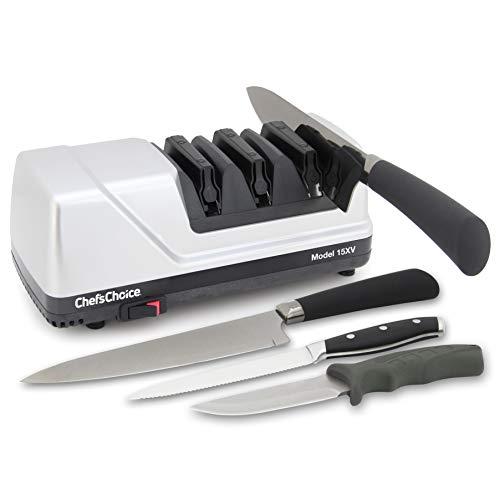 Chef'sChoice Trizor XV Model 15XV Electric Sharpener | A drawer of German knives you will never hand-sharpen | 7.6 | |
| 2 | 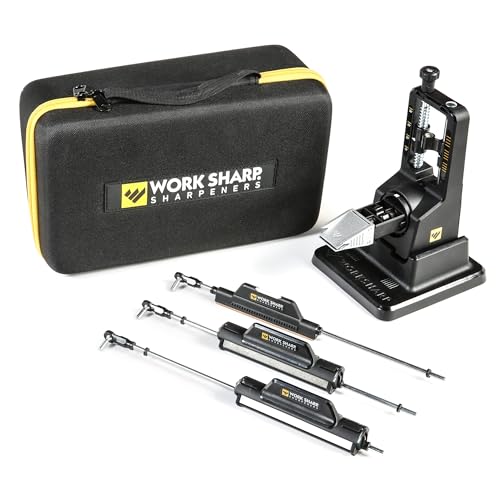 Work Sharp Precision Adjust Elite | Repeatable angles without years of practice | 8.2 | |
| 3 | 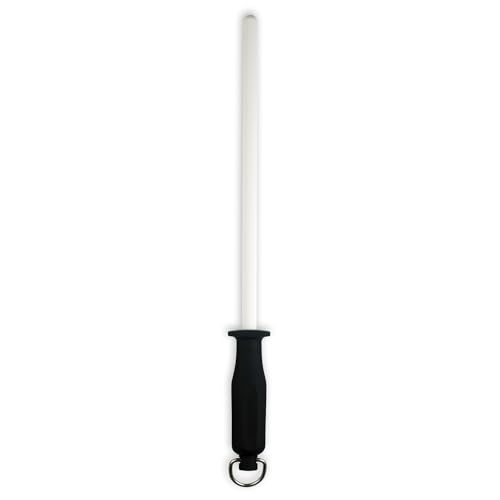 Messermeister 12" Fine Ceramic Sharpening Rod (CR-12F) | Maintaining a hard Japanese edge between sharpenings | 8.8 |
“Ruin” is doing a lot of work in that question, so let us be precise about what an electric sharpener actually does. It spins an abrasive wheel against the edge at a fixed angle, usually 15 or 20 degrees per side, and it does so quickly. Two consequences follow, and they are the whole story.
The two real problems
1. It removes a great deal of steel
A 1000-grit whetstone takes a few microns off a bevel in a careful session. A diamond wheel under motor power takes visibly more, and a full reprofile takes more still. None of that steel comes back. Over a decade of monthly machine sharpening a blade loses measurable height, the heel-to-tip profile changes, and the knife begins to feel different on the board.
That is not catastrophic on a thick, cheap knife. It is a serious waste on a clad Japanese blade where the hard core is a thin layer in the middle of the sandwich.
2. It imposes its own angle
A fixed-angle machine grinds every knife you feed it to the same bevel. If your knife was ground wider, the machine thins it, which is often an improvement. If your knife was ground narrower — the 15-degree MAC, the 16-degree Shun, the sub-12-degree Miyabi — the machine grinds the edge back to its own figure and the knife stops cutting the way it was designed to. Check your knife against the angle chart before you plug anything in.
When an electric sharpener is genuinely fine
- Soft German and Swiss steel. 56-58 HRC at 18-20 degrees from the factory. A Trizor XV conversion to 15 degrees is a real upgrade to how the knife cuts, and the steel tolerates the abrasion.
- A drawer of mismatched knives nobody will hand-sharpen. A dull knife is more dangerous than a machine-sharpened one. A machine that gets used beats a stone that does not.
- Serrated blades, on machines that explicitly support them. A stone cannot do this at all.
- Knives you expect to replace. Steel loss only matters if you intend to keep the knife for twenty years.
When it is a mistake
- Any hard Japanese knife. VG-10, VG-MAX, SG2, HAP40 — 59 HRC and up. The edge chips and the geometry goes.
- Single-bevel knives. A yanagiba or usuba has one ground face and a machine will destroy it in seconds. Why.
- Any knife with a bevel narrower than the machine's setting. You are paying to make the knife worse.
- Carbide pull-through slots specifically. These are not really sharpeners; they scrape steel out of the edge. What they do to an edge.
The better answer for most people
Most people reaching for an electric sharpener do not have a sharpening problem. They have a honing problem: the edge has rolled, not worn away, and thirty seconds on a ceramic rod would fix it. A 1200-grit ceramic rod at around 3500 JIS is harder than any kitchen steel and will keep a knife cutting for months between real sharpenings. The distinction is laid out in sharpening against honing.
When the edge genuinely is gone, a single 1000-grit stone two or three times a year does the job with a fraction of the steel loss. If you want the convenience of a machine with none of the angle risk, the Work Sharp Precision Adjust Elite clamps the blade and lets you dial 15 to 30 degrees in one-degree steps — it is the honest middle ground.
It is probably not ruined. Check the bevel under a light: if the edge is chipped, a 1000-grit stone will take the damage out over a few sessions. If the angle has been widened, you can thin it back on a stone, slowly. What you cannot undo is the steel that is gone.
What “ruined” actually looks like
It helps to be specific, because three different outcomes get called the same thing.
- Chipping. Visible nicks along the edge, usually on a hard Japanese blade that met an aggressive wheel. Fixable on a stone over several sessions, at the cost of blade height.
- Angle loss. The knife is sharp but no longer thin, so it wedges in dense food. This is the most common real damage and the least obvious, because nothing looks wrong. Fixable by thinning on a coarse stone, slowly.
- Steel loss. The blade is measurably shorter from spine to edge after years of machine use, so it sits differently on the board and the heel clears less. Not fixable at all.
Only the third is permanent, and it is cumulative rather than sudden. One session in an electric sharpener does not ruin a knife; a decade of monthly sessions genuinely shortens its life.
The middle ground is a guided system
If what you want from an electric sharpener is consistency rather than speed, a clamped guided system gives you that without the fixed angle. The Work Sharp Precision Adjust Elite holds the blade in a V-block and sets any angle from 15 to 30 degrees in one-degree increments, with abrasives from 220 to 800 grit plus a fine ceramic and a strop.
That means you can respect a 14-degree Wüsthof and a 16-degree Shun with the same tool, and you control how much steel comes off. It is slower than a motorised machine and far more forgiving of the knives you care about. Guided systems: worth it or a crutch?
The verdict
No, electric sharpeners do not ruin knives as a category. They ruin thin, hard, narrowly-ground knives, and they are a perfectly sensible tool for soft, thick, widely-ground ones. Find your knife's hardness and factory angle, and the answer stops being a matter of opinion.
If you own Japanese knives, the sharpeners that suit them are in the Japanese-knife sharpener roundup. If you own German ones, start with sharpeners for German knives.
The picks in detail
#1 · A drawer of German knives you will never hand-sharpen
Chef'sChoice Trizor XV Model 15XV Electric Sharpener
A three-stage diamond machine that converts a 20-degree Western edge to a 15-degree triple bevel in about a minute. It works, and it removes a lot of steel doing it.
What it does well
- Genuinely converts a 20-degree factory edge to 15 degrees, which most people cannot do freehand
- About a minute per knife, repeatable, no skill required
- Handles serrated edges, which stones cannot
Where it gives way
- Removes far more steel than a stone; a knife has a finite number of passes in it
- Cannot follow an existing asymmetric or single-bevel grind
- Bulky and loud on a countertop
Skip it if: A thin, hard Japanese knife. It reprofiles rather than follows, and on a single-bevel or a 61+ HRC blade that is damage, not maintenance.
| Edge angle | 15 degrees (Trizor XV triple bevel) |
|---|---|
| Stages | 3 — diamond shaping, diamond sharpening, stropping/polishing |
| Abrasives | 100% diamond in stages 1 and 2 |
| Serrated | Yes, supported |
| Dimensions | 10 x 4.2 x 4.2 in, 4.2 lb |
#2 · Repeatable angles without years of practice
Work Sharp Precision Adjust Elite
A clamped, angle-guided system adjustable from 15 to 30 degrees in one-degree steps, with five diamond plates, a ceramic and a strop. It removes the one variable beginners cannot control.
What it does well
- One-degree angle increments mean you can actually match a 15-degree Japanese factory edge
- Seven abrasive options covers repair through polish
- Angle repeatability is the thing beginners lack, and this supplies it
Where it gives way
- Clamp limits blade length and height
- Slower per knife than a competent freehand session
- A lot of parts to store and lose
Skip it if: Long or very tall blades. A clamp-and-rod system fights a 240 mm gyuto, and it is slow compared to a stone once you can hold an angle.
| Angle range | 15-30 degrees, 1-degree increments |
|---|---|
| Abrasives | 220, 320, 400, 600, 800 diamond plates + fine ceramic |
| Also included | Leather strop and ceramic rod for serrations |
| Clamp | V-Block |
| Storage | Carry case and Tri-Brasive rack |
#3 · Maintaining a hard Japanese edge between sharpenings
Messermeister 12" Fine Ceramic Sharpening Rod (CR-12F)
The honing rod that is actually harder than your knife. Fine 1200-grit ceramic, which is roughly 3000-3500 on the Japanese scale.
What it does well
- Ceramic is harder than the steel in a 60+ HRC Japanese knife; a steel rod often is not
- 1200 grit realigns without removing meaningful steel
- 12 in of rod handles a 240 mm gyuto in one pass
Where it gives way
- Ceramic is brittle — one hard knock on a stone counter and it is done
- Removes so little steel that it cannot rescue a truly dull knife
- 12 in is longer than some drawers
Skip it if: Anyone who bangs the rod on the counter. Ceramic chips; steel does not.
| Rod length | 12 in |
|---|---|
| Overall length | 18.25 in |
| Grit | Fine, 1200 grit (approx. 3500 JIS) |
| Material | Ceramic abrasive over a ceramic core |
| Handle | Soft-grip ABS with a metal hang ring |
| Weight | 8.2 oz (235 g) |
| Origin | Made in China |
Common questions
Do electric knife sharpeners ruin knives?
How much steel does an electric sharpener remove?
Are electric sharpeners bad for Japanese knives?
What should I use instead of an electric sharpener?
Sources
Read next
Sharpeners
Electric Sharpener vs Whetstone
Sharpeners
Best Electric Knife Sharpeners
Sharpeners
Pull-Through Knife Sharpeners
Sharpeners
Best Knife Sharpeners for German Knives
Whetstones & Skill
Sharpening vs Honing