Brands
Shun Classic Nakiri Review
What this is based on: published manufacturer specifications and retailer listings, cited on each product; the weight of professional and owner reviews across multiple retailers; and hands-on experience sharpening and cooking with knives of this type. We have not individually tested every model listed, we do not run instrumented sharpness testing, and we do not claim a test we did not run.
Quick picks
| # | Product | Best for | Score | Price |
|---|---|---|---|---|
| 1 | 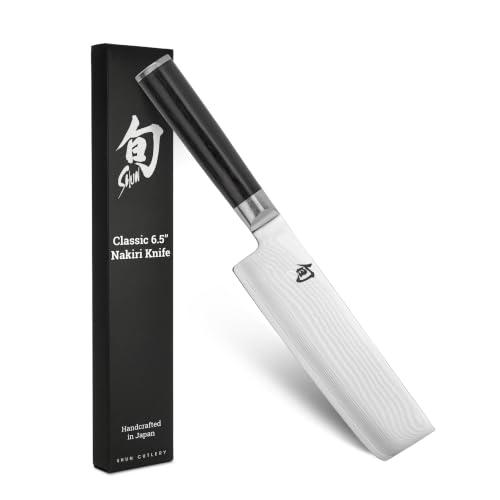 Shun Classic 6.5" Nakiri (DM0728) | An upgrade nakiri | 8.3 | |
| 2 | 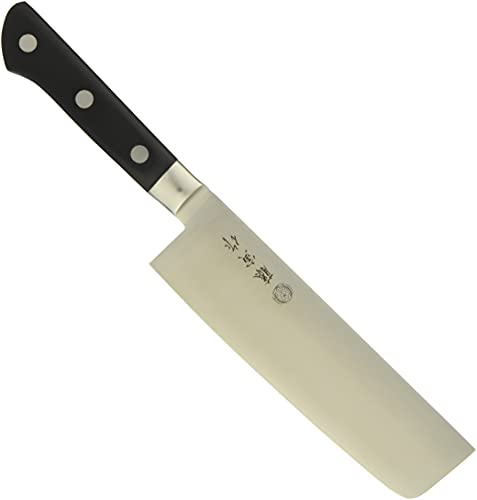 Tojiro DP Nakiri 165mm (F-502) | First nakiri | 8.7 | |
| 3 | 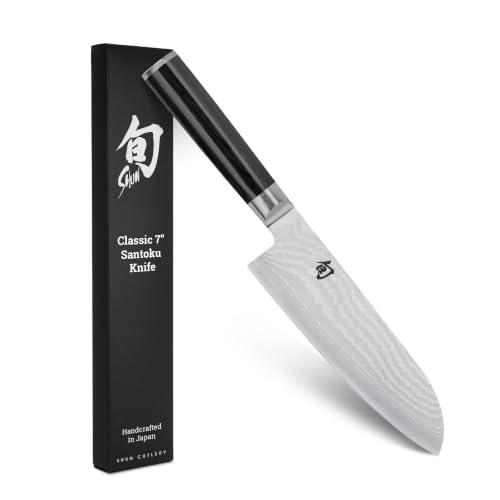 Shun Classic 7" Santoku | Small boards and short cooks | 8.2 |
A nakiri is a vegetable specialist: a flat 165 mm blade with a tall face, no belly and a blunt tip. It is designed for straight up-and-down chopping on a board, where the whole edge lands at once and a slice separates cleanly instead of hinging at the end of the cut. If you have never used one, read what a nakiri is actually for before you buy any of them.
| Shun Classic Nakiri (DM0728) | |
|---|---|
| Blade length | 6.5 in (165 mm) |
| Steel | VG-MAX core, 34 Damascus layers each side (69 total) |
| Edge | Double bevel, flat ground, 16° per side |
| Handle | Pakkawood, usable left or right handed |
| Origin | Seki, Japan |
The flat profile is the point
A chef's knife has a curved belly so it can rock. A nakiri has none, which means every millimeter of edge contacts the board at the same moment. On a pile of cabbage, spring onion or carrot that is the difference between a clean separation and the last fibre of each slice staying attached — the single most satisfying improvement a second knife can make.
The tall face does the other half of the work: it gives you a wide surface to scoop with and enough knuckle clearance that you are not grazing the board.
VG-MAX at a 16-degree bevel
VG-MAX is Kai's VG-10 variant, and across the Shun Classic line it runs around 61 HRC with a 16-degree per-side grind. On a nakiri that pairing is almost ideal: there is no tip to snap, the cutting motion is straight down with no lateral twisting, and vegetables are the least abusive thing you can put a hard edge through. A nakiri is the Japanese knife least likely to chip in normal use.
It is also the easiest knife in the drawer to sharpen, because a flat edge sits flat on a stone. If you are learning whetstone technique, learn it here — see how to use a whetstone.
A Classic you can buy left-handed
Most of the Shun Classic range uses a D-shaped handle biased to the right hand. The nakiri is listed as usable in either hand, which makes it one of the few Classic pieces a left-handed cook can buy without a compromise. Combined with the symmetrical double bevel, there is nothing handed about this knife at all.
No piercing. The blunt squared tip will not start a cut in a chicken breast or score a melon rind.
No rocking. A flat edge cannot rock-chop herbs. Push-cut or use a santoku.
Not a first knife. Buy a gyuto or santoku first; the nakiri is the second knife that makes the first one better. Santoku against nakiri.
What it is like to use
The motion is different from a chef's knife and takes about one onion to learn. You lift and push forward rather than rocking, and the tall face gives you enough knuckle clearance that the guiding hand sits comfortably. On cabbage, leeks, spring onion and carrot it is faster and tidier than any gyuto, because every slice separates at the board instead of hinging on the last fibre.
Where it surprises people is the scooping. A 165 mm blade with a tall face carries a genuinely useful amount of diced onion to the pan in one lift, which removes a bench scraper from the workflow. That is a small thing that you notice every single day.
It is also the quietest knife in the drawer. There is no tip to catch and no belly to rock, so the cutting sound is a single clean contact rather than a rolling one — and on a soft rubber board it is almost silent.
Maintenance
- Sharpen at roughly 16 degrees per side on a 1000-grit stone. The flat profile makes this the easiest knife in the kitchen to sharpen well. Angle chart.
- Ceramic rod, not steel. At 61 HRC a block-set steel rod does almost nothing. Honing rods.
- Soft board only. A 16-degree edge at 61 HRC will chip on glass, stone or bamboo — and a nakiri lands its whole edge at once, so a hard board does more damage per cut than it would to a chef's knife.
- Hand wash and dry. Pakkawood and a dishwasher cycle are not friends. Care guide.
Against the obvious alternative
The Tojiro DP Nakiri is the value answer and it is a close-run thing on performance: VG-10 at 59-61 HRC, a 45 mm heel, a consistent 1.8 mm spine and a weight around 207 g, for a fraction of the Shun's price. What the Shun adds is finish — the Damascus cladding, the pakkawood, the end cap — plus marginally harder steel.
Both appear in the nakiri roundup, which is the place to start if you have not decided on the shape yet.
The verdict
A very good nakiri and a lovely object. Buy it if you already own a chef's knife, do real vegetable volume, and want the nicer version of the shape — or if you are left-handed and want a Shun Classic that does not fight you.
Buy the Tojiro DP Nakiri instead if you want to find out whether you like the shape before spending Shun money on it. That is the honest recommendation for most first-time nakiri buyers.
The picks in detail
#1 · An upgrade nakiri
Shun Classic 6.5" Nakiri (DM0728)
Flat-ground, double-bevelled to 16 degrees per side, 69-layer Damascus over a VG-MAX core. The nakiri for someone who already knows they want one.
What it does well
- Flat grind gives excellent release on dense vegetables
- Handle works for left-handed cooks, unlike the D-shaped Classic chef's knife
- Kai's lifetime warranty applies
Where it gives way
- Several times the price of the Tojiro for a knife doing the same job
- Thin tip corners are easy to ding on the board
- Damascus cladding is cosmetic
Skip it if: A first nakiri. Buy the Tojiro, decide you use it, then buy this.
| Blade length | 6.5 in (165 mm) |
|---|---|
| Steel | VG-MAX core, 34 Damascus layers each side (69 total) |
| Edge | Double bevel, flat ground, 16 degrees per side |
| Handle | Pakkawood, usable left or right handed |
#2 · First nakiri
Tojiro DP Nakiri 165mm (F-502)
A flat 165 mm edge in VG-10 at 59-61 HRC for the price of a mid-range German paring knife. The obvious first nakiri.
What it does well
- 45 mm of blade height means your knuckles clear the board
- Genuinely flat edge — full contact, no accordion slices
- 1.8 mm spine falls through vegetables rather than wedging
Where it gives way
- No tip, so it cannot do fine tip work at all
- 207 g is heavier than the profile suggests
- Western handle and bolster feel dense for such a light job
Skip it if: Anyone expecting it to replace a chef's knife. A nakiri does not have a tip and cannot break down a chicken.
| Blade length | 165-170 mm |
|---|---|
| Steel | Takefu VG-10 core, three-layer |
| Hardness | 59-61 HRC |
| Heel height | 45 mm |
| Spine | 1.8 mm, consistent |
| Weight | approx. 207 g |
#3 · Small boards and short cooks
Shun Classic 7" Santoku
The same VG-MAX core and 16-degree edge as the Classic chef's knife, in the shorter, flatter profile that suits a small board.
What it does well
- Short enough to control on a 12-inch board
- Flat profile suits push cutting, which is how Japanese knives want to be used
- Same steel and warranty as the full-size Classic
Where it gives way
- 7 in is short for breaking down a chicken or a large squash
- Premium over a Tojiro santoku is large
- D-handle is right-hand oriented
Skip it if: Anyone who rocks-chops. The flat profile punishes that grip.
| Blade length | 7 in |
|---|---|
| Steel | VG-MAX core, Damascus-clad |
| Hardness | 61 HRC |
| Edge angle | 16 degrees per side |
| Handle | D-shaped pakkawood |
Common questions
Is the Shun Classic Nakiri worth it?
Can left-handed cooks use the Shun Classic Nakiri?
Shun Classic Nakiri or Tojiro DP Nakiri?
How do you sharpen a nakiri?
Sources
Read next
Japanese Knives
Best Nakiri Knives
Japanese Knives
What Is a Nakiri Knife Used For?
Japanese Knives
Santoku vs Nakiri
Japanese Knives
Nakiri vs Chef Knife
Japanese Knives