Steel & Care
VG-10 vs AUS-10
What this is based on: published manufacturer specifications and retailer listings, cited on each product; the weight of professional and owner reviews across multiple retailers; and hands-on experience sharpening and cooking with knives of this type. We have not individually tested every model listed, we do not run instrumented sharpness testing, and we do not claim a test we did not run.
Quick picks
| # | Product | Best for | Score | Price |
|---|---|---|---|---|
| 1 | 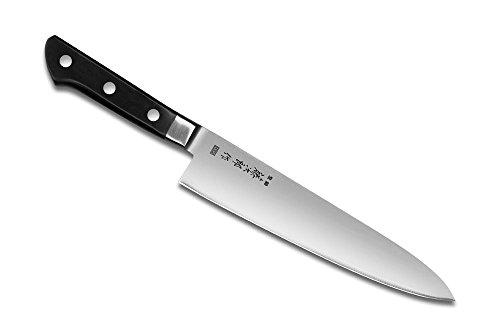 Tojiro DP Gyuto 210mm (F-808) | First Japanese knife | 8.6 | |
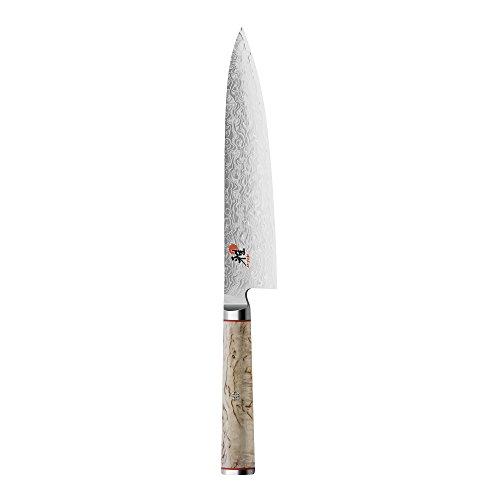
| 2 | 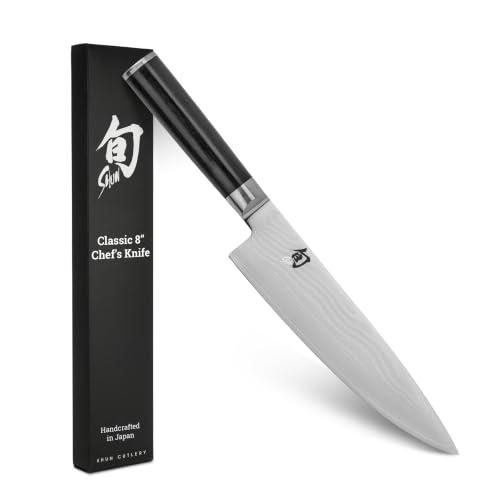 Shun Classic 8" Chef's Knife (DM0706) | A knife you want to look at | 8.3 | |
| 3 | 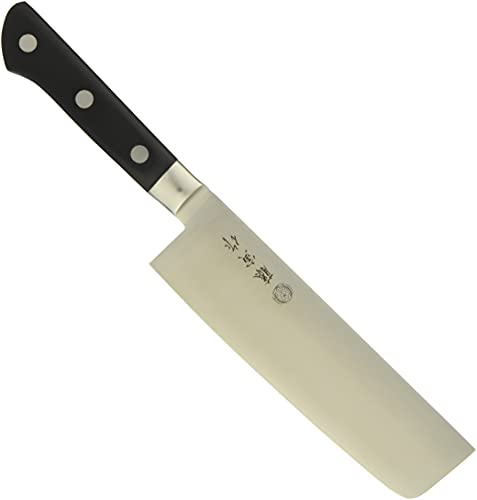 Tojiro DP Nakiri 165mm (F-502) | First nakiri | 8.7 |
These two turn up constantly on the same shortlist because they sit at the same carbon level and get used in the same price bracket of Japanese kitchen knives. They are not the same steel, but the gap is smaller than forum arguments suggest, and it is nowhere near as large as the gap between either of them and the soft German stainless most people are upgrading from.
The published composition
| VG-10 | AUS-10 | |
|---|---|---|
| Carbon | 0.95-1.05% | 0.95-1.10% |
| Chromium | 14.5-15.5% | 13.0-14.5% |
| Molybdenum | 0.9-1.2% | approx. 0.15% |
| Vanadium | 0.1-0.3% | approx. 0.15% |
| Cobalt | 1.30-1.50% | None published |
| Typical knife hardness | 60-61 HRC (published to 62) | 58-60 HRC, reference 60 HRC |
| Maker | Takefu Special Steel | Aichi Techno Metal Fukaumi |
Two percentage points of chromium
Chromium does two jobs: it forms the passive layer that makes a steel stainless, and above a certain level it forms chromium carbides that help with wear resistance but coarsen the grain. VG-10's 15 percent is comfortably stainless with margin to spare. AUS-10's 13 percent is at the practical lower bound - genuinely stainless, but with less tolerance for being left wet with something acidic on the blade.
In a home kitchen that difference shows up as spotting rather than rust. Leave lemon on an AUS-10 blade overnight and you may find a grey mark; do the same to VG-10 and you probably will not. Neither behaves like a carbon steel, which genuinely does need drying immediately - that comparison is in carbon against stainless.
Cobalt and molybdenum are the real divide
The published figure that actually separates these steels is not carbon or chromium - it is the 1.3 to 1.5 percent cobalt and roughly 1 percent molybdenum in VG-10 against almost none in AUS-10. Cobalt refines the grain, which is what lets a steel take a cleaner apex at a given hardness, and molybdenum at that level contributes to wear resistance and to how the steel responds to heat treatment.
The practical consequence is modest and consistent: a well-heat-treated VG-10 blade takes a slightly finer finishing edge and holds it a little longer than a well-heat-treated AUS-10 blade. The word doing the work in that sentence is "well". Heat treatment varies far more between makers than these two alloys vary from each other, which is why a Tojiro DP in VG-10 and a budget VG-10 knife from an unknown brand are not remotely the same product.
Both steels are hard enough to carry a 15-degree bevel and both will out-hold a German knife at 56 to 58 HRC. What decides whether a knife cuts well is the spine thickness, the grind behind the edge and the blade height. The Tojiro DP gyuto publishes a 1.9 mm spine and 43 mm of heel; that number will change your cooking far more than two points of chromium will.
Where VG-MAX fits
Shun's Classic line uses VG-MAX rather than VG-10, finished at 61 HRC behind a 16-degree-per-side edge. It is best understood as a VG-10-family stainless tuned by the maker rather than a different class of steel, and it behaves the way you would expect: a fine edge, good retention, and the same requirement for a soft board. If you want the step beyond that, you are into powder steels, which we compare in VG-10 against SG2.
For the full ladder - German stainless at 56 to 58, VG-10 and AUS-10 around 60, VG-MAX at 61, SG2 at 63 - our knife steel guide lays out the published hardness figures side by side with what each costs you in fragility.
What to buy
- Your first Japanese knife. Tojiro DP gyuto 210 mm. VG-10 at 59 to 60 HRC, 1.9 mm spine, cheap enough to learn stone work on.
- You want the finer edge and the better handle. Shun Classic 8 inch. VG-MAX at 61 HRC, 16 degrees per side.
- A second knife for produce in the same steel. Tojiro DP Nakiri. Same VG-10 core, 45 mm of blade height, 1.8 mm spine.
- You found an AUS-10 knife you like the shape of. Buy it. The steel is not the reason to walk away - check the spine thickness, the heel height and the handle instead.
How each one behaves on the stones
Both steels are pleasant to sharpen, which is not true of everything in this hardness bracket. AUS-10 at 58 to 60 HRC raises a burr quickly on an ordinary 1000-grit clay stone and forgives an uneven stroke; VG-10 at 60 to 61 takes a little longer and gives slightly crisper feedback through the stone, which experienced sharpeners tend to prefer. Neither needs a diamond plate and neither will dish a stone the way a powder steel does.
The practical consequence is that either makes a good knife to learn on. A 1000/6000 combination stone covers both from dull to finished, and a fine ceramic rod keeps either going between sessions. That is a far cheaper setup than anything SG2 demands - see our first whetstone picks and how many stones you actually need.
The verdict
VG-10 wins on the spec sheet: more chromium, real molybdenum, cobalt for grain refinement, and a point or two more hardness in finished knives. AUS-10 is tougher for its hardness, easier to sharpen and cheaper, and in a kitchen where the board is wood and the knife gets dried, the difference is a nuance rather than a decision. Choose the knife by its geometry and its handle; treat the steel as a tiebreaker. Our edge retention roundup ranks the picks on how long they actually hold.
The one AUS-10 knife in our registry is the Dalstrong Shogun, whose core Dalstrong publishes as AUS-10V. Shun against Dalstrong compares it with the VG-MAX end of this question on the figures each maker is willing to print.
For the shopping list rather than the metallurgy, the best VG-10 knives covers every knife in our registry with a published VG-10 cutting core, from a 92 g petty up to a 210 mm gyuto.
The picks in detail
#1 · First Japanese knife
Tojiro DP Gyuto 210mm (F-808)
The default answer to 'my first real Japanese knife'. VG-10 at around 60 HRC in a plain three-layer build, at a price that makes the inevitable first chip survivable.
What it does well
- VG-10 at 59-60 HRC takes a genuinely fine edge and holds it far longer than a German knife at 56-58
- 1.9 mm spine and 43 mm heel make it thin behind the edge without being fragile
- Cheap enough that learning to sharpen on it is not frightening
Where it gives way
- Handle finish is functional and unlovely; some units need the bolster easing with sandpaper
- Stainless cladding is soft and scratches readily
- Nothing about the fit and finish will impress anyone
Skip it if: Anyone who wants the knife to be beautiful. The handle is a workmanlike composite with a stainless bolster and nothing about it is charming.
| Blade length | 210 mm (8.3 in) |
|---|---|
| Steel | VG-10 core, 13-chrome stainless cladding (san mai) |
| Hardness | 59-60 HRC |
| Heel height | 43 mm |
| Spine at heel | 1.9 mm |
| Weight | approx. 187 g |
| Handle | Western, laminated composite wood with stainless bolster |
#2 · A knife you want to look at
Shun Classic 8" Chef's Knife (DM0706)
The Damascus-clad knife people actually buy. A 16-degree-per-side VG-MAX edge at 61 HRC, a D-shaped pakkawood handle, and a look that sells itself.
What it does well
- 16 degrees per side is a sensible factory angle — acute, but not so thin it chips on a carrot
- Handle geometry is genuinely comfortable in a pinch grip
- Kai's warranty and free sharpening service are real, useful things
Where it gives way
- You pay a significant premium over a MAC or Tojiro for the Damascus cladding
- The D-shaped handle is oriented for right-handed use
- Thin tip is easy to snap if you twist it in a squash
Skip it if: Left-handed cooks who dislike a D-shaped handle, and anyone who resents paying for 68 layers of cladding that do nothing for cutting.
| Blade length | 8 in |
|---|---|
| Steel | VG-MAX core, 34 layers Damascus cladding each side |
| Hardness | 61 HRC |
| Edge angle | 16 degrees per side |
| Handle | D-shaped pakkawood with stainless bolster and end cap |
| Warranty | Limited lifetime |
#3 · First nakiri
Tojiro DP Nakiri 165mm (F-502)
A flat 165 mm edge in VG-10 at 59-61 HRC for the price of a mid-range German paring knife. The obvious first nakiri.
What it does well
- 45 mm of blade height means your knuckles clear the board
- Genuinely flat edge — full contact, no accordion slices
- 1.8 mm spine falls through vegetables rather than wedging
Where it gives way
- No tip, so it cannot do fine tip work at all
- 207 g is heavier than the profile suggests
- Western handle and bolster feel dense for such a light job
Skip it if: Anyone expecting it to replace a chef's knife. A nakiri does not have a tip and cannot break down a chicken.
| Blade length | 165-170 mm |
|---|---|
| Steel | Takefu VG-10 core, three-layer |
| Hardness | 59-61 HRC |
| Heel height | 45 mm |
| Spine | 1.8 mm, consistent |
| Weight | approx. 207 g |
Common questions
Is VG-10 better than AUS-10?
What hardness does AUS-10 reach?
Which rusts more easily?
Does this site stock an AUS-10 knife?
Sources
Read next
Steel & Care
VG-10 vs SG2 Steel
Steel & Care
Knife Steel Guide
Steel & Care
Carbon vs Stainless Kitchen Knives
Steel & Care
Is Damascus Steel Worth It?
Japanese Knives
Best Chef Knives for Edge Retention