Japanese Knives
Best VG-10 Knives
What this is based on: published manufacturer specifications and retailer listings, cited on each product; the weight of professional and owner reviews across multiple retailers; and hands-on experience sharpening and cooking with knives of this type. We have not individually tested every model listed, we do not run instrumented sharpness testing, and we do not claim a test we did not run.
Quick picks
| # | Product | Best for | Score | Price |
|---|---|---|---|---|
| 1 |  Tojiro DP Gyuto 210mm (F-808) | First Japanese knife | 8.6 | |
| 2 | 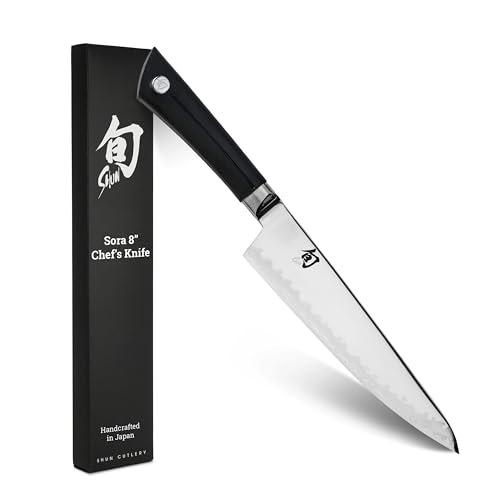 Shun Sora 8" Chef's Knife (VB0706) | A real Japanese edge under $100 | 8.0 | |
| 3 | 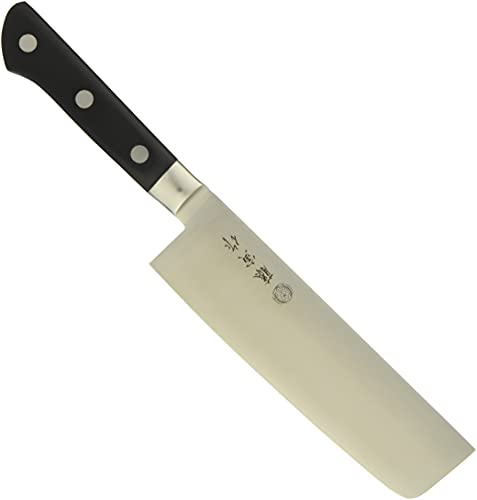 Tojiro DP Nakiri 165mm (F-502) | First nakiri | 8.7 | |
| 4 | 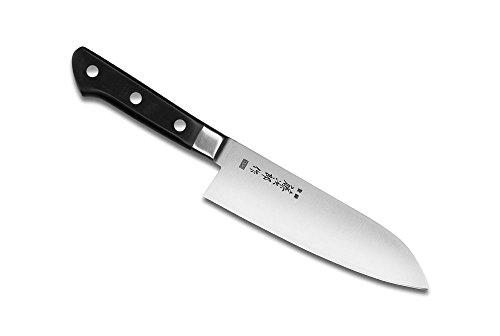 Tojiro DP Santoku 170mm (F-503) | A second Japanese knife on a budget | 8.4 | |
| 5 | 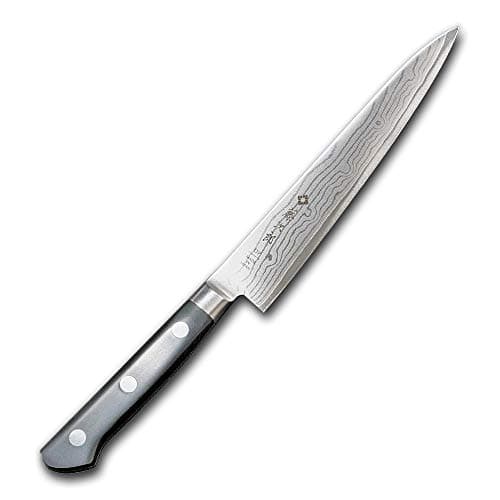 Tojiro DP Petty / Utility 150mm (F-802) | The second knife after a gyuto | 8.5 |
This page is organised by shape rather than by brand, because VG-10 is a steel and not a product line. Four of the five picks are from one maker for a simple reason: Tojiro built its whole DP range on the same VG-10 san mai construction, so the steel is constant and only the blade shape changes.
What VG-10 actually is
VG-10 is a Japanese cutlery stainless from Takefu, cobalt-bearing, with roughly 15 percent chromium and around one percent carbon, normally hardened to 59 to 61 HRC. In practical kitchen terms that combination does three things: it takes a very fine edge, it holds that edge noticeably longer than a 56 to 58 HRC German knife, and it comes back on a 1,000-grit stone without a fight.
It is almost never used on its own. Every knife here is san mai - a VG-10 core clad with softer stainless on both sides - which gives you the hard edge without the brittleness of a monosteel blade at that hardness. If you want the full comparison against the harder powder steels, VG-10 against SG2 has the edge retention trade-off, and VG-10 against AUS-10 covers the steel it is most often confused with on a listing.
Three naming traps
VG-MAX. Kai's proprietary variant, used in the Shun Classic and Premier lines at 61 HRC. A fine steel and a close relative - but if you came here for VG-10 specifically, a Shun Classic is not it.
VG-1 and VG-2. Different alloys in the same family with less cobalt. They are not VG-10 and are usually priced accordingly.
"VG-10 Damascus" with no core named. Damascus cladding is cosmetic. The question is always what the cutting layer is - see is Damascus steel worth it.
Which of these is for you
| Pick | Length and steel | Buy it for |
|---|---|---|
| Tojiro DP Gyuto | 210 mm, VG-10 core san mai, 59-60 HRC, approx. 187 g | The one knife you reach for every day |
| Shun Sora | 8 in, VG10 san mai cutting core, 16 degrees per side | The lowest price for a real VG10 edge |
| Tojiro DP Nakiri | 165-170 mm, Takefu VG-10 core, 59-61 HRC, approx. 207 g | Cabbage, squash and a board full of vegetables |
| Tojiro DP Santoku | 170 mm, VG-10 core three-layer, 59-61 HRC | A small board and a shorter reach |
| Tojiro DP Petty | 150 mm, VG-10 core san mai, 59-61 HRC, 92 g | In-hand work a chef's knife cannot do |
One steel, one stone, one angle
The underrated advantage of buying into a single steel is maintenance. Four of these knives sharpen on the same stone at the same angle with the same number of strokes, which means the skill transfers completely and you never have to think about it again. A drawer containing a 56 HRC German knife, a 61 HRC VG-MAX knife and a 63 HRC powder steel knife needs three different approaches and a reason to remember which is which.
A 1,000-grit stone covers all of it. VG-10 is not hard enough to need diamond and not soft enough to burr badly, which is why it keeps appearing in our easiest knives to sharpen ranking. Add a fine ceramic rod for weekly upkeep and the whole range stays sharp on about ten minutes of work a month.
Where VG-10 stops being the answer
If your complaint is that you sharpen too often, a harder powder steel will genuinely stretch the interval - the Miyabi Birchwood on our edge retention page is published at 63 HRC and holds on considerably longer. If your complaint is that your knife chips, going harder is the wrong direction and a softer, tougher blade is the fix. And if you cut through bone, joints or frozen food, none of these knives is for that job at any hardness.
How these were chosen
Every pick had to be currently sold to US buyers and to have a VG-10 or VG10 cutting core stated by the maker or a specialist retailer we could cite - not inferred from a brand's general reputation. That rule is why four Shun knives in our registry are absent from a page about the steel they are most often credited with: they are VG-MAX, and we are not going to blur the two to make the list look broader.
We score each on edge and steel, geometry, handle and value, on the rubric published at our methodology page. Those are editorial judgments rather than measurements, and we have run no cutting tests. Prices come from the live listing with the date they were read; where a listing has no live offer the button says so rather than showing a number we cannot stand behind.
The picks in detail
#1 · First Japanese knife
Tojiro DP Gyuto 210mm (F-808)
The default answer to 'my first real Japanese knife'. VG-10 at around 60 HRC in a plain three-layer build, at a price that makes the inevitable first chip survivable.
What it does well
- VG-10 at 59-60 HRC takes a genuinely fine edge and holds it far longer than a German knife at 56-58
- 1.9 mm spine and 43 mm heel make it thin behind the edge without being fragile
- Cheap enough that learning to sharpen on it is not frightening
Where it gives way
- Handle finish is functional and unlovely; some units need the bolster easing with sandpaper
- Stainless cladding is soft and scratches readily
- Nothing about the fit and finish will impress anyone
Skip it if: Anyone who wants the knife to be beautiful. The handle is a workmanlike composite with a stainless bolster and nothing about it is charming.
| Blade length | 210 mm (8.3 in) |
|---|---|
| Steel | VG-10 core, 13-chrome stainless cladding (san mai) |
| Hardness | 59-60 HRC |
| Heel height | 43 mm |
| Spine at heel | 1.9 mm |
| Weight | approx. 187 g |
| Handle | Western, laminated composite wood with stainless bolster |
#2 · A real Japanese edge under $100
Shun Sora 8" Chef's Knife (VB0706)
The cheapest genuine VG10 edge we can find, at the same hand-sharpened 16 degrees as a Shun Classic. The saving comes from a braze-welded 420J blade upper and a polymer handle, not from the part that cuts.
What it does well
- A VG10 san mai cutting core at the same hand-sharpened 16 degrees per side as the Shun Classic, for well under half the money
- Made in Japan, and the part of the blade that touches food is the same idea as the premium lines
- The polymer handle is textured and grippy wet, which the Classic's pakkawood is not
Where it gives way
- Shun publishes no hardness figure and no weight for the Sora, so you cannot check it against the Classic on either
- The braze-welded join between the VG10 edge section and the 420J upper is visible and is the thing people either ignore or dislike
- Textured polymer handle - durable and entirely charmless next to a pakkawood or an octagonal wa handle
Skip it if: Anyone buying a Shun for the look. The handle is textured polymer, the blade upper is plain 420J, and the join between the two sections is visible.
| Blade length | 8 in (20.3 cm) |
|---|---|
| Cutting edge | VG10 san mai core, one layer of stainless cladding each side |
| Blade upper | Japanese 420J stainless |
| Construction | Composite Blade - the two sections are laser cut, fitted and braze welded |
| Factory edge | 16 degrees per side (32 degrees inclusive), hand sharpened |
| Hardness | Not published |
| Weight | Not published |
| Handle | Textured PP/TPE polymer blend |
| Origin | Handcrafted in Japan |
#3 · First nakiri
Tojiro DP Nakiri 165mm (F-502)
A flat 165 mm edge in VG-10 at 59-61 HRC for the price of a mid-range German paring knife. The obvious first nakiri.
What it does well
- 45 mm of blade height means your knuckles clear the board
- Genuinely flat edge — full contact, no accordion slices
- 1.8 mm spine falls through vegetables rather than wedging
Where it gives way
- No tip, so it cannot do fine tip work at all
- 207 g is heavier than the profile suggests
- Western handle and bolster feel dense for such a light job
Skip it if: Anyone expecting it to replace a chef's knife. A nakiri does not have a tip and cannot break down a chicken.
| Blade length | 165-170 mm |
|---|---|
| Steel | Takefu VG-10 core, three-layer |
| Hardness | 59-61 HRC |
| Heel height | 45 mm |
| Spine | 1.8 mm, consistent |
| Weight | approx. 207 g |
#4 · A second Japanese knife on a budget
Tojiro DP Santoku 170mm (F-503)
The gyuto's sibling: same VG-10 san mai, same price bracket, shorter and flatter. The cheapest honest route into a Japanese santoku.
What it does well
- Same steel and geometry philosophy as the F-808 gyuto
- Light and easy to control for shorter cooks
- Inexpensive enough to learn stone work on
Where it gives way
- Plain finish, same as the rest of the DP line
- 170 mm limits you on anything large
- Soft cladding scratches quickly
Skip it if: Anyone who already has a 210 mm gyuto and a small board — the overlap is large.
| Blade length | 170 mm |
|---|---|
| Steel | VG-10 core, three-layer stainless cladding |
| Hardness | 59-61 HRC |
| Handle | Western composite wood with bolster |
#5 · The second knife after a gyuto
Tojiro DP Petty / Utility 150mm (F-802)
The small knife a Japanese-knife kitchen is actually missing. 92 g, a 1.7 mm spine and the same VG-10 core as the DP gyuto, at a 150 mm length that does in-hand work a chef's knife cannot.
What it does well
- 92 g and 1.7 mm at the spine - light enough for in-hand work, thin enough to peel and segment cleanly
- Same VG-10 san mai core as the DP gyuto, so it sharpens on the same stone at the same angle
- 150 mm is the length that covers both paring and the small slicing jobs a 210 mm gyuto is clumsy at
Where it gives way
- Only 31 mm of heel height, so it is useless for chopping on a board
- The Amazon listing titles it Damascus; the DP build is a plain stainless-clad san mai with no pattern
- Soft 13-chrome cladding scratches readily, as on the rest of the DP line
Skip it if: Anyone who wants one knife. A petty is a companion blade - 31 mm of heel height means your knuckles hit the board on anything you try to chop with it.
| Edge length | 153 mm (6 1/32 in) |
|---|---|
| Steel | VG-10 core, san mai, 13-chrome stainless clad |
| Hardness | 59-61 HRC |
| Heel height | 31 mm |
| Spine at heel | 1.7 mm |
| Spine 1 cm from tip | 1.0 mm |
| Weight | 92 g (3.2 oz) |
| Handle | Western pakkawood with stainless bolster |
| Edge grind | Even double bevel |
Common questions
Is VG-10 a good knife steel?
Is VG-MAX the same as VG-10?
What does 'VG-10 core' or san mai mean?
Does VG-10 rust?
What angle should I sharpen VG-10 at?
Sources
Read next
Steel & Care
VG-10 vs SG2 Steel
Steel & Care
VG-10 vs AUS-10
Japanese Knives
Best Japanese Chef Knives for Home Cooks
Steel & Care
Knife Steel Guide
Japanese Knives
Best Chef Knives for Edge Retention