Japanese Knives
Petty Knife Size Guide
What this is based on: published manufacturer specifications and retailer listings, cited on each product; the weight of professional and owner reviews across multiple retailers; and hands-on experience sharpening and cooking with knives of this type. We have not individually tested every model listed, we do not run instrumented sharpness testing, and we do not claim a test we did not run.
Quick picks
| # | Product | Best for | Score | Price |
|---|---|---|---|---|
| 1 | 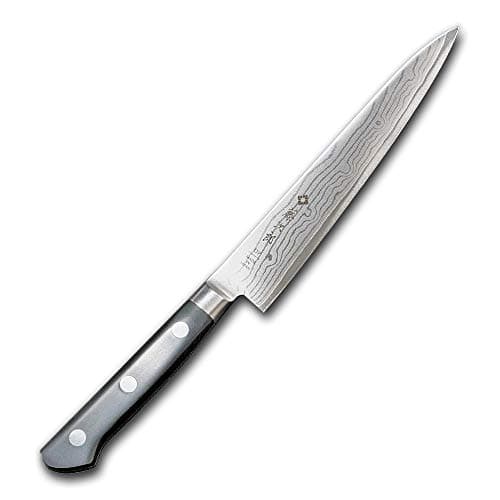 Tojiro DP Petty / Utility 150mm (F-802) | The second knife after a gyuto | 8.5 | |
| 2 | 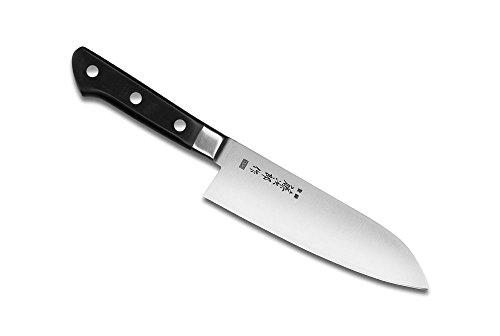 Tojiro DP Santoku 170mm (F-503) | A second Japanese knife on a budget | 8.4 | |
| 3 |  Tojiro DP Gyuto 210mm (F-808) | First Japanese knife | 8.6 |
Petty sizing gets confused because people size it like a chef's knife, by hand and board. It is not chosen that way. A petty is chosen by which jobs you want it to take off your main knife, and the length follows from the jobs. Pick the jobs first and the number falls out.
The four size bands
| Length | Role | Good at | Bad at |
|---|---|---|---|
| 90-120 mm | Paring knife | Peeling in the hand, hulling strawberries, coring tomatoes, deveining | Anything on a board - too short to clear your knuckles or finish a cut |
| 135 mm | Large paring / small utility | Trimming, segmenting citrus, cutting cheese, splitting a chilli | Slicing a large tomato in one pass; portioning protein |
| 150 mm | True utility petty | Tomatoes, shallots, chicken breast, short board work, in-hand work | Chopping volume - the heel is too shallow |
| 165-180 mm | Small slicer | Sandwich work, long slicing cuts, breaking down small proteins | Overlaps a santoku or a short gyuto, so it earns less drawer space |
The jump that matters is 135 to 150. Below 150 you are buying a better paring knife, which is a legitimate purchase but a different one. At 150 the blade is long enough to pass through a beefsteak tomato in a single stroke and to lay flat on a board, which is when it starts taking work off your chef's knife instead of off your thumb.
The two published numbers that decide it
- Heel height. This is your knuckle clearance and it is why a petty cannot be your only knife. The Tojiro DP petty at 150 mm publishes 31 mm; the same maker's 210 mm gyuto publishes 43 mm. Twelve millimeters sounds small and is the difference between chopping an onion comfortably and rapping your knuckles on the board every stroke.
- Spine thickness. A petty earns its place by being thin. The Tojiro DP petty is 1.7 mm at the heel and 1.0 mm a centimeter back from the tip. That taper is what lets it slide under tomato skin and along a rib bone. A petty with a 2.5 mm spine is a short chef's knife and will not do the delicate work you bought it for.
Weight is a distant third, but worth noticing: 92 g on the 150 mm Tojiro against roughly 187 g on its 210 mm gyuto. Half the mass is most of why a petty feels precise. If a listing publishes none of these three figures, that is itself information - the makers who care about geometry publish it.
Lay your chef's knife on the counter and ask what it is bad at. If the answer is peeling and hulling, buy 120 to 135 mm. If the answer is tomatoes, citrus and trimming meat, buy 150 mm. If the answer is "it is too big for my board", you do not want a petty at all - you want a 170 mm santoku, and our sizes guide covers that decision.
Steel and bevel on a small blade
A petty takes less abuse than a chef's knife, so hard steel is a safer bet here than it is on a big blade - there is simply less leverage available to chip it; the opposite case, a long blade at 63 HRC, is the subject of our Miyabi Birchwood SG2 review. The Tojiro DP petty runs VG-10 at 59 to 61 HRC in the same three-layer stainless-clad san mai as the rest of the DP line, with an even double bevel. That matters practically: it sharpens at the same angle, on the same stone, in the same session as a DP gyuto, so owning both does not add a maintenance routine.
Avoid a single-bevel petty unless you know you want one. The traditional single-bevel small knives steer in the cut and need a flat back maintained, which is a project rather than a convenience - single bevel against double bevel sets out what you are signing up for. And treat the tip the way you would a gyuto's: thin small blades break at the point more often than they chip at the edge.
What to buy
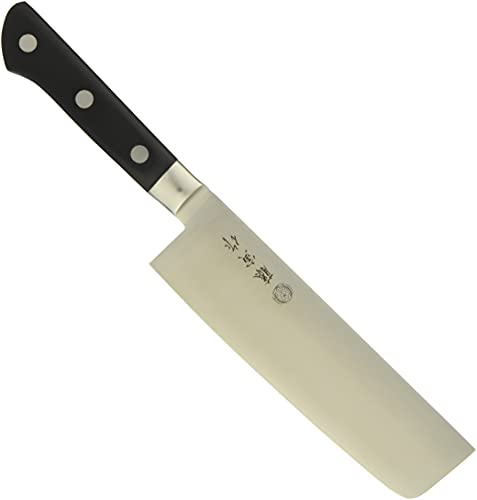
- You own a gyuto or chef's knife and want the missing small blade. The Tojiro DP petty at 150 mm. 153 mm edge, 1.7 mm spine, 92 g, VG-10 at 59-61 HRC, and the same sharpening angle as the DP gyuto.
- You want one knife rather than two. Not a petty - the Tojiro DP santoku at 170 mm. A flatter profile, a real heel and enough height to chop with.
- You do not yet own a proper main knife. Buy that first. The Tojiro DP gyuto at 210 mm is the knife a petty is meant to complement, and buying the small one first is the common mistake.
- You only ever peel and hull. A 90 to 120 mm paring knife is the honest answer and costs less than any petty - petty against paring knife compares the two properly.
How a petty fits a three-knife kitchen
The reason length matters so much here is that a petty is the third purchase, not the first, and a third knife only justifies itself by covering work the first two cannot. In a kitchen with a 210 mm gyuto and a 165 mm nakiri, the gaps are: anything you want to hold in your hand rather than put on a board, anything small enough that a 210 mm blade is clumsy, and anything where you need to see the tip. A 150 mm petty covers all three. A 120 mm paring knife covers only the first.
Run the test on your own drawer. Peeling an apple, hulling strawberries, segmenting an orange, deveining a prawn, splitting a vanilla pod, trimming the silverskin off a tenderloin, portioning a chicken breast, slicing one tomato for a sandwich - how many of those do you do in a week, and how many are in-hand rather than on a board? Mostly in-hand means shorter. A real mix means 150 mm. Our guide to how many knives you actually need makes the same argument across the whole set.
One thing a petty does not do at any length is replace a bread knife or a slicer. If you want long, clean slicing cuts through a roast or a side of salmon, that is a sujihiki and a different purchase - sujihiki against gyuto covers it.
Handle, bolster and balance on a short blade
Length gets all the attention and the handle decides how the knife actually feels. A petty is used in the hand as often as on a board, which means you want the balance point close to the bolster rather than out along the blade - a tip-heavy small knife is tiring to peel with. The Tojiro DP petty's 92 g across a 153 mm edge sits in the right place; a 150 mm petty much over 110 g usually does not.
Bolsters matter more on a small knife than a large one. A full bolster running to the heel on a 150 mm blade eats a meaningful fraction of a short edge and blocks you from choking up onto the spine, which is exactly the grip you want for close work. The DP's stainless bolster sits at the handle and leaves the edge clear.
Western against Japanese handle is less consequential here than on a chef's knife, simply because you are not holding it for an hour - but if you have small hands, a slimmer wa handle is easier to control on a short blade. Our handle comparison sets out the difference, and the small-hands roundup covers the knives that suit a shorter reach.
The short version
150 mm, double bevel, under 2 mm at the spine, and under 100 g. That is the petty that changes how a kitchen works, because it is the first small knife long enough to be useful on a board and still light enough to use in the hand. Buy it second, after a gyuto - never first. If you are still mapping which Japanese shapes do what, start with our guide to Japanese knife types and how many knives you actually need.
The picks in detail
#1 · The second knife after a gyuto
Tojiro DP Petty / Utility 150mm (F-802)
The small knife a Japanese-knife kitchen is actually missing. 92 g, a 1.7 mm spine and the same VG-10 core as the DP gyuto, at a 150 mm length that does in-hand work a chef's knife cannot.
What it does well
- 92 g and 1.7 mm at the spine - light enough for in-hand work, thin enough to peel and segment cleanly
- Same VG-10 san mai core as the DP gyuto, so it sharpens on the same stone at the same angle
- 150 mm is the length that covers both paring and the small slicing jobs a 210 mm gyuto is clumsy at
Where it gives way
- Only 31 mm of heel height, so it is useless for chopping on a board
- The Amazon listing titles it Damascus; the DP build is a plain stainless-clad san mai with no pattern
- Soft 13-chrome cladding scratches readily, as on the rest of the DP line
Skip it if: Anyone who wants one knife. A petty is a companion blade - 31 mm of heel height means your knuckles hit the board on anything you try to chop with it.
| Edge length | 153 mm (6 1/32 in) |
|---|---|
| Steel | VG-10 core, san mai, 13-chrome stainless clad |
| Hardness | 59-61 HRC |
| Heel height | 31 mm |
| Spine at heel | 1.7 mm |
| Spine 1 cm from tip | 1.0 mm |
| Weight | 92 g (3.2 oz) |
| Handle | Western pakkawood with stainless bolster |
| Edge grind | Even double bevel |
#2 · A second Japanese knife on a budget
Tojiro DP Santoku 170mm (F-503)
The gyuto's sibling: same VG-10 san mai, same price bracket, shorter and flatter. The cheapest honest route into a Japanese santoku.
What it does well
- Same steel and geometry philosophy as the F-808 gyuto
- Light and easy to control for shorter cooks
- Inexpensive enough to learn stone work on
Where it gives way
- Plain finish, same as the rest of the DP line
- 170 mm limits you on anything large
- Soft cladding scratches quickly
Skip it if: Anyone who already has a 210 mm gyuto and a small board — the overlap is large.
| Blade length | 170 mm |
|---|---|
| Steel | VG-10 core, three-layer stainless cladding |
| Hardness | 59-61 HRC |
| Handle | Western composite wood with bolster |
#3 · First Japanese knife
Tojiro DP Gyuto 210mm (F-808)
The default answer to 'my first real Japanese knife'. VG-10 at around 60 HRC in a plain three-layer build, at a price that makes the inevitable first chip survivable.
What it does well
- VG-10 at 59-60 HRC takes a genuinely fine edge and holds it far longer than a German knife at 56-58
- 1.9 mm spine and 43 mm heel make it thin behind the edge without being fragile
- Cheap enough that learning to sharpen on it is not frightening
Where it gives way
- Handle finish is functional and unlovely; some units need the bolster easing with sandpaper
- Stainless cladding is soft and scratches readily
- Nothing about the fit and finish will impress anyone
Skip it if: Anyone who wants the knife to be beautiful. The handle is a workmanlike composite with a stainless bolster and nothing about it is charming.
| Blade length | 210 mm (8.3 in) |
|---|---|
| Steel | VG-10 core, 13-chrome stainless cladding (san mai) |
| Hardness | 59-60 HRC |
| Heel height | 43 mm |
| Spine at heel | 1.9 mm |
| Weight | approx. 187 g |
| Handle | Western, laminated composite wood with stainless bolster |
Common questions
What size petty knife should I buy?
What is the difference between a 135mm and a 150mm petty?
Is a petty knife the same as a utility knife?
Can a petty knife replace a chef's knife?
Sources
Read next
Japanese Knives
Petty vs Paring Knife
Japanese Knives
Japanese Knife Sizes
Japanese Knives
Japanese Knife Types
Japanese Knives
How Many Kitchen Knives Do You Need?
Japanese Knives
Best Chef Knives for Small Hands
Japanese Knives