Gift Guides
Kitchen Knife Gifts Under $50

What this is based on: published manufacturer specifications and retailer listings, cited on each product; the weight of professional and owner reviews across multiple retailers; and hands-on experience sharpening and cooking with knives of this type. We have not individually tested every model listed, we do not run instrumented sharpness testing, and we do not claim a test we did not run.
Quick picks
| # | Product | Best for | Score | Price |
|---|---|---|---|---|
| 1 |  King KDS Combination Whetstone #1000/#6000 | Your first stone | 8.4 | |
| 2 |  Leather Bench Strop with Stropping Compound | Finishing after the stones | 8.0 | |
| 3 | 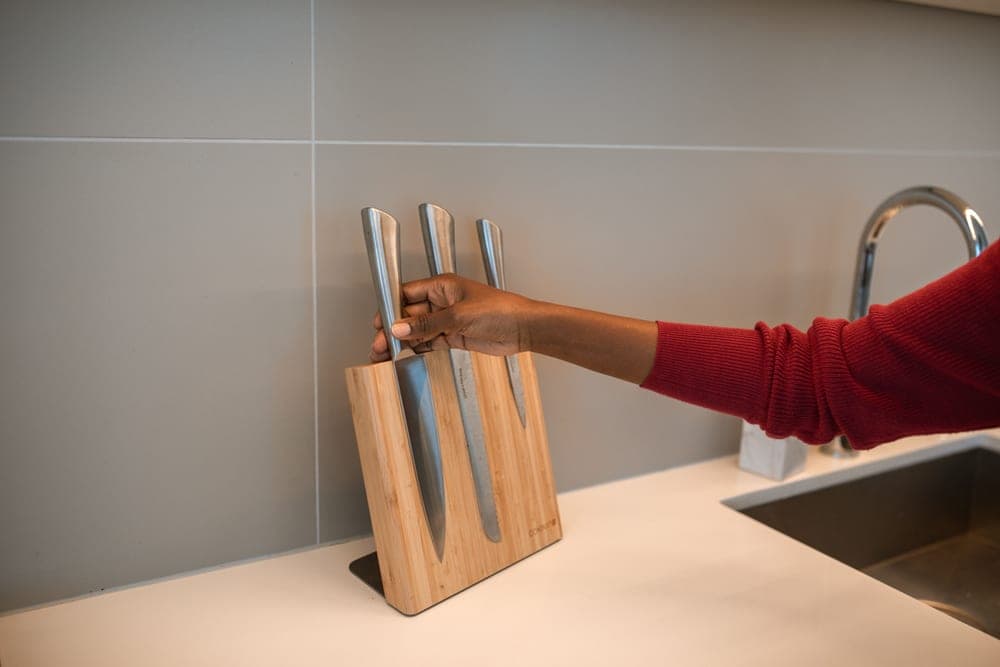 Saya / Magnetic Blade Guard | Anyone whose knives live in a drawer | 8.9 | |
| 4 |  Tsubaki (Camellia) Blade Oil | Anyone who owns carbon steel | 8.6 |
We do not display prices on this site, because we have no live price feed we can verify and a stale number is worse than none. "Under $50" describes the band these items have consistently occupied at US retail — check the current figure on Amazon before you buy. Why we work this way.
A whetstone
The best gift in the band, and it is not close. A King KDS 1,000/6,000 combination stone gives both a sharpening grit and a finishing grit in one block — 207 by 66 by 36mm of clay-bonded stone that is soft, talkative and nearly impossible to damage a knife on.
Most people who own good knives do not own a stone. That is the gap this gift fills, and it is why it improves every knife in their kitchen rather than adding a new one. The one thing to mention when you give it: the 1,000 side wants a 10 to 15 minute soak before use. How to use it.
A leather strop with compound
The cheapest genuine improvement in sharpening. A strop removes the burr — the ribbon of fatigued steel that folds over the edge during sharpening and then tears off on the first tomato. Ten to fifteen light passes per side, and a good stone edge becomes a noticeably better one.
Pair it with the stone and you have given a complete sharpening setup for less than the price of one mid-range knife. Strop picks.
Blade guards
Unglamorous, very cheap, and they solve the most common cause of a chipped tip. A knife loose in a drawer meets a peeler, a can opener and the drawer runner every time it opens; the tip, being thinnest, takes the damage.
Buy one per knife. Mention that the knife should be dry before it goes in the sheath.
Blade oil, if they own carbon steel
Only relevant if their knife is carbon or has a carbon core — but if it is, this is the difference between a blade that ages beautifully and one that pits. Tsubaki (camellia) oil is the traditional choice: food safe, non-drying, effectively odorless, and one small bottle lasts years.
How to tell: if their knife shows a fine dark line along the edge while the rest of the blade stays bright, it has a carbon core. Patina against rust.
What not to buy in this band
| Item | Verdict |
|---|---|
| A cheap knife set | Several compromised knives instead of one good tool |
| A pull-through sharpener | Tears steel and reprofiles the edge. Why. |
| A bamboo cutting board | Harder than people think; damages thin edges |
| An unbranded "1000/6000" stone | Grit ratings are not comparable across standards |
| A steel honing rod | Does nothing on a 60+ HRC Japanese knife |
The verdict
The King KDS stone, with the strop as the small addition if you want the gift to feel complete. Between them they cost less than one decent knife and they will be used every few months for the next twenty years.
The picks in detail
#1 · Your first stone
King KDS Combination Whetstone #1000/#6000
The stone almost everyone learns on. Soft, forgiving, cheap, and it tells you loudly when your angle wanders.
What it does well
- Two useful grits in one block for the price of half a premium stone
- Soft binder builds slurry readily, which gives beginners real feedback
- Almost impossible to damage a knife on it
Where it gives way
- Dishes quickly and needs flattening often
- The soak is a real commitment — you cannot sharpen on a whim
- Slow on hard powder steels like SG2
Skip it if: Impatient people. The 1000 side wants a 10-15 minute soak before every session and the clay binder dishes fast.
| Grits | #1000 / #6000, combination |
|---|---|
| Binder | Clay |
| Soaking | #1000 side: 10-15 minutes. #6000 side: splash only |
| Size | 207 x 66 x 36 mm |
| Weight | approx. 956 g |
#2 · Finishing after the stones
Leather Bench Strop with Stropping Compound
Ten dollars of leather and abrasive that removes the burr your finishing stone left behind. The cheapest real improvement in this whole category.
What it does well
- Turns a good stone edge into a noticeably better one in two minutes
- Extends the interval between full sharpenings
- Costs less than almost anything else in the kitchen
Where it gives way
- Easy to round the edge over if you lift the spine
- Does nothing for a genuinely dull knife
- Leather needs re-charging with compound periodically
Skip it if: Sharpening. A strop refines and deburrs; it removes almost no steel and will not fix a dull knife.
| Function | Burr removal and edge refinement |
|---|---|
| Compound | Typically chromium oxide, roughly 0.5 micron |
| Direction | Edge-trailing strokes only |
#3 · Anyone whose knives live in a drawer
Saya / Magnetic Blade Guard
The cheapest way to stop a drawer from ruining a good edge. A sheath costs a few dollars; re-profiling a chipped tip costs an evening.
What it does well
- Stops the single most common cause of chipped tips: loose drawer storage
- Cheap enough to buy one per knife
- Makes it safe to reach into a drawer
Where it gives way
- A wet knife sheathed in wood will corrode — dry it properly first
- Sizes are fussy; a loose saya is worse than none
- Adds a step to putting the knife away
Skip it if: Nobody, really — but if you already have a magnetic rack or a proper block, you do not need one too.
| Function | Edge protection in storage and transit |
|---|---|
| Materials | Wood (saya), plastic, or magnet-lined guards |
#4 · Anyone who owns carbon steel
Tsubaki (Camellia) Blade Oil
Food-safe, non-drying oil traditionally used on Japanese blades. A few drops after washing is what stands between a carbon-steel knife and a rust bloom.
What it does well
- Genuinely prevents flash rust on carbon steel between uses
- Food safe and effectively odorless
- One small bottle lasts years
Where it gives way
- Unnecessary for most stainless knives
- Needs reapplying after every wash to actually work
- Does nothing for rust that has already started
Skip it if: Stainless owners, mostly. If your knife is VG-10 or CROMOVA and you dry it, you do not need this.
| Type | Non-drying, food-safe plant oil |
|---|---|
| Use | Wipe a thin film on a clean, dry blade |
| Applies to | Carbon steel and clad carbon core blades |
Common questions
What is the best kitchen gift under $50?
Can you buy a decent knife for under $50?
What is a good small gift for someone who cooks?
Are cheap knife gifts a bad idea?
Sources
Read next
Gift Guides
Best Gifts for Home Cooks
Gift Guides
Gifts for Someone Learning to Sharpen
Whetstones & Skill
Best Whetstones for Kitchen Knives
Whetstones & Skill
Best Strops for Kitchen Knives
Steel & Care
Knife Storage Guide
Japanese Knives