Brands
Best German Chef Knives
What this is based on: published manufacturer specifications and retailer listings, cited on each product; the weight of professional and owner reviews across multiple retailers; and hands-on experience sharpening and cooking with knives of this type. We have not individually tested every model listed, we do not run instrumented sharpness testing, and we do not claim a test we did not run.
Quick picks
| # | Product | Best for | Score | Price |
|---|---|---|---|---|
| 1 | 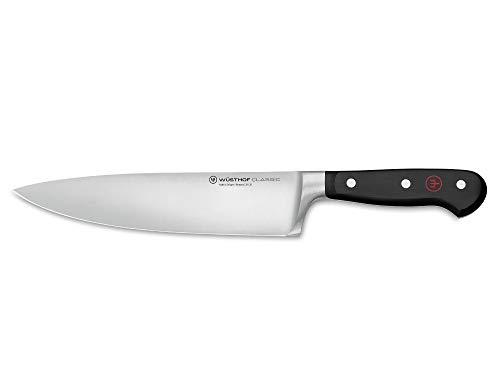 Wüsthof Classic 8" Chef's Knife | Cooks who want weight and a bolster | 7.4 | |
| 2 | 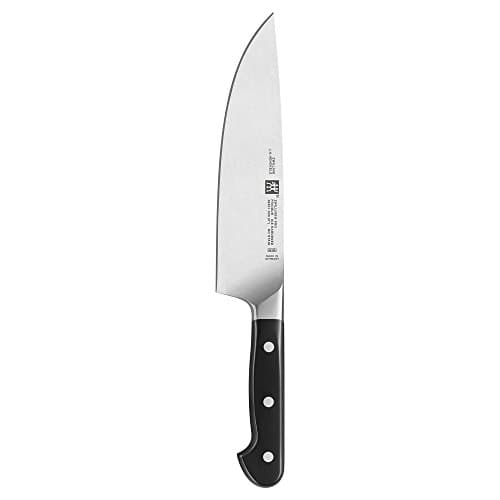 Zwilling Pro 8" Chef's Knife (38401-203) | Cooks who choke up on the blade | 7.3 | |
| 3 | 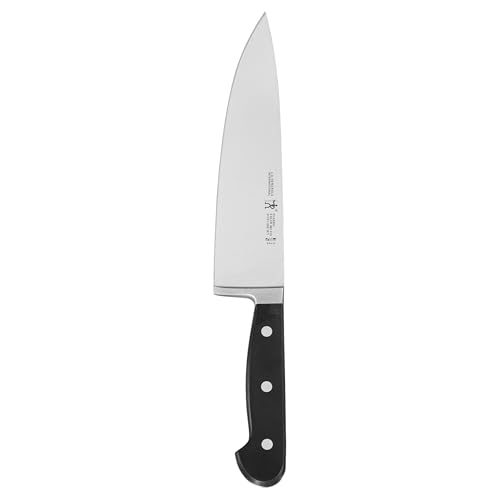 Henckels Classic 8" Chef's Knife (31161-201) | A forged, bolstered knife on a small budget | 6.4 | |
| 4 | 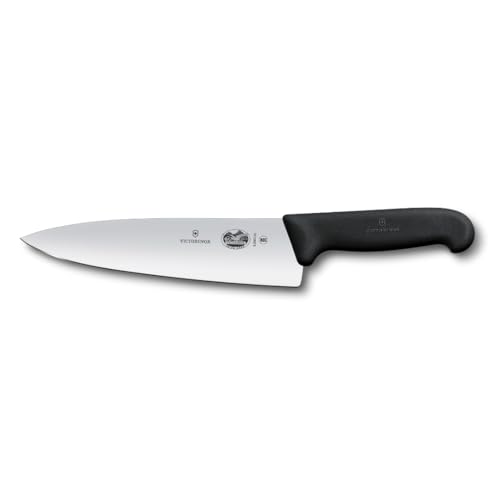 Victorinox Fibrox Pro 8" Chef's Knife | A beater, or a sanity check before you spend more | 7.0 |
This is a Japanese-knife site, so it is worth saying plainly why a German roundup belongs on it. Most people arriving here own one of these knives, and a fair number of them should keep it. The German pattern is not a worse knife; it is a knife that solves a different problem, and knowing which problem you have is the whole point.
What the pattern buys you
Three things, all of them consequences of mass and softness. A 9.3 oz blade with a 3 mm spine gets through dense produce because it is heavy, so you can let it fall rather than push. Steel at 56 to 58 HRC rolls when it meets bone or a hard board instead of chipping, which means damage is recoverable with a rod rather than with a stone and a repair grind. And soft steel sharpens fast on anything, including the machines we warn people off everywhere else on this site.
The costs are the mirror image. Mass is fatigue - three extra ounces, lifted a few hundred times, is felt - and 56 to 58 HRC means the edge needs attention more often than a 61 HRC Japanese blade does. We set the two patterns against each other in detail on Japanese against German knives, and if weight is your actual complaint, the lightweight chef's knives page ranks the alternatives on published grams.
Which of these is for you
| Pick | Steel and hardness | Weight and origin |
|---|---|---|
| Wusthof Classic 8 in | X50CrMoV15, 58 HRC | 9.3 oz (265 g), Solingen |
| Zwilling Pro 8 in | Friodur X2 ice-hardened, 57 HRC | 9.3 oz (266 g), Solingen |
| Henckels Classic 8 in | "German stainless steel" - no grade, no HRC published | Not published; made in Spain |
| Victorinox Fibrox Pro 8 in | X55CrMo14, 56 HRC | 5.6 oz, Switzerland; stamped, not forged |
Why a Swiss knife is on a German page
Because it keeps winning the argument on value and we would rather say so than pretend the category is sealed. The Victorinox Fibrox Pro is stamped rather than forged, has no bolster, weighs 5.6 oz instead of 9.3, and is published at 56 HRC - every one of which reads as a downgrade on paper. It also costs a fraction of the Wusthof, and after ten minutes on a stone it cuts well enough that a lot of buyers discover their old knife was never the problem.
Buy it as the control sample. If a freshly sharpened Fibrox feels great, what you needed was a stone. If it feels thin and light and you miss the heft, you have learned something real about your own preference, and the Wusthof is the knife to buy. We put the two head to head on Victorinox against Wusthof.
Three mistakes in this category
Buying the block set. The money goes into a bread knife, a boning knife and six steak knives. One chef's knife, one paring knife and a serrated loaf knife covers nearly everything - are knife sets worth it does the arithmetic.
Assuming forged means specified. Forging is a construction method, not a performance figure. Two of the four knives here publish a steel grade and a hardness; one publishes neither.
Sharpening it at 15 degrees because you read that somewhere. These arrive near 20 degrees per side and the steel is too soft to support a thinner edge well. Our angle guide has the numbers by knife type.
How these were chosen
Every pick is in our registry, currently sold to US buyers, and ranked primarily on what its maker publishes - steel grade, Rockwell hardness, weight, bolster geometry and origin. Where a manufacturer publishes nothing, as Henckels does on hardness and weight for the Classic 8-inch, that absence is reported as a finding rather than filled in from a retailer's guess or from memory.
We score on edge and steel, geometry, handle and value, on the rubric at our methodology page - editorial judgment, not laboratory measurement. Prices come from the live listing for each pick with the date they were read beside the button; a listing with no live offer shows that rather than a number we cannot back.
The picks in detail
#1 · Cooks who want weight and a bolster
Wüsthof Classic 8" Chef's Knife
The German benchmark, and the knife most of this site's readers are replacing. 265 g, a 3 mm spine, 58 HRC, and a 14-degree-per-side factory edge that is more acute than its reputation suggests.
What it does well
- Forged, full tang, triple-riveted — it will outlive you
- 14 degrees per side from Wüsthof's Precision Edge Technology is sharper than most people assume
- Soft enough at 58 HRC to be nearly chip-proof
Where it gives way
- 265 g is heavy; the 3 mm spine wedges in dense produce
- 58 HRC gives up meaningful edge retention to a 61 HRC Japanese blade
- Full bolster gets in the way when you sharpen the heel
Skip it if: Anyone whose complaint is 'my knife feels heavy and wedges in a sweet potato' — that is the 3 mm spine, and a thinner Japanese blade is the fix.
| Blade length | 8 in (200 mm) |
|---|---|
| Steel | X50CrMoV15 high-carbon stainless |
| Hardness | 58 HRC |
| Edge angle | 14 degrees per side (28 degrees inclusive) |
| Blade height | 1.9 in (47 mm) |
| Spine | 3 mm |
| Weight | 9.3 oz (265 g) |
#2 · Cooks who choke up on the blade
Zwilling Pro 8" Chef's Knife (38401-203)
The German knife with the curved half bolster, which is the one real ergonomic idea in this category. 57 HRC and 3.25 mm at the spine, so it is tough rather than keen.
What it does well
- The curved half bolster leaves the heel clear, so you can sharpen the whole edge and choke up onto the blade
- Friodur ice-hardening and a forged full tang - this is a knife that tolerates a careless kitchen
- 15 degrees per side is more acute than the German reputation suggests
Where it gives way
- 3.25 mm at the spine is the thickest blade here; it wedges in dense produce
- 57 HRC gives up real edge retention to any 60+ HRC Japanese blade
- 266 g is heavy over a long prep session
Skip it if: Anyone whose complaint is wedging. At 3.25 mm the spine is the thickest in our registry, and no amount of sharpening thins a blade.
| Blade length | 8 in |
|---|---|
| Blade height | 1.87 in |
| Overall length | 13 in |
| Steel | Friodur X2 ice-hardened high-carbon stainless |
| Hardness | 57 HRC |
| Edge angle | approx. 15 degrees per side, double bevel |
| Spine at heel | 3.25 mm |
| Weight | 9.3 oz (266 g) |
| Handle | Triple-riveted resin with a curved half bolster |
| Origin | Made in Germany |
#3 · A forged, bolstered knife on a small budget
Henckels Classic 8" Chef's Knife (31161-201)
A fully forged knife at a price where almost everything else is stamped, carrying the triple-rivet shape most cooks already know. Henckels publishes no hardness, no edge angle and no weight for it, and its own page says it is made in Spain.
What it does well
- Fully forged with a bolster at a price where the competition is stamped
- The triple-rivet Henckels handle is the shape a lot of cooks learned on, and it is comfortable
- Lifetime warranty, and cheap enough to own as the knife you do not worry about
Where it gives way
- No published hardness, no published edge angle and no published weight - there is no number on this knife to compare against anything
- Henckels' own page says made in Spain while the marketing copy leans on "German engineered"; both are true and only one is on the box
- Listed as dishwasher safe, which is guidance we would not follow on any thin edge
- The Victorinox Fibrox Pro costs less and publishes its steel grade, its hardness and its edge angle
Skip it if: Anyone who wants to compare it on numbers. There is not a single performance figure on the manufacturer's page for this knife.
| Blade length | 8.00 in |
|---|---|
| Steel | "High-quality, German stainless steel" - no grade published |
| Hardness | Not published |
| Factory edge | Not published ("finely honed") |
| Construction | Fully forged |
| Handle | Traditional triple-rivet |
| Weight | Not published |
| Origin | Made in Spain |
| Care | Listed as dishwasher safe |
| Warranty | Lifetime |
#4 · A beater, or a sanity check before you spend more
Victorinox Fibrox Pro 8" Chef's Knife
Not a Japanese knife and not pretending to be. It is the control sample: if your cooking does not improve after upgrading from this, the knife was never the problem.
What it does well
- Stamped, light and genuinely non-slip when wet
- Soft enough that a pull-through sharpener will not destroy it
- Costs a fraction of everything else here
Where it gives way
- 56 HRC means frequent honing and frequent sharpening
- 18-degree edge is blunt by Japanese standards
- No bolster, no heft, no presence — it feels like a tool because it is one
Skip it if: This site's usual reader. At 56 HRC with an 18-degree edge it is a softer, blunter tool than anything else on this page.
| Blade length | 8 in |
|---|---|
| Steel | X55CrMo14 high-carbon stainless |
| Hardness | 56 HRC |
| Edge angle | 18 degrees |
| Weight | 5.6 oz |
| Handle | Fibrox Pro thermoplastic elastomer, no bolster |
Common questions
What makes a knife a German chef's knife?
Wusthof or Zwilling?
Is a German knife worse than a Japanese one?
Why is the Henckels the budget pick when so little is published about it?
How should I sharpen a German chef's knife?
Sources
Read next
Brands
Victorinox vs Wüsthof
Brands
Victorinox vs Zwilling
Brands
Wusthof Alternatives
Japanese Knives
Japanese vs German Knives
Sharpeners