Brands
Wusthof Classic 8" Review
What this is based on: published manufacturer specifications and retailer listings, cited on each product; the weight of professional and owner reviews across multiple retailers; and hands-on experience sharpening and cooking with knives of this type. We have not individually tested every model listed, we do not run instrumented sharpness testing, and we do not claim a test we did not run.
Quick picks
| # | Product | Best for | Score | Price |
|---|---|---|---|---|
| 1 | 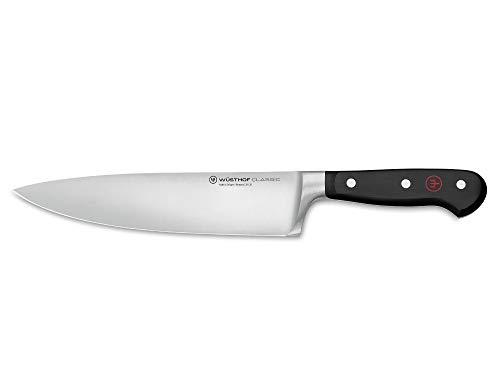 Wüsthof Classic 8" Chef's Knife | Cooks who want weight and a bolster | 7.4 | |
| 2 | 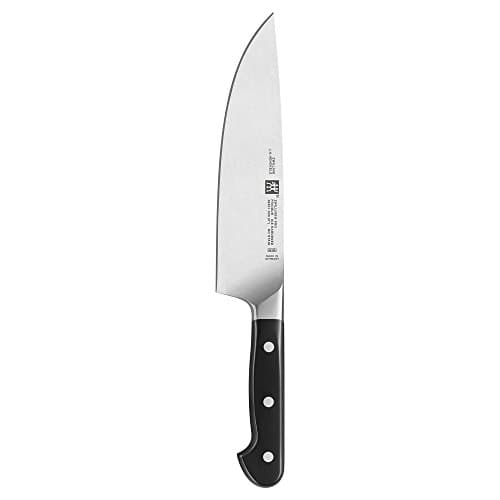 Zwilling Pro 8" Chef's Knife (38401-203) | Cooks who choke up on the blade | 7.3 | |
| 3 | 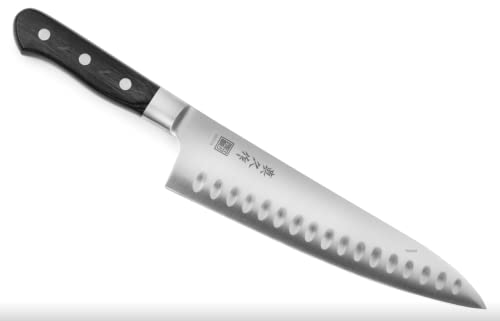 MAC Professional 8" Chef's Knife with Dimples (MTH-80) | The one-knife kitchen | 8.8 |
If you already own one, this review is about whether to keep it. If you are choosing one, it is about what you are actually buying, which is build quality and longevity - not cutting performance.
The published numbers, and where each one comes from
| Specification | Figure | Published by |
|---|---|---|
| Blade length | 8.0 in (200 mm) | Wusthof |
| Blade width / height | 1.9 in (47 mm) | Wusthof |
| Handle length | 4.5 in | Wusthof |
| Hardness | 58 HRC | Wusthof and both retailers |
| Factory edge | 14° per side (28° inclusive) | Wusthof |
| Steel | "Special stainless steel" / X50CrMoV15 | Wusthof names no grade; retailers give X50CrMoV15 |
| Spine at heel | 3 mm, or 2.9 mm | Retailers disagree slightly; Wusthof does not publish it |
| Weight | 9.3 oz (265 g) | Retailer; Wusthof does not publish it |
| Construction | Forged, full tang, triple riveted, full bolster | Wusthof |
| Origin | Made in Solingen, Germany | Wusthof |
| Warranty | Limited lifetime | Wusthof |
The third column exists because this knife is a good example of how patchy manufacturer specifications can be. Wusthof publishes a blade length, a width, a handle length, a hardness and an angle - and no spine thickness and no weight, which are the two figures that predict how a chef's knife feels. Those come from specialist retailers, and they do not perfectly agree: 3 mm from one, 2.9 mm from another. A tenth of a millimeter changes nothing in the hand, but we would rather show you the disagreement than average it into a number nobody published.
58 HRC and 14 degrees: sharper than the stereotype
The folklore is that German knives come at 20 degrees per side and are blunt by design. That has not been true of this line for years. Wusthof publishes 14 degrees per side for its standard blades - its own FAQ says so, and a Q&A answer on the same site says 14.5 - which is one degree off the MAC Professional and two off the Shun Classic. On arrival this is a genuinely acute knife.
What 58 HRC changes is how long that holds. A softer steel at an acute angle deflects rather than chips, so the edge rolls over gradually instead of failing suddenly. In practice you get a knife that goes from sharp to adequate quickly, comes back with a few passes on a steel rod, and needs the stones a handful of times a year. That is a maintenance pattern, not a flaw, and it is why a honing rod has lived in German knife blocks for a century - honing is not sharpening covers why those are two different jobs.
Edge retention is a steel property; how a blade moves through food is a geometry property. A 58 HRC blade can be made very sharp - this one is - and it will still split a sweet potato rather than slice it if there is 3 mm of steel behind the edge. Sharpening cannot thin a blade. If wedging is your complaint, no amount of stone work on this knife will answer it, and our knife steel guide sets out the whole hardness ladder so you can see where 58 sits.
265 grams, and who that suits
This knife weighs 9.3 oz. It is the joint-heaviest blade in our registry, and the mass is doing something: it drops through an onion under its own weight, it feels planted rather than nimble, and it makes rock-chopping effortless because you are mostly steering rather than pushing.
Cooks who learned on a forged German knife usually find lighter blades insubstantial and never adapt. Cooks who prep for an hour at a stretch usually want something lighter by the end of it. If your hands or wrists complain after a prep session, 265 g is working against you, and our knives for arthritis guide explains why mass matters more there than any other specification. None of that makes the Classic a bad knife - it makes it a specific one.
The bolster is the thing to decide on
The Classic carries a full bolster: the forged collar runs all the way down to the heel. It looks right, it protects your knuckles, and it creates the one structural problem with this knife. Because the bolster stands proud of the edge, the last half inch of the blade cannot reach a stone. Sharpen a full-bolstered knife for ten years and you develop a permanent dull stub at the heel that nothing short of a grinder will fix.
Wusthof knows this, which is why it sells the same 8 inch Classic in a demi half-bolster form that clears the heel entirely. If you sharpen your own knives, buy that one. If you send them out or use a guided sharpener that handles the heel differently, the full bolster costs you nothing. The same problem, solved the same way, is the reason we rate the Zwilling Pro's curved half bolster as the best handle detail among German knives.
The handle itself is a triple-riveted black synthetic with a full tang through it. It is hard, smooth, extremely durable and slightly slippery when wet - less secure than the Victorinox's textured Fibrox, better looking than almost anything, and symmetrical, so it has no handedness.
Living with it
Hone it two or three times a week on a steel or a fine ceramic rod and it will stay usable almost indefinitely between stone sessions. When it does need stones, it is one of the most forgiving knives you can learn on: the steel grinds fast, raises a burr quickly and tolerates a wandering angle, which is exactly the combination a first whetstone session wants. How to use a whetstone is the place to start, and a 1,000-grit stone finished on 3,000 is all this knife ever needs.
Wusthof's own care guidance is to wash by hand, towel-dry immediately, and avoid soaking and abrasive sponges. Follow it. The steel is stainless enough to survive neglect; the edge is not, and a dishwasher cycle damages a knife mechanically rather than chemically.
Who should buy it
- You want one knife for the next thirty years and do not want to think about it. Forged, full tang, lifetime warranty, nearly impossible to chip.
- You prefer a heavy knife. There is no substitute for mass and this has it.
- The knife will be shared, or used by someone careless. 58 HRC steel rolls instead of chipping, which is the difference between a five-minute fix and a repair.
- You are buying your first stone. This is a better first project than any hard Japanese blade - buy the demi-bolster version if you can.
Who should not
Your complaint about your current knife is that it feels thick, wedges in dense produce, or goes dull too fast. All three are the specification of this knife rather than a fault in your old one, so replacing like with like will not help. The answer is a thinner, harder blade: MAC against Wusthof runs that comparison with numbers, and the MAC MTH-80 publishes 2.5 mm at the spine, 6.8 oz and 61 HRC against this knife's roughly 3 mm, 9.3 oz and 58.
Left-handed cooks have no issue here - the handle is symmetrical - but anyone buying for small hands should note the 4.5 in handle and the 265 g mass before committing.
The verdict
The Wusthof Classic is an excellent knife and a poor upgrade, and knowing which of those you need is the whole decision. Bought as the knife you own forever, it is close to unimprovable: Solingen-forged, warranted for life, sharper from the factory than people expect, and forgiving enough that it will survive whatever your kitchen does to it. Bought because your current knife disappoints you, it will disappoint you in exactly the same way, because thickness and hardness are the things you are reacting to and this knife is on the wrong side of both.
For the cross-shops people actually make at this moment: Shun against Wusthof is the Japan-versus-Germany version, Victorinox against Wusthof asks whether the forging is worth the money at all, and Japanese against German knives is the category-level answer with the published numbers behind it.
Weighing it against the wider field rather than one rival? Wusthof alternatives sets out the four specific reasons people shop away from this knife - 9.3 oz of weight, a roughly 3 mm spine, a full bolster you cannot sharpen past, and 58 HRC edge retention - and the knife that answers each.
The picks in detail
#1 · Cooks who want weight and a bolster
Wüsthof Classic 8" Chef's Knife
The German benchmark, and the knife most of this site's readers are replacing. 265 g, a 3 mm spine, 58 HRC, and a 14-degree-per-side factory edge that is more acute than its reputation suggests.
What it does well
- Forged, full tang, triple-riveted — it will outlive you
- 14 degrees per side from Wüsthof's Precision Edge Technology is sharper than most people assume
- Soft enough at 58 HRC to be nearly chip-proof
Where it gives way
- 265 g is heavy; the 3 mm spine wedges in dense produce
- 58 HRC gives up meaningful edge retention to a 61 HRC Japanese blade
- Full bolster gets in the way when you sharpen the heel
Skip it if: Anyone whose complaint is 'my knife feels heavy and wedges in a sweet potato' — that is the 3 mm spine, and a thinner Japanese blade is the fix.
| Blade length | 8 in (200 mm) |
|---|---|
| Steel | X50CrMoV15 high-carbon stainless |
| Hardness | 58 HRC |
| Edge angle | 14 degrees per side (28 degrees inclusive) |
| Blade height | 1.9 in (47 mm) |
| Spine | 3 mm |
| Weight | 9.3 oz (265 g) |
#2 · Cooks who choke up on the blade
Zwilling Pro 8" Chef's Knife (38401-203)
The German knife with the curved half bolster, which is the one real ergonomic idea in this category. 57 HRC and 3.25 mm at the spine, so it is tough rather than keen.
What it does well
- The curved half bolster leaves the heel clear, so you can sharpen the whole edge and choke up onto the blade
- Friodur ice-hardening and a forged full tang - this is a knife that tolerates a careless kitchen
- 15 degrees per side is more acute than the German reputation suggests
Where it gives way
- 3.25 mm at the spine is the thickest blade here; it wedges in dense produce
- 57 HRC gives up real edge retention to any 60+ HRC Japanese blade
- 266 g is heavy over a long prep session
Skip it if: Anyone whose complaint is wedging. At 3.25 mm the spine is the thickest in our registry, and no amount of sharpening thins a blade.
| Blade length | 8 in |
|---|---|
| Blade height | 1.87 in |
| Overall length | 13 in |
| Steel | Friodur X2 ice-hardened high-carbon stainless |
| Hardness | 57 HRC |
| Edge angle | approx. 15 degrees per side, double bevel |
| Spine at heel | 3.25 mm |
| Weight | 9.3 oz (266 g) |
| Handle | Triple-riveted resin with a curved half bolster |
| Origin | Made in Germany |
#3 · The one-knife kitchen
MAC Professional 8" Chef's Knife with Dimples (MTH-80)
The knife that wins the most side-by-side tests and asks the least of you. Thin, light, 61 HRC, and forgiving enough that a mediocre sharpening job still cuts well.
What it does well
- 6.8 oz with a 2.5 mm spine — genuinely light in the hand over a long prep session
- 15 degrees per side from the factory, which is the angle you will maintain anyway
- 25-year warranty and a reputation for consistency unit to unit
Where it gives way
- Costs meaningfully more than a Tojiro DP for a similar hardness
- Mono-steel, so no cladding to protect the core if you drop it edge-first
- The dimples do less for release than the marketing implies
Skip it if: Anyone chasing maximum edge retention. At 61 HRC in a mono-steel it will not out-last a powder-steel blade, and the dimples are cosmetic more often than useful.
| Blade length | 8 in (approx. 200 mm) |
|---|---|
| Steel | Sub-zero tempered high-carbon molybdenum vanadium alloy |
| Hardness | 61 HRC |
| Edge angle | 15 degrees per side (double bevel) |
| Blade height | 1 7/8 in |
| Spine at heel | 2.5 mm |
| Weight | 6.8 oz |
| Handle | Riveted Pakkawood with integrated bolster |
Common questions
Is the Wusthof Classic worth it?
What steel does Wusthof use in the Classic?
What angle is the Wusthof Classic sharpened to?
Can I sharpen a Wusthof on Japanese whetstones?
Should I buy the full-bolster or the half-bolster Classic?
Is the Wusthof Classic dishwasher safe?
Sources
- WUSTHOF - Classic 8" Cook's Knife (1040100120) product page and care guidance
- Cutlery and More - Wusthof Classic Chef's Knife 8" specifications (spine and weight)
- Knife Merchant - Wusthof Classic 8 in. Chef Knife specifications (steel grade and spine)
- Cutlery and More - Wusthof Classic 8" Chef's Knife with Demi Half Bolster
Read next
Brands
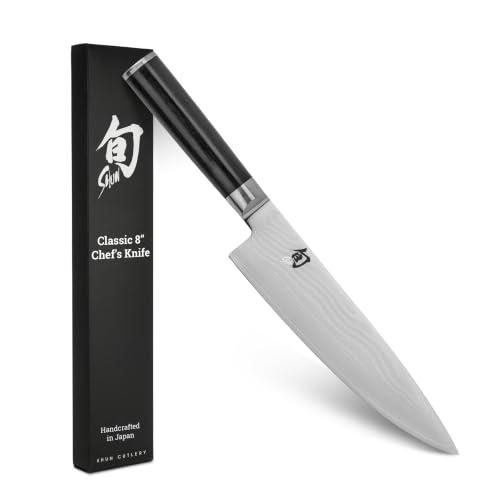
Shun vs Wüsthof
Brands
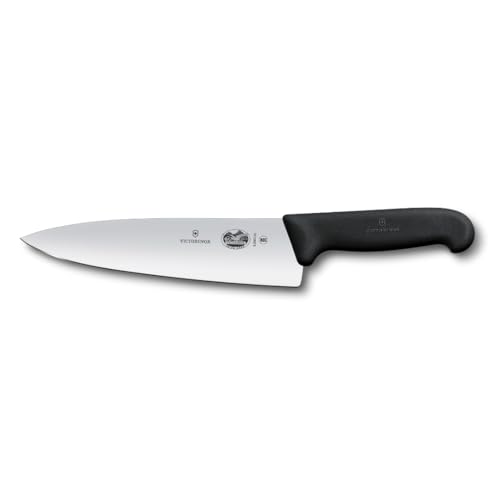
Victorinox vs Wüsthof
Brands
MAC vs Wüsthof
Brands
Victorinox vs Zwilling
Japanese Knives
Japanese vs German Knives

Steel & Care