Japanese Knives
Kiritsuke vs Santoku
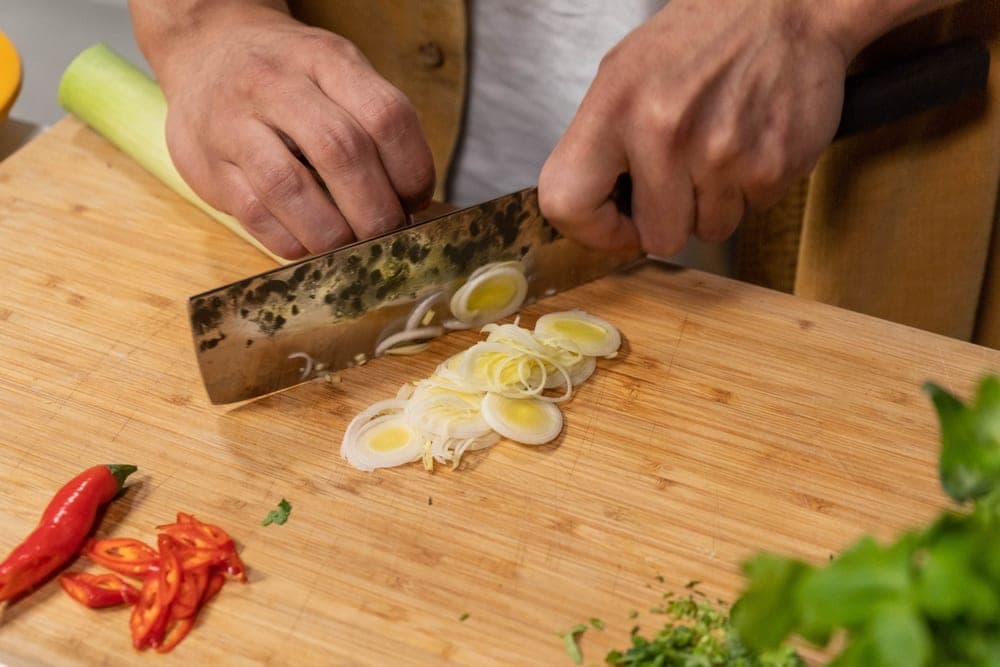
What this is based on: published manufacturer specifications and retailer listings, cited on each product; the weight of professional and owner reviews across multiple retailers; and hands-on experience sharpening and cooking with knives of this type. We have not individually tested every model listed, we do not run instrumented sharpness testing, and we do not claim a test we did not run.
Quick picks
| # | Product | Best for | Score | Price |
|---|---|---|---|---|
| 1 | 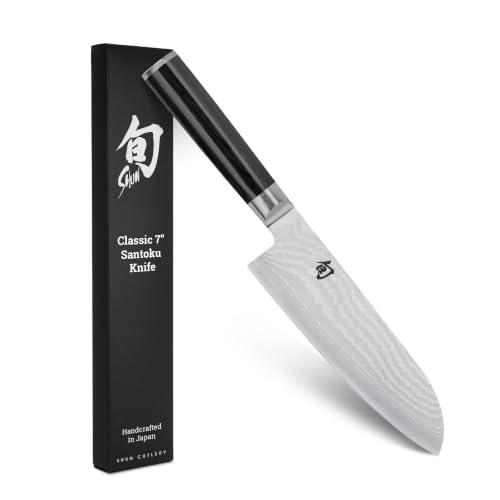 Shun Classic 7" Santoku | Small boards and short cooks | 8.2 | |
| 2 |  Tojiro DP Gyuto 210mm (F-808) | First Japanese knife | 8.6 | |
| 3 | 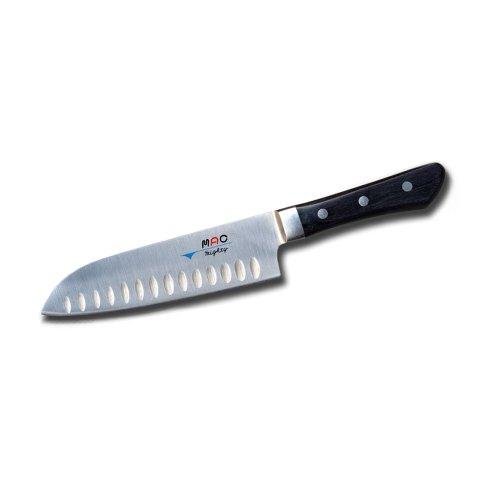 MAC Professional 6.5" Santoku (MSK-65) | Precision vegetable work | 8.5 |
These two get compared because both have a flat cutting edge and neither is a gyuto, so they end up on the same shortlist. In the hand they could hardly be more different. One is a short, light, forgiving everyday knife; the other is a long blade with a dramatic profile and a point you have to think about.
What separates them
| Kiritsuke | Santoku | |
|---|---|---|
| Typical length | 210-270 mm, usually 240 mm | 165-180 mm |
| Tip | Angled flat grind to a very fine point (k-tip / reverse tanto) | Rounded sheepsfoot |
| Edge | Flat | Flat with a slight curve |
| Bevel | Traditionally single; most modern ones double | Double |
| Board needed | Large - 240 mm of blade needs room | Small is fine; 12 in is workable |
| Tip durability | Low - the thinnest point in the Japanese range | High - there is barely a point to break |
| Learning curve | Steep, especially single bevel | Shallow |
Length is the first thing you feel
A 240 mm kiritsuke is a long knife. On a generous board it is wonderful: one pass through a cabbage, a full stroke down a side of salmon, the heel never running out of edge. On a 12 inch board it is a nuisance, and in a 30 cm drawer it is a problem. Our sizes guide works through the 180 against 210 against 240 mm question properly, and the answer is almost always decided by the board rather than the cook.
A santoku goes the other way. At 165 to 180 mm it is short enough to control with very little wrist movement, which is why it suits a small kitchen, a shorter cook and anyone who finds an 8 inch chef's knife unwieldy. The Shun Classic santoku is 7 inches with the same VG-MAX core and 16-degree edge as its full-size chef's knife, so you give up reach and nothing else.
The tip is the real argument
A santoku's rounded sheepsfoot tip is tough and slightly useless. You cannot score duck skin neatly with it or get into the hollow of a shallot, but you also cannot snap it. A kiritsuke's k-tip is the opposite: a straight diagonal drop from the spine to an extremely fine point, which is superb for detail work and the easiest part of any Japanese knife to break.
If you regularly score, mince close, trim silverskin or portion fish, that tip earns its keep. If you mostly chop vegetables and portion boneless meat, it is a liability you are paying for. The shape question across the whole k-tip family - kiritsuke, bunka, hakata - comes down to that same honest audit of how you use the first inch of your knife, which we go through in Japanese flat tipped knives.
A traditional kiritsuke is single-bevel, which means asymmetric sharpening, a flat back that has to be maintained, and a knife that steers in the cut until you learn it. Most kiritsuke sold to home cooks are double-bevel knives wearing the profile, which is fine - but the two sharpen completely differently. See single bevel against double bevel before you commit.
What each one is actually better at
- Long slicing cuts. Kiritsuke. 240 mm of flat edge through a cabbage or a loin is a different experience from 170 mm.
- Everyday chopping on a normal board. Santoku. Less knife to manage, no overhang, no point to protect.
- Fine tip work. Kiritsuke, clearly - and a MAC Professional santoku at 15 degrees per side is the closest a santoku gets.
- One knife for everything. Neither, strictly. A 210 mm gyuto gives you most of the kiritsuke's reach with a tip that survives contact with the world.
Which one to buy
For a first or only Japanese knife, the santoku - and the Shun Classic 7 inch is the premium version of it, with the MAC MSK-65 the thinner, more precise alternative at the same length. If what attracts you to the kiritsuke is the length rather than the profile, the Tojiro DP gyuto at 210 mm is the sane route: longer than an 8 inch Western knife, 43 mm of heel height, a 1.9 mm spine, and a tip that will not break the first time you lever something.
Buy a kiritsuke third, once you know you want it, have the board for it and have decided whether you are taking on a single bevel. It is a genuinely lovely knife and a poor first choice.
Sharpening and storage
A double-bevel kiritsuke sharpens like any other Japanese knife, with one caveat: the angled tip has a short, awkward edge section and it is very easy to round it off by letting the knife drift at the end of the stroke. Work the tip deliberately, in its own passes, rather than hoping it comes along with the rest of the blade. A single-bevel kiritsuke is a different project entirely, involving a flat back that has to be maintained and an asymmetric bevel that steers the cut.
Storage is the other practical difference. A santoku survives a drawer; a kiritsuke's point does not, and neither does a 240 mm blade fit most blocks. A saya, a magnetic rack or a knife roll is part of the purchase. Our storage guide covers the options, and our sharpening guide gives the sequence for a double bevel.
The verdict
The santoku wins on practicality by a distance: short, flat, forgiving, cheap to own and impossible to break at the tip. The kiritsuke wins on reach and on precision, and it costs you board space, fragility and - if you buy the traditional version - a new sharpening skill. Start with the santoku or a gyuto. Our kiritsuke against gyuto comparison covers the other half of this decision, and santoku knife uses sets out what the short knife actually does all day.
The picks in detail
#1 · Small boards and short cooks
Shun Classic 7" Santoku
The same VG-MAX core and 16-degree edge as the Classic chef's knife, in the shorter, flatter profile that suits a small board.
What it does well
- Short enough to control on a 12-inch board
- Flat profile suits push cutting, which is how Japanese knives want to be used
- Same steel and warranty as the full-size Classic
Where it gives way
- 7 in is short for breaking down a chicken or a large squash
- Premium over a Tojiro santoku is large
- D-handle is right-hand oriented
Skip it if: Anyone who rocks-chops. The flat profile punishes that grip.
| Blade length | 7 in |
|---|---|
| Steel | VG-MAX core, Damascus-clad |
| Hardness | 61 HRC |
| Edge angle | 16 degrees per side |
| Handle | D-shaped pakkawood |
#2 · First Japanese knife
Tojiro DP Gyuto 210mm (F-808)
The default answer to 'my first real Japanese knife'. VG-10 at around 60 HRC in a plain three-layer build, at a price that makes the inevitable first chip survivable.
What it does well
- VG-10 at 59-60 HRC takes a genuinely fine edge and holds it far longer than a German knife at 56-58
- 1.9 mm spine and 43 mm heel make it thin behind the edge without being fragile
- Cheap enough that learning to sharpen on it is not frightening
Where it gives way
- Handle finish is functional and unlovely; some units need the bolster easing with sandpaper
- Stainless cladding is soft and scratches readily
- Nothing about the fit and finish will impress anyone
Skip it if: Anyone who wants the knife to be beautiful. The handle is a workmanlike composite with a stainless bolster and nothing about it is charming.
| Blade length | 210 mm (8.3 in) |
|---|---|
| Steel | VG-10 core, 13-chrome stainless cladding (san mai) |
| Hardness | 59-60 HRC |
| Heel height | 43 mm |
| Spine at heel | 1.9 mm |
| Weight | approx. 187 g |
| Handle | Western, laminated composite wood with stainless bolster |
#3 · Precision vegetable work
MAC Professional 6.5" Santoku (MSK-65)
The MTH-80's logic in a santoku: thin, light, 15 degrees per side, and consistent from unit to unit.
What it does well
- Extremely thin behind the edge for its price
- Same 15-degree factory geometry as the rest of the Professional line
- Light and neutral in the hand
Where it gives way
- Thin tip is easy to damage
- No bolster to protect your knuckles in a heavy grip
- Costs more than the Tojiro equivalent
Skip it if: Heavy jobs. It is thin, and thin blades dislike bone and frozen food.
| Blade length | 6.5 in |
|---|---|
| Steel | Sub-zero tempered high-carbon molybdenum vanadium alloy |
| Hardness | approx. 61 HRC (MAC Professional line) |
| Edge angle | 15 degrees per side |
Common questions
Is a kiritsuke better than a santoku?
What length is a kiritsuke?
Is a kiritsuke single bevel or double bevel?
Which should I buy if I only own one Japanese knife?
Sources
Read next
Japanese Knives
Kiritsuke vs Gyuto
Japanese Knives
Santoku vs Bunka
Japanese Knives
Santoku vs Nakiri
Japanese Knives
Japanese Flat Tipped Knives
Japanese Knives
Santoku Knife Uses
Japanese Knives