Brands
Shun Premier Review
What this is based on: published manufacturer specifications and retailer listings, cited on each product; the weight of professional and owner reviews across multiple retailers; and hands-on experience sharpening and cooking with knives of this type. We have not individually tested every model listed, we do not run instrumented sharpness testing, and we do not claim a test we did not run.
Quick picks
| # | Product | Best for | Score | Price |
|---|---|---|---|---|
| 1 | 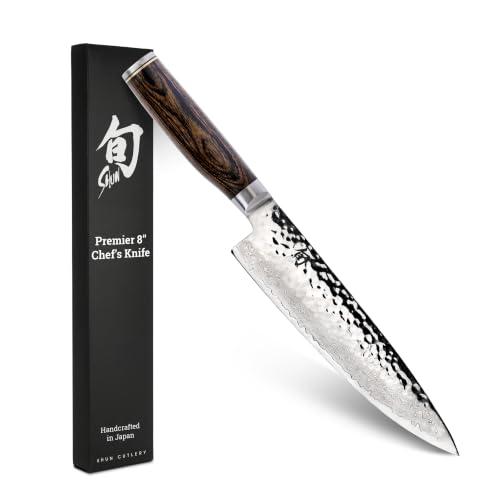 Shun Premier 8" Chef's Knife (TDM0706) | A right- or left-handed cook who wants the Shun edge without a D-handle | 8.2 | |
| 2 | 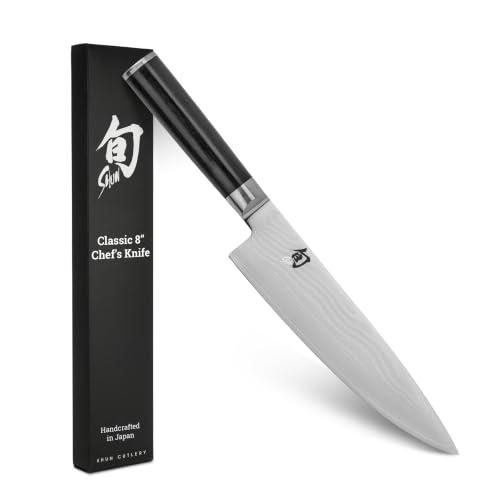 Shun Classic 8" Chef's Knife (DM0706) | A knife you want to look at | 8.3 | |
| 3 | 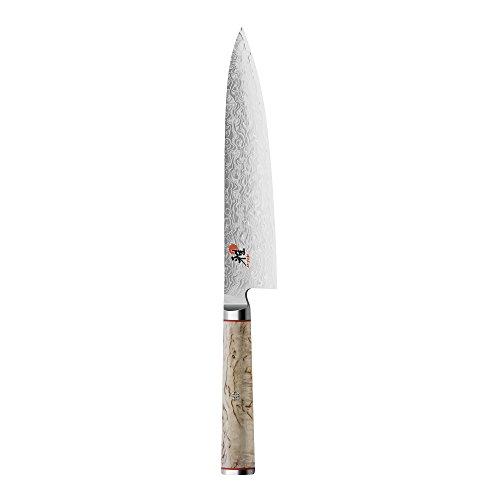 Miyabi Birchwood SG2 8" Chef's Knife | Someone who already sharpens their own | 8.6 |
Shun's line-up confuses people, so the short version: the Classic and the Premier share the same core steel and the same edge geometry. What differs is the blade finish and the handle. That makes this review mostly about whether those two things are worth the gap — and for a specific group of buyers, they clearly are.
| Shun Premier TDM0706 | |
|---|---|
| Blade length | 8 in (200 mm) |
| Blade height | 1.9 in (47 mm) |
| Steel | VG-MAX core, 34-layer SUS410/SUS431 Damascus each side |
| Hardness | 60-61 HRC |
| Edge angle | approx. 16° per side, double bevel |
| Spine thickness | 1.9 mm |
| Finish | Hammered tsuchime |
| Handle | Contoured walnut PakkaWood, stainless end cap, 5 in |
| Weight | 7.5 oz (215 g) |
| Origin | Seki, Japan |
The handle is the reason to buy it
The Classic's D-shaped pakkawood is lovely and is shaped for a right-handed pinch grip; held in the left hand the flat of the D presses into the wrong place. The Premier's handle is a symmetrical contoured walnut PakkaWood with a stainless end cap, and it is comfortable in either hand. For a left-handed cook who wants Shun's steel, this is the knife. The left-handed guide has the wider picture.
At 5 inches the handle is also longer than the Classic's, which suits larger hands. The trade is weight: 215 g is heavy for a Japanese knife, heavier than the Tojiro DP and far heavier than a Global.
The tsuchime finish is not just decoration
The hammered dimples along the blade face reduce the surface area in contact with a wet slice, which breaks the suction that makes potato cling. The effect is real and modest — it will not turn a thick knife into a thin one, but it does make repetitive vegetable work tidier. It also hides scratches better than a mirror polish, which matters over a decade of use.
The 34-layer Damascus cladding either side of the VG-MAX core is cosmetic. It does nothing for cutting and nothing for strength; the hard core is the knife and the layers are the jacket. That is true of every Damascus-clad kitchen knife, as covered in is Damascus steel worth it.
On the board
- Keen and durable, within limits. 60-61 HRC behind a 16-degree bevel is a sensible pairing — hard enough to hold the edge for weeks, not so hard that it chips on an onion skin.
- Thin where it counts. 1.9 mm at the spine, which is thinner than the MAC MTH-80 and much thinner than a Wüsthof Classic.
- Front-heavy for its weight. The stainless end cap does not fully offset the blade, so it drops into a cut more readily than a Tojiro.
- Needs a stone. A steel rod does almost nothing to a 61 HRC edge. Use a ceramic rod between sharpenings.
No bolster-free heel. There is a stainless bolster at the blade junction, so the very heel is slightly awkward to sharpen. Minor, but permanent.
Not for hard boards. A 16-degree edge at 61 HRC will chip on glass, stone or bamboo. Board guide.
The weight is the thing nobody warns you about
215 g is heavy for a Japanese knife. For comparison, the Tojiro DP gyuto is about 187 g, the Global G-2 is 170 g, and the MAC MTH-80 is 6.8 oz — the Premier is the heaviest Japanese 8-inch knife most buyers will seriously consider, and the stainless end cap does not fully balance a 47 mm blade.
Whether that is a flaw depends entirely on you. Cooks coming from a 265 g Wüsthof will find the Premier light and lively. Cooks coming from a Global will find it substantial, and some will find it tiring over an hour of prep. If lightness is what you are chasing, this is the wrong Shun.
Premier or Classic, decided
| Premier (TDM0706) | Classic (DM0706) | |
|---|---|---|
| Core steel | VG-MAX | VG-MAX |
| Hardness | 60-61 HRC | 61 HRC |
| Edge angle | approx. 16° per side | 16° per side |
| Blade finish | Hammered tsuchime | Flat Damascus |
| Handle | Contoured walnut, symmetrical, 5 in | D-shaped pakkawood, right-biased |
The cutting end of these two knives is effectively the same. If you are right-handed, happy with a D-handle and indifferent to the hammered finish, there is no performance reason to pay the Premier premium. If you are left-handed, have large hands, or want the tsuchime face, there is a clear one.
One more practical difference: the Premier's walnut PakkaWood shows wear differently from the Classic's darker pakkawood, picking up a lighter patina along the top of the grip where the hand sits. Some owners like that and some do not. Both handles are resin-impregnated wood composite, so neither needs oiling and neither should go near a dishwasher. Handle types compared.
The verdict
A genuinely good knife, and a specific one. The Premier earns its premium for left-handed cooks, for larger hands, and for anyone who wants Shun's steel without the D-handle. The hammered finish is a small real benefit on top.
If you are right-handed and the D-handle suits you, the Shun Classic is the same cutting performance for less money, and Classic against Premier lays the two side by side. If you want harder steel and a longer edge at this price point, the Miyabi Birchwood SG2 runs 63 HRC with a sub-12-degree bevel.
The picks in detail
#1 · A right- or left-handed cook who wants the Shun edge without a D-handle
Shun Premier 8" Chef's Knife (TDM0706)
The same VG-MAX core and 16-degree edge as the Classic, in a thinner blade with a hammered tsuchime face and a contoured walnut handle. You are buying the finish and the grip, not a better cutter.
What it does well
- Contoured symmetrical handle works in either hand, unlike the Classic D-handle
- 1.9 mm spine is thinner than the Classic at the same blade height, so it wedges less
- Hammered face measurably reduces how much wet food clings to the blade
Where it gives way
- List price sits above the Classic for the same steel, hardness and edge angle, though street prices often overlap
- The walnut handle has no bolster, which some cooks read as less secure
- Hammered finish is cosmetic above the first few millimeters of the edge
Skip it if: Anyone chasing cutting performance per dollar. A MAC MTH-80 or a Tojiro DP cuts as well or better for less.
| Blade length | 8 in (200 mm) |
|---|---|
| Blade height | 1.9 in (47 mm) |
| Spine thickness | 1.9 mm |
| Steel | VG-MAX core, 34-layer SUS410/SUS431 Damascus each side |
| Hardness | 60-61 HRC |
| Edge angle | Approximately 16 degrees per side, double bevel |
| Finish | Hammered tsuchime |
| Handle | Contoured walnut PakkaWood, stainless end cap, 5 in |
| Weight | 7.5 oz (215 g) |
| Origin | Seki, Japan |
| Warranty | Limited lifetime |
#2 · A knife you want to look at
Shun Classic 8" Chef's Knife (DM0706)
The Damascus-clad knife people actually buy. A 16-degree-per-side VG-MAX edge at 61 HRC, a D-shaped pakkawood handle, and a look that sells itself.
What it does well
- 16 degrees per side is a sensible factory angle — acute, but not so thin it chips on a carrot
- Handle geometry is genuinely comfortable in a pinch grip
- Kai's warranty and free sharpening service are real, useful things
Where it gives way
- You pay a significant premium over a MAC or Tojiro for the Damascus cladding
- The D-shaped handle is oriented for right-handed use
- Thin tip is easy to snap if you twist it in a squash
Skip it if: Left-handed cooks who dislike a D-shaped handle, and anyone who resents paying for 68 layers of cladding that do nothing for cutting.
| Blade length | 8 in |
|---|---|
| Steel | VG-MAX core, 34 layers Damascus cladding each side |
| Hardness | 61 HRC |
| Edge angle | 16 degrees per side |
| Handle | D-shaped pakkawood with stainless bolster and end cap |
| Warranty | Limited lifetime |
#3 · Someone who already sharpens their own
Miyabi Birchwood SG2 8" Chef's Knife
SG2 powder steel at 63 HRC behind a 9.5-to-12-degree edge and 101 layers of Damascus. The sharpest knife here out of the box, and the least forgiving.
What it does well
- 63 HRC SG2 holds an edge appreciably longer than VG-10 at 60 — commonly cited as roughly twice as long
- A sub-12-degree factory edge is genuinely rare and it shows on the first cut
- 178 g with a 2.1 mm spine — light and thin for a Damascus-clad knife
Where it gives way
- 63 HRC and a very acute edge is a chipping risk on any hard board
- Powder steel is slow on a soft clay stone; you want a hard stone or diamond
- Costs several times what a Tojiro DP does
Skip it if: A first Japanese knife. At 63 HRC with an edge under 12 degrees per side it will chip on a hard board or a careless twist, and it is slow to sharpen on a soft stone.
| Blade length | 8 in |
|---|---|
| Steel | SG2 micro-carbide powder steel core, 50 Damascus layers each side |
| Hardness | 63 HRC, Cryodur ice-hardened |
| Edge angle | approx. 9.5-12 degrees per side, double bevel |
| Blade height | 1.75 in |
| Spine at heel | 2.1 mm |
| Weight | 6.2 oz (178 g) |
| Handle | Karelian birch with stainless bolster and mosaic pin |
| Origin | Seki, Japan |
Common questions
Is the Shun Premier worth the extra over the Classic?
Does the hammered tsuchime finish actually do anything?
Can left-handed cooks use the Shun Premier?
How do you sharpen a Shun Premier?
Sources
Read next
Brands
Shun Classic vs Premier
Brands
Shun vs Miyabi

Japanese Knives
Left-Handed Japanese Knives
Japanese Knives
Best Gyuto Under $300
Brands