Sharpeners
Best Knife Sharpeners for Beginners
What this is based on: published manufacturer specifications and retailer listings, cited on each product; the weight of professional and owner reviews across multiple retailers; and hands-on experience sharpening and cooking with knives of this type. We have not individually tested every model listed, we do not run instrumented sharpness testing, and we do not claim a test we did not run.
Quick picks
| # | Product | Best for | Score | Price |
|---|---|---|---|---|
| 1 | Tumbler Rolling Knife Sharpener | People who want a fixed angle and hate gear | 8.0 | |
| 2 |  Work Sharp Precision Adjust Elite | Repeatable angles without years of practice | 8.2 | |
| 3 |  King KDS Combination Whetstone #1000/#6000 | Your first stone | 8.4 | |
| 4 | 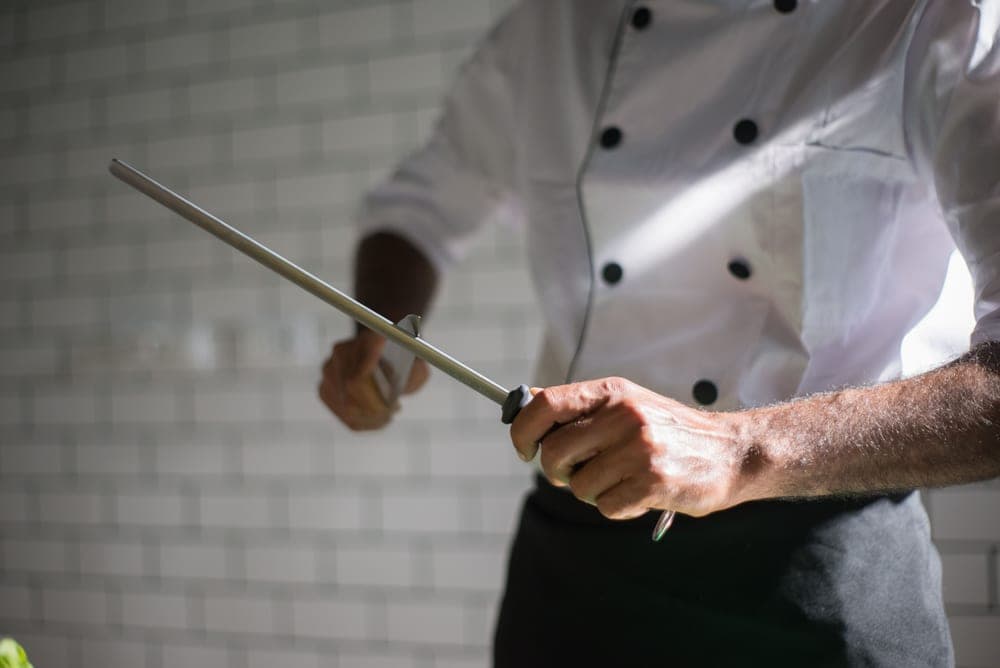 Idahone Fine Ceramic Honing Rod, 12" | Maintaining a hard Japanese edge between sharpenings | 8.8 |
Beginners do not fail at sharpening because they lack abrasive. They fail because sixty strokes at a consistent 15 degrees is a motor skill, and on stroke forty the spine drifts up two degrees and the bevel rounds over. Every tool on this page is a different answer to that one problem: remove the variable mechanically, constrain it with a clamp, or learn to feel it.
What to look for in a first sharpener
- A fixed or guided angle. Not a suggestion, a mechanism. A magnetic roller or a clamped rod gives you the same angle on stroke sixty as on stroke one. This is the single feature that separates a good first sharpener from a bad one.
- 15 degrees per side, available. Japanese kitchen knives come from the factory between about 15 and 16 degrees per side. A tool that only offers 20 degrees will grind a new, blunter edge onto your knife and it will take several sessions to undo. Our angle chart has the numbers by knife type.
- Abrasive that is replaceable, not disposable. Rolling sharpeners with removable discs and guided systems with separate plates can be serviced. A sealed pull-through with fixed carbides is worn out when it is worn out, and it scrapes steel off in strips in the meantime — see why we do not recommend them.
The four picks compared
| Tool | Angle control | Time per knife | Skill needed | Steel removed |
|---|---|---|---|---|
| Tumbler rolling sharpener | Fixed, 15 or 20 degrees | approx. 3 min | Almost none | Low |
| Work Sharp Precision Adjust Elite | Clamped, 15-30 degrees in 1-degree steps | 10-15 min | Low, but there is setup | Low to moderate |
| King KDS #1000/#6000 stone | Yours to hold | 20 min when learning | Real, and worth having | Lowest |
| Idahone fine ceramic rod | Yours to hold, but forgiving | 30 seconds | Minimal | Negligible — it realigns |
The Work Sharp is the most capable tool here and the one most likely to sit in a cupboard. It adjusts in one-degree increments from 15 to 30, comes with five diamond plates, a ceramic and a strop, and it will put a better edge on a knife than a roller can. It also has a clamp that fights a 240 mm gyuto and a lot of parts to lay out. Buy it if you have four or five knives to do in one sitting.
Which one to buy
- You want a sharp knife and no project. Tumbler rolling sharpener. Magnetic holder, 15-degree setting, two pieces. In side-by-side comparisons it produces an edge as sharp as the German alternative at a considerably lower price.
- You have several knives and want one setup to do them all. Work Sharp Precision Adjust Elite. One-degree angle increments mean you can actually match a 15-degree Japanese factory edge, and the seven abrasive options cover chip repair through polish.
- You want the skill, not the shortcut. King KDS #1000/#6000. The soft clay binder gives feedback no fixed-angle device can, it removes the least steel of anything here, and it follows whatever grind is already on the blade. Expect the first attempt to be disappointing.
- Whatever you chose above. Idahone 12 inch fine ceramic rod. It is harder than a 60 HRC Japanese blade, where a ribbed steel rod frequently is not, and thirty seconds every few uses keeps an edge feeling fresh for weeks longer.
A cheap pull-through with two crossed carbide wheels. It takes a strip of steel off the edge rather than abrading a bevel, at a fixed angle that is usually 20 degrees or wider, and on a thin Japanese blade that is damage. It will make a very dull knife cut again, which is why they sell — and it will shorten the life of a good knife considerably. The full argument is in pull-through sharpener versus whetstone.
The path most people actually take
A roller first, because it works immediately and costs little. A honing rod alongside it within a month, because the roller fixes the edge and the rod keeps it. Then, about a year later, a 1000-grit stone — bought not because the roller failed but because the roller only does 15 and 20 degrees, and by then you want to thin a blade behind the edge or fix a chip or follow an asymmetric grind. That progression costs more in total than buying the stone on day one, and far more people finish it.
If you already know you are the sort of person who will enjoy the stone, start there and save the detour: the beginner whetstone picks cover which 1000-grit stone suits the steel you own, and are whetstones worth it is the honest case both ways.
The verdict
Tumbler for the beginner who wants a result tonight. Work Sharp Precision Adjust Elite for the beginner with a drawer of knives and an afternoon. King KDS for the beginner who wants to be able to sharpen anything in ten years' time. An Idahone ceramic rod in all three cases, because honing is the cheapest sharpness per dollar in this whole category.
The picks in detail
#1 · People who want a fixed angle and hate gear
Tumbler Rolling Knife Sharpener
A magnetic holder and a rolling abrasive disc that fixes your angle at 15 or 20 degrees. Two pieces, almost no learning curve.
What it does well
- Two pieces, nothing to assemble, nothing to set
- 15-degree setting is the correct angle for most Japanese kitchen knives
- Cheaper than the German alternative and, in side-by-side comparisons, as sharp
Where it gives way
- Magnetic holder limits you to the angles it offers
- Rolls less smoothly than the Horl 2
- Does nothing for a chipped or badly reprofiled edge
Skip it if: Anyone who wants to learn to sharpen. It works by removing the skill, which means you never acquire it.
| Angles | 15 degrees and 20 degrees |
|---|---|
| Components | Sharpening roller + magnetic knife holder |
| Origin | Made in China |
#2 · Repeatable angles without years of practice
Work Sharp Precision Adjust Elite
A clamped, angle-guided system adjustable from 15 to 30 degrees in one-degree steps, with five diamond plates, a ceramic and a strop. It removes the one variable beginners cannot control.
What it does well
- One-degree angle increments mean you can actually match a 15-degree Japanese factory edge
- Seven abrasive options covers repair through polish
- Angle repeatability is the thing beginners lack, and this supplies it
Where it gives way
- Clamp limits blade length and height
- Slower per knife than a competent freehand session
- A lot of parts to store and lose
Skip it if: Long or very tall blades. A clamp-and-rod system fights a 240 mm gyuto, and it is slow compared to a stone once you can hold an angle.
| Angle range | 15-30 degrees, 1-degree increments |
|---|---|
| Abrasives | 220, 320, 400, 600, 800 diamond plates + fine ceramic |
| Also included | Leather strop and ceramic rod for serrations |
| Clamp | V-Block |
| Storage | Carry case and Tri-Brasive rack |
#3 · Your first stone
King KDS Combination Whetstone #1000/#6000
The stone almost everyone learns on. Soft, forgiving, cheap, and it tells you loudly when your angle wanders.
What it does well
- Two useful grits in one block for the price of half a premium stone
- Soft binder builds slurry readily, which gives beginners real feedback
- Almost impossible to damage a knife on it
Where it gives way
- Dishes quickly and needs flattening often
- The soak is a real commitment — you cannot sharpen on a whim
- Slow on hard powder steels like SG2
Skip it if: Impatient people. The 1000 side wants a 10-15 minute soak before every session and the clay binder dishes fast.
| Grits | #1000 / #6000, combination |
|---|---|
| Binder | Clay |
| Soaking | #1000 side: 10-15 minutes. #6000 side: splash only |
| Size | 207 x 66 x 36 mm |
| Weight | approx. 956 g |
#4 · Maintaining a hard Japanese edge between sharpenings
Idahone Fine Ceramic Honing Rod, 12"
The honing rod that is actually harder than your knife. 1200 ANSI alumina ceramic, which is roughly 3000-3500 on the Japanese scale.
What it does well
- Ceramic is harder than the steel in a 60+ HRC Japanese knife; a steel rod often is not
- 1200 ANSI realigns without removing meaningful steel
- High-alumina body resists the grooving that ruins cheaper rods
Where it gives way
- Ceramic is brittle — one hard knock on a stone counter and it is done
- Removes so little steel that it cannot rescue a truly dull knife
- 12 in is longer than some drawers
Skip it if: Anyone who bangs the rod on the counter. Ceramic chips; steel does not.
| Rod length | 12 in (30.5 cm) |
|---|---|
| Rod diameter | 1/2 in (12.7 mm) |
| Overall length | 17.5 in (44.5 cm) |
| Grit | Fine, 1200 ANSI (approx. 3500 JIS) |
| Material | High-alumina ceramic |
| Handle | Hard rock maple, 5.25 in |
| Origin | Made in the USA |
Common questions
What is the best knife sharpener for a beginner?
Should a beginner start with a whetstone or a sharpener?
Are electric sharpeners good for beginners?
Do I need a honing rod as well as a sharpener?
Sources
Read next
Sharpeners
Guided Sharpening Systems
Sharpeners
Best Rolling Knife Sharpeners
Whetstones & Skill
Best Whetstone for Beginners
Sharpeners
Whetstone vs Rolling Sharpener
Sharpeners