Sharpeners
Best Diamond Knife Sharpeners
What this is based on: published manufacturer specifications and retailer listings, cited on each product; the weight of professional and owner reviews across multiple retailers; and hands-on experience sharpening and cooking with knives of this type. We have not individually tested every model listed, we do not run instrumented sharpness testing, and we do not claim a test we did not run.
Quick picks
| # | Product | Best for | Score | Price |
|---|---|---|---|---|
| 1 | 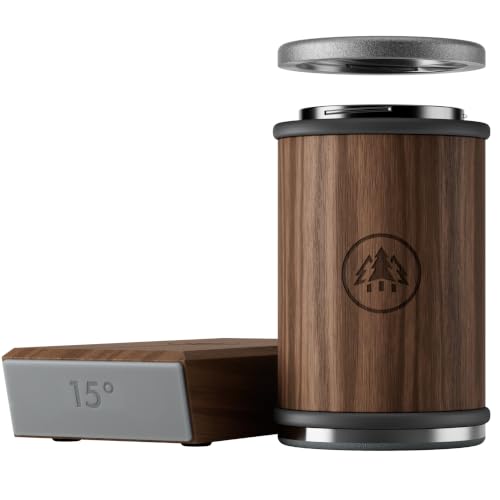 HORL 3 Rolling Knife Sharpener | A 15-degree Japanese edge you want kept sharp without learning to sharpen | 8.1 | |
| 2 | 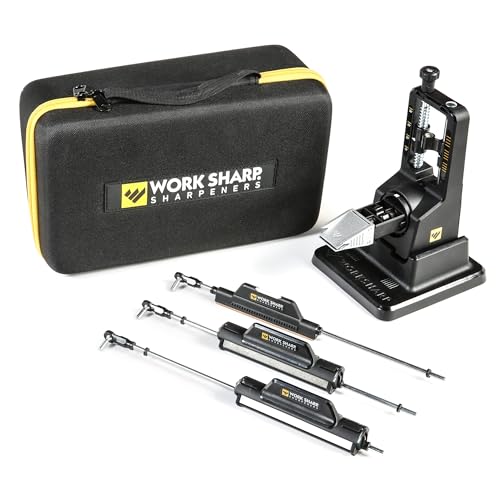 Work Sharp Precision Adjust Elite | Repeatable angles without years of practice | 8.2 | |
| 3 | 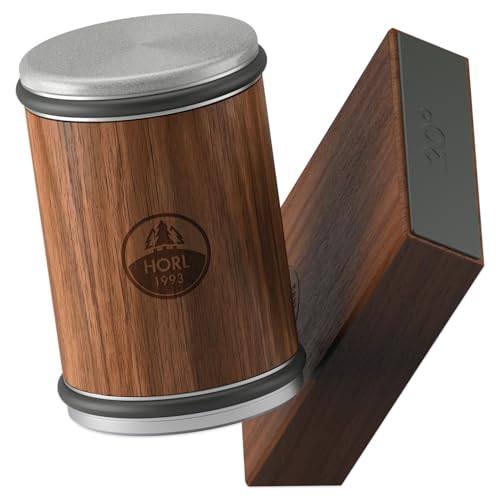 Horl 2 Rolling Knife Sharpener | Someone who will leave it on the counter | 7.9 | |
| 4 | 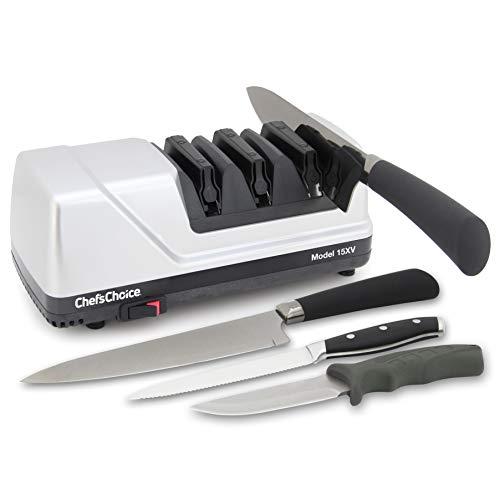 Chef'sChoice Trizor XV Model 15XV Electric Sharpener | A drawer of German knives you will never hand-sharpen | 7.6 |
Diamond is the only abrasive on this site that is reliably harder than everything in a kitchen knife. That is the whole case for it, and it only matters above a certain steel hardness. Below that, diamond is an expensive way to do what a combination stone costing a third as much already does well.
What diamond is actually for
Modern knife steel is a soft matrix with hard carbides suspended in it. A bonded stone abrades the matrix easily; whether it abrades the carbides depends on how hard the abrasive is relative to them. On a 59 to 61 HRC VG-10 blade almost any decent stone copes. On a 63 HRC powder steel - Miyabi's SG2, for instance - a soft stone can polish the surrounding steel and leave carbides proud, which is the sensation people describe as the stone sliding off it. Diamond does not have that problem.
The cost of that hardness is speed you did not ask for. A diamond surface removes steel quickly even under light pressure, and a knife has a finite amount of steel in it. So the ranking here is not on cutting rate; it is on how much the tool stops you overdoing it. That is why two rolling sharpeners, which physically cap the angle and the stroke, sit above a set of loose diamond plates.
Which of these is for you
| Pick | Diamond format | Angle control |
|---|---|---|
| HORL 3 | Block-diamond disc, plus a ceramic honing disc | Fixed 15 or 20 degrees, magnetic grip pad |
| Work Sharp Precision Adjust Elite | 220, 320, 400, 600 and 800 grit diamond plates | 15-30 degrees in one-degree steps, clamped |
| HORL 2 | Removable abrasive discs, superseded by the 3 | Fixed 15 or 20 degrees, 4.5 in magnetic support |
| Chef'sChoice Trizor XV 15XV | 100 percent diamond in stages 1 and 2 | None - the machine sets 15 degrees and reprofiles to it |
Where diamond is the wrong choice
A single-bevel knife. A fixed-angle roller or a clamped guide cannot follow an asymmetric grind, and the Chef'sChoice will simply put a symmetric 15-degree edge on it. See single bevel against double bevel.
A thin, hard blade in an electric machine. The Chef'sChoice earns its place here for a drawer of soft German knives. It is on the warning list for a 61 HRC Japanese gyuto, for the reasons set out on do electric knife sharpeners ruin knives.
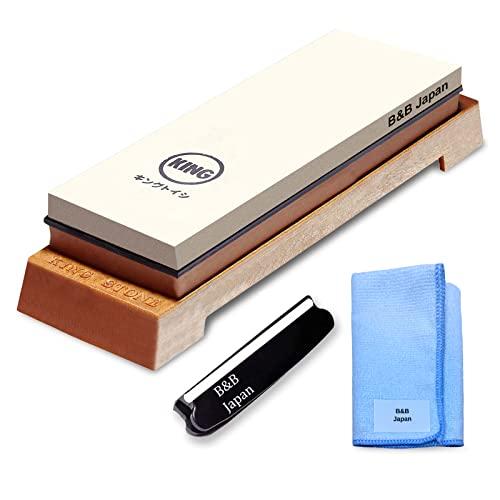
A soft 56 HRC workhorse. Nothing is harmed, but nothing is gained either. A King combination stone sharpens a Victorinox Fibrox beautifully for a fraction of the money - see sharpeners under $100.
Diamond grit does not mean what stone grit means
A 600-grit diamond plate and a 600-grit water stone are not interchangeable. Diamond plates are usually rated on a mesh scale and cut far more aggressively than a bonded stone at the same number, partly because the particles are harder and partly because they sit proud of the surface rather than being held in a matrix that wears back with them. Treat the Work Sharp's 800 grit as a mid-range finish rather than a polish; our whetstone grit guide maps the scales against each other.
Diamond also breaks in. A new plate or disc feels coarse for the first few knives as the most exposed particles fracture away, then settles. That is normal, not a fault, and it is why first impressions of a diamond sharpener are usually worse than the fifth.
How these were chosen
Every pick had to be currently sold to US buyers and to have its diamond abrasive stated by the manufacturer rather than inferred - HORL publishes the block-diamond disc and the 80 percent increase in material removal over the HORL 2, Work Sharp lists its five diamond plates by grit, and Chef'sChoice states 100 percent diamond in stages one and two. Where we could not confirm the abrasive from a published source the product is not on this page, even where it would have given us a cheaper pick.
Scores are our editorial judgment on effectiveness, kindness to the edge, durability and value, on the rubric at our methodology page. Prices come from the live listing with the date they were read, and they are the reason the cheapest diamond pick here still sits well above $100.
The picks in detail
#1 · A 15-degree Japanese edge you want kept sharp without learning to sharpen
HORL 3 Rolling Knife Sharpener
The third generation of the sharpener everyone copies. Block diamonds remove 80 percent more steel than the HORL 2, the magnetic grip pad holds 70 percent harder, and the discs now swap with a twist. Still only two angles.
What it does well
- 15-degree setting matches the factory grind on most Japanese kitchen knives
- Interchangeable diamond and ceramic discs, so it is serviceable rather than disposable
- The stronger magnetic grip pad holds small knives that the HORL 2 struggled with
Where it gives way
- Two angles only — the six-angle range is reserved for the much pricier Pro
- Sits at the premium end of the rolling-sharpener bracket; the Tumbler does the same job for far less
- Cannot repair a chip, flatten a warped bevel or thin a blade behind the edge
Skip it if: Anyone whose knives are not ground near 15 or 20 degrees, and anyone with a chipped or badly reprofiled edge — this is maintenance, not repair.
| Angles | 15 degrees and 20 degrees |
|---|---|
| Discs | Block-diamond sharpening + ceramic honing, interchangeable |
| Disc exchange | Quick Lock — swap with a twist |
| Magnetic support | Grip Pad, 70% more grip than the HORL 2 |
| Abrasion | 80% more material removal than the HORL 2 |
| Body | Solid oak or walnut |
| Origin | Engineered in Germany |
#2 · Repeatable angles without years of practice
Work Sharp Precision Adjust Elite
A clamped, angle-guided system adjustable from 15 to 30 degrees in one-degree steps, with five diamond plates, a ceramic and a strop. It removes the one variable beginners cannot control.
What it does well
- One-degree angle increments mean you can actually match a 15-degree Japanese factory edge
- Seven abrasive options covers repair through polish
- Angle repeatability is the thing beginners lack, and this supplies it
Where it gives way
- Clamp limits blade length and height
- Slower per knife than a competent freehand session
- A lot of parts to store and lose
Skip it if: Long or very tall blades. A clamp-and-rod system fights a 240 mm gyuto, and it is slow compared to a stone once you can hold an angle.
| Angle range | 15-30 degrees, 1-degree increments |
|---|---|
| Abrasives | 220, 320, 400, 600, 800 diamond plates + fine ceramic |
| Also included | Leather strop and ceramic rod for serrations |
| Clamp | V-Block |
| Storage | Carry case and Tri-Brasive rack |
#3 · Someone who will leave it on the counter
Horl 2 Rolling Knife Sharpener
The original of the type, made in Germany, with a long magnetic angle support and a very smooth roll. It is also the outgoing generation — HORL has replaced it with the HORL 3 line, so stock is whatever retailers have left.
What it does well
- 4.5 in magnetic support gives the most stable blade hold
- Rolls the smoothest of the rolling sharpeners, which makes control easier
- Removable abrasive discs mean it is serviceable rather than disposable
Where it gives way
- Superseded by the HORL 3, which removes more steel and grips harder — buy the 2 only if it is discounted
- Same 15 / 20 degree limitation as the cheaper alternatives
- Four pieces to keep track of instead of two
Skip it if: A tight budget. The performance gap over the Tumbler is smaller than the price gap.
| Angles | 15 degrees and 20 degrees |
|---|---|
| Magnetic support | 4.5 in — the longest of the rolling sharpeners |
| Components | 4 pieces, both abrasive surfaces removable |
| Origin | Made in Germany |
#4 · A drawer of German knives you will never hand-sharpen
Chef'sChoice Trizor XV Model 15XV Electric Sharpener
A three-stage diamond machine that converts a 20-degree Western edge to a 15-degree triple bevel in about a minute. It works, and it removes a lot of steel doing it.
What it does well
- Genuinely converts a 20-degree factory edge to 15 degrees, which most people cannot do freehand
- About a minute per knife, repeatable, no skill required
- Handles serrated edges, which stones cannot
Where it gives way
- Removes far more steel than a stone; a knife has a finite number of passes in it
- Cannot follow an existing asymmetric or single-bevel grind
- Bulky and loud on a countertop
Skip it if: A thin, hard Japanese knife. It reprofiles rather than follows, and on a single-bevel or a 61+ HRC blade that is damage, not maintenance.
| Edge angle | 15 degrees (Trizor XV triple bevel) |
|---|---|
| Stages | 3 — diamond shaping, diamond sharpening, stropping/polishing |
| Abrasives | 100% diamond in stages 1 and 2 |
| Serrated | Yes, supported |
| Dimensions | 10 x 4.2 x 4.2 in, 4.2 lb |
Common questions
Why use diamond instead of a stone?
Do diamond sharpeners remove too much steel?
Does a diamond sharpener wear out?
Can I use a diamond sharpener on a Japanese knife?
Is diamond better than ceramic for honing?
Sources
Read next
Sharpeners
Best Manual Knife Sharpeners
Sharpeners
HORL 2 vs HORL 3
Sharpeners
Guided Sharpening Systems
Whetstones & Skill
Whetstone Grit Chart
Sharpeners